Original article: China avanza en Código ecológico y ambiental, la Ley de Unidad Étnica y Promoción del Progreso
The latest legislation approved in China regarding ethnic relations is the Ethnic Unity and Progress Promotion Law (officially, the Law on the Promotion of National Unity and Progress). Adopted on March 12, 2026, by the National People’s Congress (NPC), the country’s highest legislative body, it is set to take effect on July 1, 2026 .
The fundamental essence of this new legislation is to establish a comprehensive legal framework to «forge a strong sense of community for the Chinese nation» . The law, structured in chapters that include general principles, the construction of a shared spiritual home, the promotion of interaction and integration, and the drive for common prosperity and development, aims to legally consolidate the vision of the 56 ethnic groups as a unified entity, 多元一体 (duōyuán yītǐ, «pluralistic and integrated») . It is presented as a tool to govern ethnic affairs based on law, advancing the modernization of state governance in this area .
In terms of practical content, the law mandates both central and local governments to enhance infrastructure, promote industrial growth, ensure better access to public services, and intensify environmental protection efforts in regions inhabited by ethnic minorities . The goal is for these regions, often located in mountainous or remote areas, to be fully integrated into the national development agenda and achieve common prosperity, not merely through temporary assistance, but with sustained political support guaranteed by law . On cultural and linguistic matters, the regulation states that the state will promote the use of the common Chinese language and characters (Mandarin), while respecting and safeguarding the rights of ethnic groups to study and use their own languages .
Ultimately, the law underscores that unity is the premise for progress, incorporating provisions to safeguard stability and harmony. It stipulates that defending national unity and ethnic solidarity is the responsibility of all Chinese citizens and explicitly prohibits discrimination and oppression against any ethnic group . Additionally, to protect the development environment, it combats activities such as violent terrorism, ethnic separatism, and religious extremism, with organizers and financiers facing potential criminal liabilities, aiming to ensure a stable and harmonious environment for the development of multi-ethnic areas.
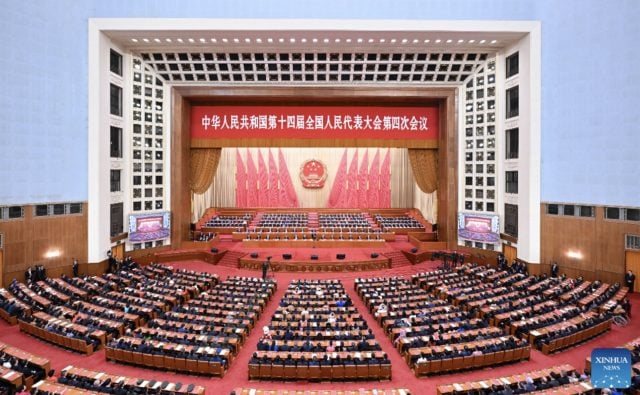
The XIV National People’s Congress (NPC), China’s national legislative body, concluded its fourth session on Thursday, the 13th.
Chinese President Xi Jinping, along with other leaders including Li Qiang, Wang Huning, Cai Qi, Ding Xuexiang, Li Xi, and Han Zheng, attended the closing meeting of the session at the Great Hall of the People in Beijing.
Zhao Leji, executive president of the presidium of the session, presided over the meeting which saw the participation of 2,762 NPC deputies.
Lawmakers approved the report on the government’s work as well as the outline of the 15th Five-Year Plan (2026-2030) for national economic and social development.
They approved the Ecological and Environmental Code, the Law on the Promotion of Ethnic Unity and Progress, and the National Development Planning Law. Xi signed presidential orders to promulgate these laws.
The legislators also approved a report on the implementation of the 2025 national economic and social development plan, along with the project plan for 2026, and approved the 2026 plan.
They voted to approve a report on the execution of the 2025 central and local budgets, as well as the draft central and local budgets for 2026, and approved the central budget for 2026.
Lawmakers approved the work reports from the NPC Standing Committee, the Supreme People’s Court, and the Supreme People’s Procuratorate.
They also adopted a decision on the approval of the Standing Committee’s report regarding the work on law revision and the proposed management of certain laws and decisions. Xi signed a presidential order regarding this decision.
In a speech at the meeting, Zhao stated that the annual session had completed its agenda.
He noted that the 15th Five-Year Plan period is a crucial stage to strengthen the foundations and advance on all fronts toward the basic achievement of socialist modernization by 2035, emphasizing that effective implementation of the plan is of great importance.
Zhao stressed the need to focus on effectively managing the country’s own affairs and striving for a solid start to the period of the 15th Five-Year Plan.
He added that people’s congresses must fulfill their duties and provide the legal guarantee for achieving the goals and tasks of the 15th Five-Year Plan.
Prior to the closing meeting, a presidium meeting was held, presided over by Zhao.
Zhao, who also serves as president of the NPC Standing Committee, chaired an executive president’s meeting before the presidium meeting.
Relacionados
Chile Sustainable: "Inadequate Implementation of SBAP Law Signals Rocky Start for Biodiversity Service in 2026"
Hace 2 meses
Palestinian Community in Chile Warns of Serious Setback Amid Potential Return of Israeli Companies to FIDAE 2026
Hace 2 semanas
Chavismo Remains United: Jorge Rodríguez Reaffirmed as President of Venezuela's National Assembly
Hace 2 meses