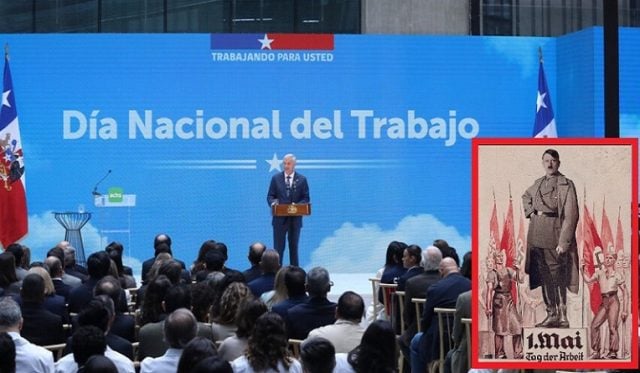
Original article: ¿Coincidencia o referencia? La polémica en redes por el uso de Kast del ‘Día Nacional del Trabajo’, misma denominación que usó Hitler en 1934
‘National Labor Day’: Kast’s Phrase Sparks Controversy and Comparison to Nazi Regime Language of 1934

The National Federation of Labor Unions of CCU highlighted on their website: «The backdrop of the initiative said ‘National Labor Day’. Just like the phrase coined by Nazi Germany in 1934 which violently distorted terms that referred to completely opposing issues. It is evident that Kast and his propaganda team attempt to emulate and bring to contemporary Chile concepts associated with an ideological project linked to national unity and nationalism. However, the reality is that Chile is a society divided by irreconcilable class interests, arguably one of the most polarized and unequal nations on the planet (the top 1% holds over 50% of socially produced wealth); its national-development period was shattered by the 1973 coup through systematic deindustrialization and privatization of all state-owned enterprises, reducing to its minimum (Codelco barely retains 27% ownership of copper, with widespread rumors of Kast’s economic group’s intentions to fully privatize what remains of the state-run copper industry).
On Labor Day, Chile’s President, José Antonio Kast, made headlines with his speech under the slogan ‘National Labor Day,’ which quickly trended on social media due to its comparison with the terminology used by the Nazi regime in 1934.
According to a publication from Barricada Informativa, “the use of the concept ‘National Labor Day’ has raised alarms on social media” because “history tells us that words are never neutral,” asking: Is it a coincidence or a reference?
Barricada Informativa reminds us that “historically, May 1st is International Workers’ Day, a date for the fight for labor rights. However, in 1934, the Nazi regime in Germany changed the name to ‘National Labor Day’ (Tag der nationalen Arbeit)”. The publication emphasizes two pivotal aspects of that shift: “Nationalism vs. Internationalism” to eliminate a global and class-based character, and “Absolute control,” as just one day later all independent unions were dissolved.
“Seeing an aesthetic and terminology that exactly replicates the formula used to neutralize historical labor movements raises a necessary question: Is this a design error or a deliberate message regarding one’s view of the labor world?” questions Barricada Informativa. The source concludes that “history does not repeat itself, but it often rhymes.”
View the publication from BARRICADA INFORMATIVA
Obtén tu Pasaporte y apoya a El Ciudadano
Elimina la publicidad, accede a contenido exclusivo y sé parte de la comunidad.
Cancela en cualquier momento · Sin permanencia