Original article: Radiografía del desastre económico de Milei: caen actividad, empleo y empresas
From tourism to the automotive industry, along with the food and chemical sectors, indicators are revealing a downward trend that alarmingly portrays the scale of the economic disaster in Argentina .
The document titled «Economic Crisis in the Province of Buenos Aires: The Productive Consequences of Milei’s Government,» was presented by the Ministry of Production, Science, and Technological Innovation in Buenos Aires, led by economist Augusto Costa.
The investigation conducted by the administration of Buenos Aires Governor Axel Kicillof leaves no room for doubt: the promised economic cuts by the far-right leader are not only harming the state but are also severely damaging the productive fabric and employment in the country’s main district.
Tourism in Freefall
The first major alert from the study focuses on the summer season, a reliable gauge of the economic health and purchasing power of Argentines. Consolidated data show a drop in tourist arrivals and weak spending, which business owners in the sector label as catastrophic.
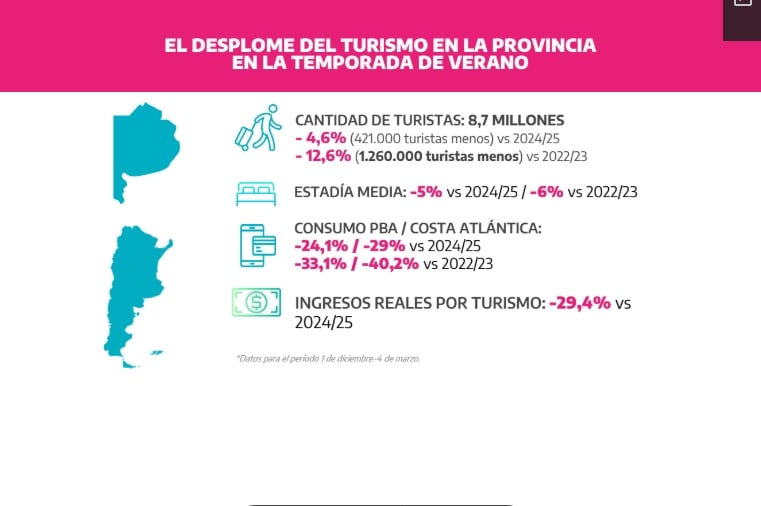
According to the report, tourist influx to Buenos Aires during the summer was 8.7 million, a figure that is 4.6 points lower than the previous season and 12.6 points less than the 2022/2023 season, which was the last before Javier Milei took office.
However, the length of stay is not the only metric showing decline; those who traveled did so for shorter periods and, most notably, spent much less.
The average stay fell by 5% compared to 2024 and by 6% compared to the summer prior to Milei’s government. The most alarming figure, however, is the per capita spending, which plummeted by 29% compared to last year and an astonishing 40% when compared to the 2022/2023 season.
This situation resulted in a significant drop in tourism revenue, with the Atlantic coast seeing almost a 30 percentage point decrease.
The report presented by Minister Costa warns about the future implications of this phenomenon, as in localities where the activity has a strong seasonal nature, «a very complex winter is anticipated in social terms,» as noted by Página/12, predicting a challenging scenario for thousands of families who rely on savings from the high season to survive the rest of the year.
Industry, Commerce, and Construction: The Collapse of Productive Engines
While tourism is one of the most visible faces of the crisis, the Buenos Aires Ministry of Production, Science, and Technological Innovation report outlines an equally bleak picture for other productive sectors.
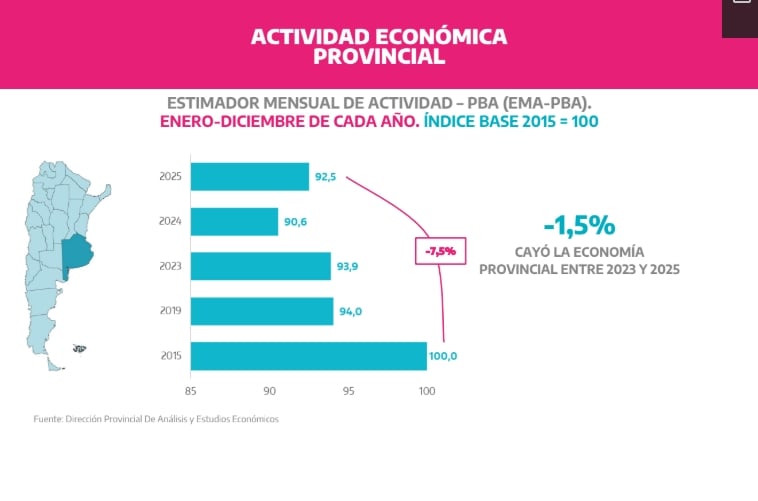
Analyzing the evolution of economic activity based on the year 2015 (with a base index of 100), a generalized drop of 1.5% in the provincial economy is observed when comparing 2025 to 2023.
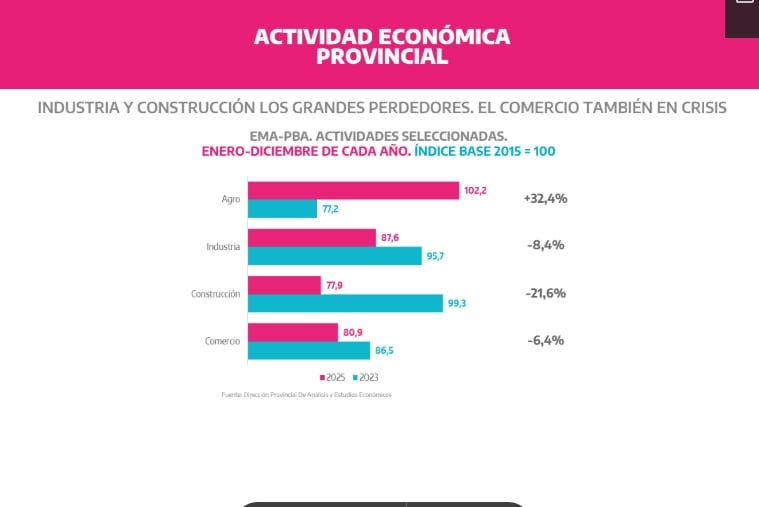
The industry, a pillar of the Buenos Aires productive network, has fallen from an index of 95 to 87. Commerce, reflecting internal consumption and money circulation, dropped from 86 to 81.
However, the hardest-hit sector is construction, traditionally a major job creator and economic dynamo. Known for its high “multiplier effect,” construction has plummeted from an index of 99 to 77, marking an unprecedented contraction that leaves thousands of workers and small business owners in distress.
The only sector showing growth in the statistics is agriculture, although the report itself clarifies the misleading nature of this data. This uptick does not stem from a success of current policies, but rather a “methodological issue” of comparison, since 2023 was marked by a severe drought with historically low yields. In other words, growth is compared to the worst moment, not due to a current productive boom.
The Axe Against Employment: 80,000 Jobs Lost and 5,500 Fewer Companies
One of the most disturbing chapters in the analysis presented by Minister Costa details the direct impact on employment and the number of productive units in Buenos Aires. The adjustment policy and import liberalization, far from fostering competition, have proven lethal for small and medium-sized Argentine enterprises.
According to the report, the number of employers (i.e., companies that generate registered jobs) has drastically reduced. From 168,236 at the end of 2023, when the current «libertarian» government took office, it has been cut down to 162,738.
In simple terms, Milei’s economic axe has wiped out 5,498 productive units in just over a year. Companies of various sizes and sectors have ceased operations or been forced to downsize, unable to sustain operations amid falling sales and rising costs.
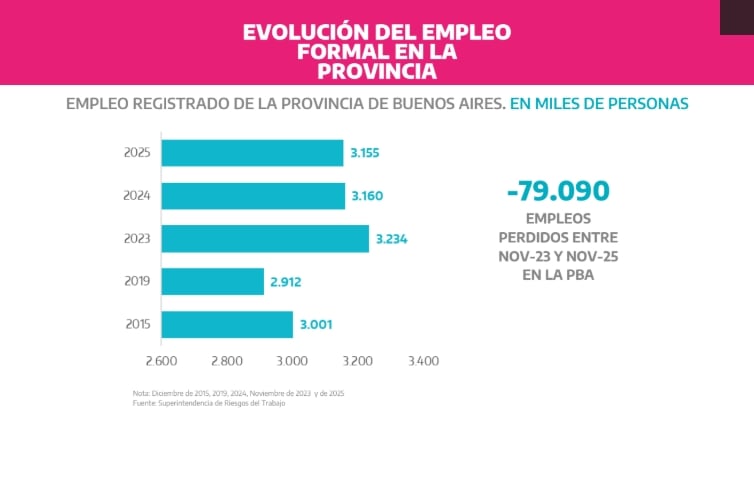
As a result of this reduction in the business fabric, around 80,000 jobs have been lost in Buenos Aires territory.
According to the study, there were 3,234,000 registered workers in 2023, whereas today there remain only 3,155,000.
Mass Layoffs by Industrial Sector
The study dissects the situation within specific branches of industrial activity, revealing a map of companies that, under Milei’s management, have opted for downsizing or outright closure.
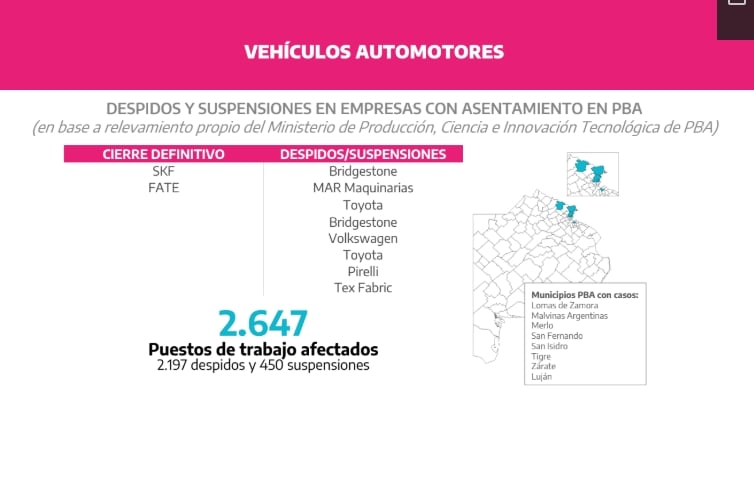
In the automotive and auto parts sector, one of the most emblematic in Argentine industry, Buenos Aires has seen 2,647 jobs affected. Of this figure, 2,197 correspond to layoffs, while the rest are on suspension. Notable companies that have reduced their workforce include giants such as Bridgestone, FATE, MAR Maquinarias, Toyota, Volkswagen, Pirelli, and Tex Fabric.
The situation is even more dismal in the food and beverage sector, with over 2,000 workers laid off and 1,100 suspended.
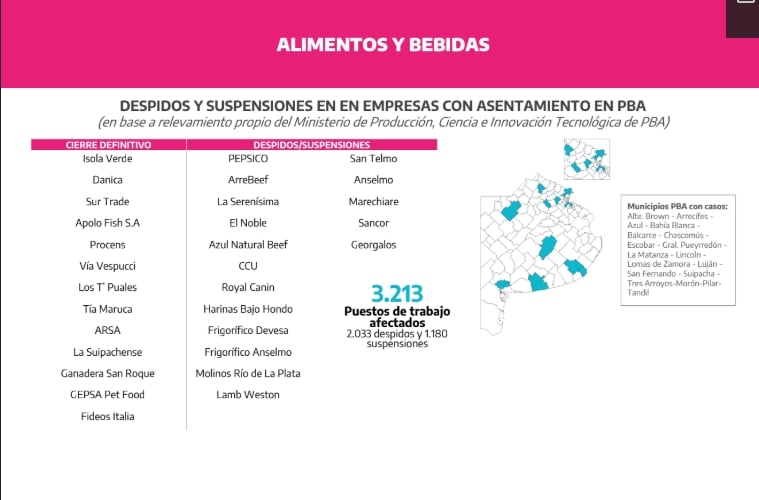
The most severe issue is the number of companies that have permanently shut down. The report lists several firms that have ceased operations, including: La Suipachense, Dánica, Tía Maruca, ARSA, Ganadera San Roque, Fideos D’Italia, Isola Verde, Sur Trade, and Apolo Fish, among others.
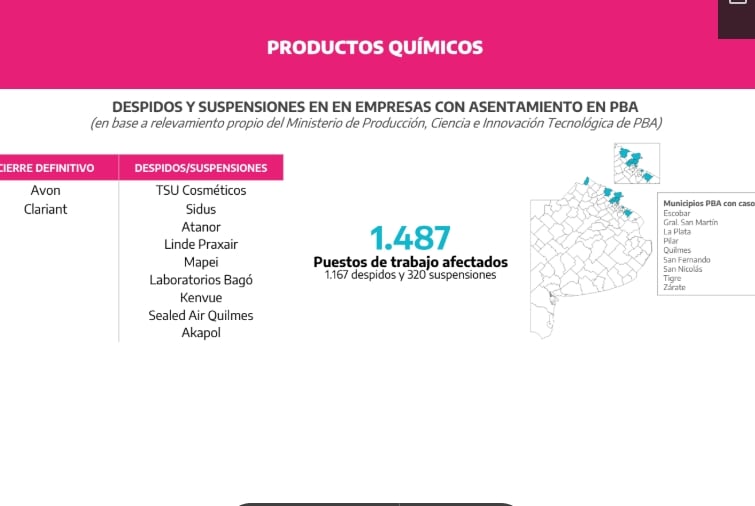
The chemical and pharmaceutical industry is not escaping the crisis either. In this sector, nearly 1,200 jobs were lost and 300 suspensions were recorded. Companies affected by this wave of layoffs include TSU Cosmetics, Clariant, Sidus, Atanor, Linde Praxair, Mapei, Laboratorios Bagó, Kenvue, Sealed Air Quilmes, and Akapol.
Milei Acknowledges That «Some Sectors Will Disappear»
This accumulation of hard data and layoffs ironically correlates with comments from the President himself. Over the weekend, in a televised interview with journalist Luis Majul, Javier Milei discussed the consequences of his structural reform plans with a frankness that may border on indifference.
On camera, he acknowledged that some sectors of the Argentine economy will disappear as a result of the model shift implemented by his administration in an era of open imports.
“If you’re shocking the economy with structural reforms all the time, you can’t expect that some sectors won’t disappear,” he stated.
“Obviously, some sectors will thrive, and others, if they don’t adapt, will struggle,” added the libertarian.
You can read the report “Economic Crisis in the Province of Buenos Aires: The Productive Consequences of Milei’s Government” below:
Economic Crisis in the Province of Buenos Aires 09 03 2026 by lahuanche
Relacionados



Milei's Economic Recipe Falters: Inflation Hits 2.5% in November, Food Prices Surge, No Relief in Sight for 2026
Hace 3 meses

Milei's Economic 'Chainsaw': Official Data Reveals 22,000 Businesses and Over 290,000 Jobs Lost
Hace 3 semanas
José Kast and Javier Milei: More Than Just Friends in Latin America's Right-Wing Movement
Hace 3 meses