Original article: Más recursos para territorios rezagados: 308 comunas reciben $113 mil millones del royalty minero
308 municipalities have received over $113 billion from mining royalties. According to the General Treasury of the Republic (TGR), this amount transferred in April represents the first disbursement of 2026 and shows an increase of nearly 87 billion pesos compared to the same month last year.
This influx of resources, which corresponds to the first two installments of 2026 out of a total of four, aims to bolster the municipalities with relatively less development as well as those directly impacted by extractive activities.
The TGR reminded that these 308 municipalities benefit from two funds that receive resources from mining royalties: the Territorial Equality Fund (FET) and the Mining Communities Fund (FCMI).
In total, the amount transferred in April 2026 is $113.268 billion, which exceeds by $86.908 billion the amount delivered in the same month of 2025, indicating a significant leap in the distribution of mining rents to territories.
It is worth noting that the mining royalty was a measure initiated and approved during the previous administration of President Gabriel Boric, designed as a tax imposed on large mining companies to distribute $450 million annually to regions and municipalities in the country, with the aim of promoting their development.
This tax scheme focuses on the largest companies in the mining sector whose sales derive more than 50% from copper, and with a production exceeding 50,000 metric tons of fine copper (TMCF) per year.
During its processing in Parliament, the project of Law 21.591 reached a cross-party agreement from all political sectors, with the sole exception of the Republican Party, which opposed its approval that was ultimately realized in May 2023, following its promulgation on August 3 of that year.
Puente Alto Leads Resource Transfer
According to data released by the Comptroller’s Office, Puente Alto leads the list of the 308 municipalities that received resources from mining royalties with $3.771 billion, followed by Calama ($2.263 billion), Maipú ($1.949 billion), Copiapó ($1.492 billion), La Pintana ($1.485 billion), and Huasco ($1.399 billion).
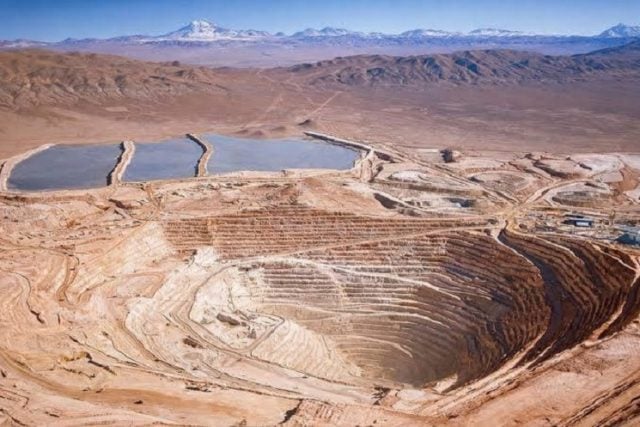
In the specific case of the Mining Communities Fund (FCMI), which this time benefited 89 localities, the largest disbursements were concentrated in Calama, Copiapó, Rancagua, Huasco, and Tierra Amarilla, municipalities where mining activities have a significant environmental and social impact.
Resources for Underdeveloped Municipalities and Areas Affected by Environmental Damage
The General Treasurer of the Republic, Hernán Nobizelli, explained that the transfer process is carried out with the guidelines provided by the Undersecretary of Regional and Administrative Development (Subdere) and reiterated that both the FCMI and the FET are funded by resources from mining royalties, as stipulated in Law 21.591.
He highlighted that this regulation created «new mechanisms to transfer resources generated by the mining industry to the municipalities where there are operations that affect the environment, as well as to others with lower relative development.»
2025 Municipal Financing Report
Meanwhile, the TGR has published a new edition of the Municipal Financing Report (IFC) on its website (tgr.cl), a document that systematizes all transfers made to the 345 municipalities of the country during 2025. According to this report, last year the service distributed a total of $2.93 trillion to local governments. Of this amount, the majority corresponded to the Common Municipal Fund (FCM), with $2.71 trillion, while the FET contributed $165.595 million and the FCMI added $52.721 million.
The report also reveals the performance of the Property Tax, the main funding source for the FCM. During 2025, revenue from real estate contributions reached $2.61 trillion.
Distribution of Resources by Regions
The regional breakdown of the $113.268 billion delivered in April 2026 reveals that the Metropolitan Region received $18.679 billion, the highest amount in the country, followed by Valparaíso with $15.126 billion, O’Higgins with $10.385 billion, Coquimbo with $9.226 billion, and Biobío with $8.816 billion.
On the other hand, La Araucanía received $8.565 billion, Atacama reached $7.859 billion, Maule achieved $7.727 billion, and Antofagasta $7.070 billion.
Closing the list are: Los Lagos ($5.302 billion), Ñuble ($4.659 billion), Tarapacá ($2.744 billion), Los Ríos ($2.673 billion), Aysén ($1.652 billion), Arica and Parinacota ($1.415 billion), and finally, Magallanes ($1.367 billion).

Obtén tu Pasaporte y apoya a El Ciudadano
Elimina la publicidad, accede a contenido exclusivo y sé parte de la comunidad.
Cancela en cualquier momento · Sin permanencia
Artículos Relacionados
Local Leaders Criticize Government's Plan to Fund Wealthy Municipalities with Taxpayer Money
Hace 3 meses