Original article: Tiburón de cuatro metros obliga a suspender faenas submarinas en Puerto Montt (Video)
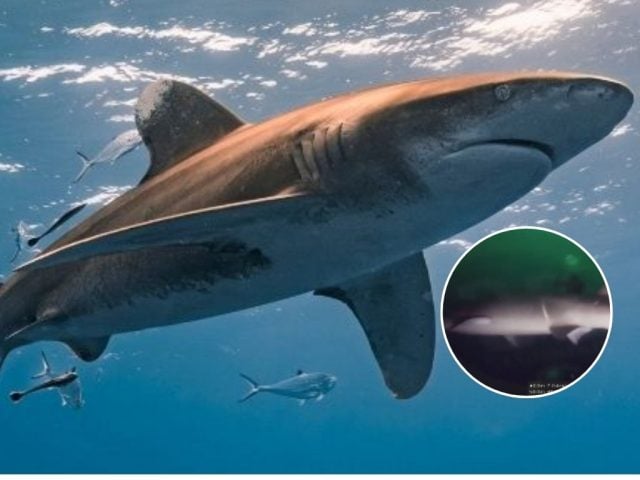
A viral video on social media shows a massive shark spotted along the coastal area of Chinquihue in Puerto Montt.
The sighting of a shark approximately four meters long has halted underwater activities in the coastal sector of Chinquihue, in Puerto Montt, Los Lagos Region.
This shark’s presence, captured in a video that quickly spread on social media, necessitated the activation of safety protocols and caused astonishment and concern in the local community due to the rarity of seeing such creatures in the southern part of the country.
The footage, widely shared on digital platforms, documents the moment the shark appears in the waters where a group of divers was conducting maintenance or inspection underwater.
The video clearly shows the impressive shark swimming calmly among the personnel, moving away and then returning minutes later.
In light of this unexpected encounter, the company responsible for the operations activated the safety protocol, withdrawing personnel from the water and temporarily suspending activities.
This measure, regarded as standard in such cases, aims primarily at ensuring the physical safety of workers in the presence of a large shark, whose behavior can be unpredictable.
Sernapesca: “The shark is in its natural habitat”
In response to the incident, the National Fisheries and Aquaculture Service (Sernapesca) issued a statement to calm concerns and contextualize the sighting, making it clear that the observed shark “is in its natural habitat.”
Ricardo Sáez, the National Head of the Conservation and Biodiversity Unit at Sernapesca, provided a detailed technical analysis regarding the identity and significance of the shark’s presence.
“From what can be seen in the images, we could say that it might be a cow shark (Notorynchus cepedianus) or a sevengill shark (Heptranchias perlo); however, we are awaiting confirmation from the IFOP (Fisheries Development Institute). This specimen is within its distribution range. It’s also important to mention that Chile is home to various species and sizes of sharks along its coast,” he explained.
Ecological Importance and Shark Conservation
The agency not only identified the animal but also took the opportunity to educate the public about the ecological importance of these sharks in Chile’s marine ecosystems.
Sernapesca highlighted that cow sharks “are classified as vulnerable by the IUCN (International Union for Conservation of Nature).”
Additionally, they emphasized the crucial role these «top predators» play in maintaining healthy marine environments and the balance of the trophic web, suggesting that their presence in Chinquihue could be a positive indicator.
In its statement, the agency also discussed the legal framework protecting these species in national waters, reminding that “in Chile, some sharks, such as blue sharks and dorado sharks, are fishing resources that can be caught as bycatch in fisheries like swordfish, and must be landed whole, meaning their fins cannot be cut off, as this practice, known as finning, is illegal under Law 20.525 of 2011, which prohibits the mutilation of any shark’s fins on board fishing vessels or during transshipment.”
In light of the four-meter shark sighting, authorities urged the public and marine workers to exercise caution.
Sernapesca encouraged “taking necessary precautions, as this is a wild animal that may feel threatened and attack.”
According to Chiloé News, activities remain under observation pending the maritime authority’s determination that conditions are safe for the divers’ re-entry.
Furthermore, citing local sources and experts, the digital outlet noted that while such sightings are not common in areas so close to the port, the presence of this large species is possible due to shifts in currents and food-seeking behavior.
Relacionados
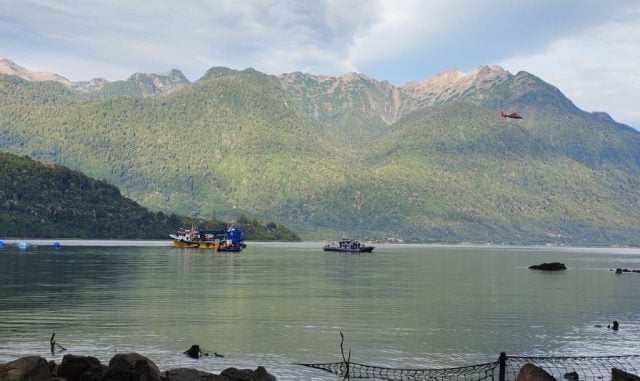
Search Intensifies in Los Lagos for 6 Missing Crew After Salmon Boat Sinks in Reloncaví Estuary
Hace 1 mes
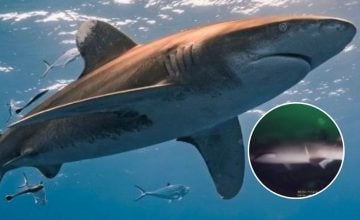


Court Overturns Expulsion of 8-Year-Old Student with Autism in Puerto Montt: Declares it "Illegal" and "Arbitrary"
Hace 2 meses