Original article: Gaza colapsa ante las lluvias: Bebés mueren por frío extremo e inundaciones sepultan campamentos
The Palestinian enclave plunged into a humanitarian catastrophe is enduring a relentless winter that has claimed at least 21 lives from hypothermia, including eight infants. Official figures raise the total death toll since October 2023 to 71,550, while the UN warns of an unprecedented food and shelter crisis.
The humanitarian emergency in the Gaza Strip has entered a critical phase with the arrival of winter storms, compounding the destruction wreaked by war with a climate situation that aid organizations cannot mitigate due to severe restrictions imposed by Israel.
According to a recent report from the Embassy of the State of Palestine in Chile, based on data from UN agencies and local institutions, torrential rains and extreme cold are wreaking havoc among a displaced population lacking access to food.
Infants Dying from Hypothermia
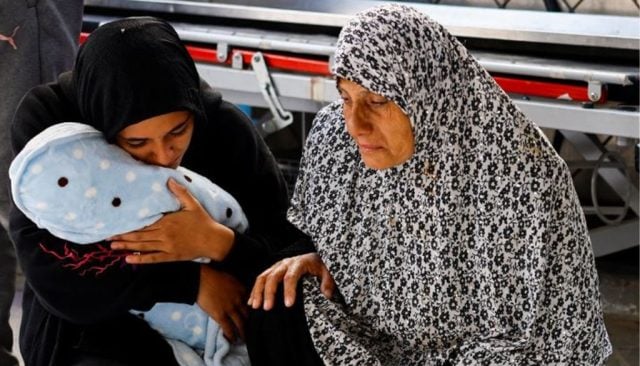
On Saturday, January 18, baby Aisha al-Agha, just 27 days old, died from extreme cold in a displaced persons camp. However, her case is not isolated, as medical sources indicate that the number of infants who have died from hypothermia since the onset of winter in Gaza has reached eight, while the total death toll from extreme cold this winter already stands at 21.
Conditions are inhumane. Nearly 800,000 people—approximately 40% of Gaza’s population—currently live in hazardous areas prone to flooding. The rains have buried makeshift camps.
“Health and local sources warned that about 127,000 of the 135,000 tents in the Strip are no longer suitable for shelter due to severe shortages of winter supplies,” the report states.
The situation is exacerbated by previous destruction, as strong winds have also caused the collapse of buildings that were already damaged by Israeli attacks, resulting in the deaths of four more Palestinians.
The Gaza Ministry of Health confirmed to CNN that this week, at least eight Palestinians died from these collapses, half of whom were infants suffering from hypothermia due to “lack of warm clothing.”
The international response encounters a wall of restrictions, with institutions like the UN Office for the Coordination of Humanitarian Affairs (OCHA) warning that “support for winter preparedness remains extremely limited, reaching only 4% among adolescents, including disabled adolescents.”
A video attached to the embassy report highlights that nearly 10,000 trucks loaded with aid are sitting in Jordanian warehouses while Gaza suffers in the cold and rain.
“The UN and the Jordan Hashemite Charity Organization (JHCO) are ready to send food, shelter, and medicines, but Israel is blocking large-scale delivery,” the report states.
UN Warns of Deteriorating Humanitarian Crisis in Gaza
After a visit to the Strip, Jorge Moreira da Silva, UN Assistant Secretary-General and Executive Director of the UN Office for Project Services (UNOPS), warned that the humanitarian crisis in Gaza is worsening due to extensive destruction, severe winter conditions, and heavy rainfall.
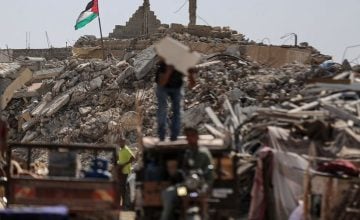
He indicated that significant damage has been reported to housing, infrastructure, and essential services, with over 60 million tons of debris scattered throughout the Strip and the prolonged and repeated displacement of families.
He also noted that fuel remains crucial for vital services such as healthcare, water, sanitation, and food distribution, calling for greater humanitarian access, the reopening of all border crossings, facilitation of essential supplies, and the restoration of basic services.
Violence and Large-Scale Demolitions Continue Despite Ceasefire
The report from the Embassy of Palestine in Chile details that “102 days into the implementation of the ceasefire agreement, Israeli Occupation Forces (IOF) have killed 445 Palestinians in the Gaza Strip and injured another 1,287.” The total since October 7, 2023, reaches 71,550 martyrs and 171,365 injured.
The New York Times reported that, according to satellite image analysis, more than 2,500 structures, including entire residential neighborhoods like Shuja’iyya in Gaza City, have been demolished despite provisions of the ceasefire that suspend military activity.
Additionally, Israeli forces have expanded the so-called “Yellow Line,” a unilateral security zone, “by an average of almost 300 meters in multiple locations in Gaza,” increasing the risks for civilians.
Since October 2025, 69 incidents of Israeli fire near the “Yellow Line” have been documented, including cases resulting in civilian and child deaths, according to the report.
Nutritional Crisis and Education Under Siege
The food crisis is another ticking time bomb. The UN warns of nearly 95,000 cases of acute malnutrition identified in 2025, with 4,900 reported in just the last month.
In the educational sector, the situation is alarming. Although spaces have been created for 268,000 children, “Israeli authorities continue to block the entry of educational materials under the claim that education is not a critical activity, a stance that the United Nations has strongly rejected, reaffirming the right to learn.
According to James Elder, UNICEF spokesperson, more than 100 children have died in Gaza since the ceasefire began in early October 2025, equating to approximately one child lost each day.
Elder clarified that the recorded figure—at least 60 boys and 40 girls—is only a partial count, as it only includes detailed verified cases, and the actual number is likely higher, with hundreds more injured.
Despite the reduction in bombings, isolated attacks and severe restrictions by Tel Aviv on the entry of essential supplies, such as medicines, fuel, and parts for water and sanitation systems, maintain an extreme risk situation for children.
Amid the ceasefire declared in October 2025, children’s lives remain marked by fear, unaddressed psychological trauma, and precarious conditions.
In this regard, UNICEF has warned that a ceasefire that does not completely stop the deaths of minors is insufficient and demands full humanitarian access, massive medical evacuations, and a definitive end to violence against children in Gaza.
Occupied West Bank: Repression and Settlement Expansion Persist
The report does not overlook the other part of Palestinian territory. In the West Bank, the figures since October 2023 are equally grave: 1,107 martyrs, 11,525 injured, and more than 11,100 detained in Israeli prisons, including over 350 children and 49 women.
Military operations are daily, and “during a military raid in the village of Al-Mughayyir, east of Ramallah, the IOF shot dead 14-year-old Mohammed Na’san,” the document recounts.
Additionally, at least 25,000 students from occupied East Jerusalem are on strike following Israel’s decision to restrict access to teachers coming from the West Bank, a measure denounced as an attack on the right to education and Palestinian identity.
You can access the report from the Embassy of Palestine in Chile through this link.
Relacionados

Gaza colapsa ante las lluvias: Bebés mueren por frío extremo e inundaciones sepultan campamentos
Hace 1 mes