Original article: Juan Pablo Leiva: El posible indultado condenado por castigar con químicos y golpes a menores
The court found the former officer guilty of four counts of unlawful duress against defenseless and handcuffed civilians.
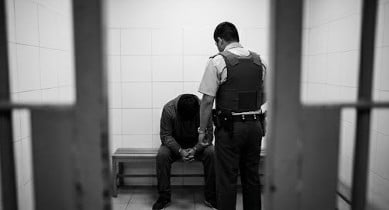
Between the evening of October 20 and the early hours of October 21, 2019, then-Second Corporal Juan Pablo Leiva Puga transformed the 43rd Police Station in Peñalolén into a site of medieval punishment. According to the ruling from the Seventh Oral Criminal Court of Santiago, the officer did not act under the pressure of a street confrontation, but instead exercised systematic violence against individuals who were already restrained, under state custody, and even handcuffed to metal structures within the facility.
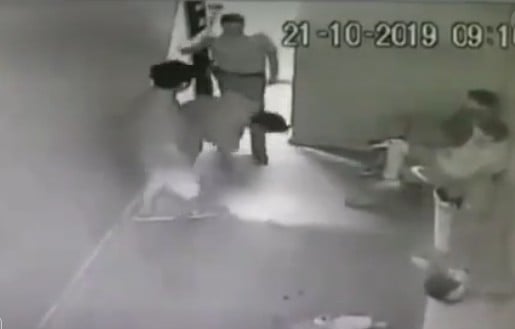
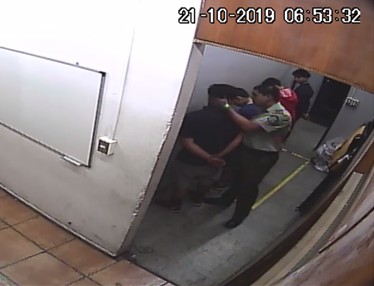
Court records depict a staff member who abandoned his duty to protect the public and became an aggressor, as shown in the case of a 14-year-old boy identified as K.A.G.L. While the minor was tied to a metal bar in the hallway, Leiva approached and slapped him without provocation, returning an hour later to grab him by the neck and violently slam him against the wall of the unit.
This physical violence was merely the beginning of greater brutality, as the court confirmed that the ex-officer used pepper spray and tear gas as methods of unofficial torture. The officer directly applied powder to the faces and mucous membranes of youths such as M.A.G.M., 16, and J.A.M.A., 17, who, while handcuffed, had no means to defend themselves or alleviate the burning caused by the chemical.
For the plaintiffs from the National Human Rights Institute (INDH), these actions were deemed «deliberate,» as the sole aim of the second corporal was to maximize the physical pain of young people who were legally under his care. The criminal record of the ex-officer shows a complete disregard for existing regulations, especially concerning adolescents who remained confined in the police station’s cells awaiting processing.
Records indicate that the convicted officer entered the cells to violently assault victims such as D.A.M.B., 16, striking him in the face and back while the youth tried unsuccessfully to protect himself. During these assaults, the officer shouted, «I’ll take it out on you,» as he unleashed his fury on the minor, a phrase that was noted in the proceedings and highlights his total lack of professional ethics.
This behavior was crucial for judges to dismiss any theory of «stress reaction,» concluding that the attacks were acts of intentional cruelty conducted with full awareness. The ruling emphasizes that Juan Pablo Leiva acted with a troubling lack of impulse control, breaching his duty as a guardian to exercise disproportionate force that deeply harmed the physical and psychological integrity of the minors.
After being dismissed from the institution, his trajectory took a controversial turn as he joined municipal security efforts in the Padre Hurtado commune. Organizations such as the INDH and the Association of Families of the Disappeared (AFDD) denounced that while he was being prosecuted for serious human rights violations, Leiva Puga worked as an inspector, enabling a person under investigation for torture to perform public surveillance duties before receiving his final sentence.
The judiciary then issued a unanimous sentence of five years and one day, resulting in a lifetime disqualification from public office, preventing him from wearing a uniform or holding any state position. This measure aimed to protect society from agents proven capable of using the state to commit abuses and humiliation against civilians.
However, Leiva’s name has resurfaced in political discourse as the government of José Kast considers his case among a list of potential presidential pardons for uniformed personnel. This agenda, which seeks to protect those who allegedly «defended the homeland,» triggers deep rejection due to the implied message of impunity that would arise from pardoning a convicted aggressor of minors.
While the Executive evaluates this benefit, court documents remain as a reminder that the actions of Juan Pablo Leiva Puga left permanent scars on youths and their families who are seeking justice, not pardon. Pursuing this process is essential for scrutinizing a presidential power that, if applied, would erase the criminal responsibility of someone who violently assaulted children and used chemicals to torture handcuffed individuals in a police facility.
The facts are not an interpretation but a proven criminal conduct documented through expert reports, testimonies, and compelling evidence. The case of the 43rd Police Station serves as a necessary reminder of the fragility of democracy when those entrusted with carrying weapons choose to use them for personal punishment, breaking the protective pact that the state owes its citizens.
El Ciudadano
Obtén tu Pasaporte y apoya a El Ciudadano
Elimina la publicidad, accede a contenido exclusivo y sé parte de la comunidad.
Cancela en cualquier momento · Sin permanencia