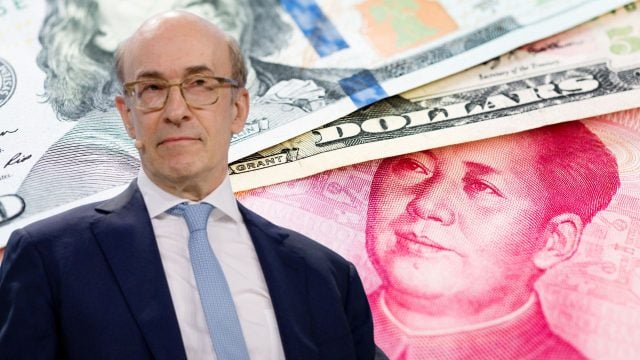
Original article: Kenneth Rogoff, ex profesor de Harvard: El yuan se convertirá en moneda de reserva en los próximos 5 años
Kenneth Rogoff, former chief economist at the International Monetary Fund (IMF) and renowned chess master, has extensively written about the topic since the global economic recession of the early 2000s. Now, he is directing his focus on the increasingly precarious position of the U.S. dollar at the top of the global financial system.
In an interview published by the South China Morning Post on March 30, the author, who has repeatedly warned about the legitimacy crisis facing the U.S. dollar, discussed China’s recent public announcement of its ambitious vision to transform the renminbi into a global reserve currency. He believes that once the renminbi begins its journey to becoming a reserve currency, foreign investors will undoubtedly respond enthusiastically to China’s call.
Rogoff points out that investors are actively working to diversify their asset portfolios to reduce excessive reliance on the U.S. dollar. He predicts that the renminbi will become a reserve currency «within the next five years.»
Previously, Rogoff has indicated that the dominance of the U.S. dollar is waning due to multiple factors, including China’s rise, geopolitical tensions, and the increasing influence of cryptocurrencies.
In an interview with Hong Kong media, Rogoff stated that, based on his observations and experience over the past decades, China has long been committed to reducing its overreliance on the U.S. dollar, thus achieving greater independence. He asserts that, given its vast territorial expanse, China should pursue an independent monetary policy.
However, he also noted that for some time, China has remained cautious about the risks of abruptly adjusting its monetary policy toward the United States.
Earlier this year, Chinese leadership outlined an ambitious plan to build a robust financial nation, establishing the strategic vision of «possessing a powerful currency with global reserve currency status.» Rogoff believes this call will naturally inspire Chinese technocrats to enthusiastically promote the achievement of this goal.
He considers that achieving this goal requires a gradual approach, implementing a series of step-by-step measures. However, this does not mean that the capital market should be fully opened all at once. From his personal perspective, China could open its government bond market to foreign investors and establish a fairly mature system of derivative instruments, such as futures markets and interest rate swaps.
«China does not necessarily need to open all its markets to become a reserve currency. In fact, the United States imposed many restrictions on foreign investment during much of the 1940s, 1950s, 1960s, and even the 1970s, yet its currency remained a reserve. However, China still needs to take other relatively direct measures, such as improving its financial system’s ability to provide intermediation services for international transactions independently of the dollar,» he stated.
«Once the renminbi embarks on its path to becoming a reserve currency, foreign investors will show great enthusiasm in response to China’s call for it to be adopted as such,» Rogoff predicted. He added that this transformation would be achieved within the next five years. «After all, investors are eagerly seeking diverse ways to diversify their asset portfolios and reduce their excessive reliance on the dollar.»
When discussing the euro, currently the second most important reserve currency in the world, Rogoff frankly stated that in many respects, Europe still heavily relies on the dollar-centered global financial system. Consequently, the euro remains primarily a regional currency, with much less widespread use in transactions with third parties compared to the dollar.
The main reason is that the operational center of the global banking system is in the United States, whether in administrative processing, payment settlement channels, operational mechanisms, or market settlement. China has long opposed this arrangement because it grants the U.S. the ability to impose financial sanctions.
He asserted that Europe has never been content with this situation either. Especially after the Greenland crisis and the trade war, European policymakers have become more proactive and determined to address their vulnerability to U.S. financial sanctions.
Rogoff further explained that, indeed, if a conflict were to arise with the United States, the battleground would likely unfold in the realm of trade and financial sanctions. Europe has begun to realize that achieving financial independence must be a priority, which is also a more pressing issue that Europe needs to urgently address.
«It is true that implementing a single currency can enhance efficiency, but it also means that we will all be at the mercy of arbitrary decisions by the United States. For a long time, China and Europe have been relatively tolerant of this situation, but now we will see how both countries accelerate their efforts to free themselves from this dependency,» he stated.
Artículos Relacionados
Kenneth Rogoff, ex profesor de Harvard: El yuan se convertirá en moneda de reserva en los próximos 5 años
Hace 2 minutos
IMF Pressures Milei to Purchase Reserves Amid Currency Risk Concerns, While Government Hesitates Over Inflation Fears
Hace 4 meses
Safe Haven or Liquidity? Divergence in Silver Prices Between Shanghai and New York Tests Market Confidence
Hace 2 meses