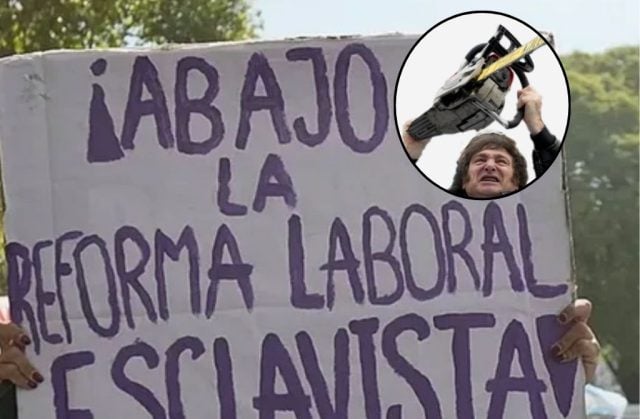
Original article: La motosierra de Milei se topa con la Justicia: juez frena parte sustancial de su reforma laboral
In a significant judicial setback for Argentine President Javier Milei and his controversial «chainsaw» reforms, Argentina’s National Labor Justice system ruled on Monday to suspend key elements of the proposed labor reform pushed by the libertarian administration. This decision followed a precautionary measure filed by the General Confederation of Labor (CGT), with the court noting serious indications of unconstitutionality and an imminent risk of irreparable harm to workers should the law take full effect.
This ruling adds to at least four other judicial decisions that had already halted various components of the reform. With this action, the Judiciary emerges as the primary hurdle for one of the Executive’s flagship projects, which sought to deregulate the labor market under the premise of enhancing formal employment and attracting investment while dismantling fundamental workers’ rights developed over decades of struggles against exploitation.
Blow to Milei’s Labor Reform
The ruling was made in the context of a class action lawsuit filed by the CGT against the National State. While it does not deliver a definitive ruling on the law’s constitutionality, the precautionary measure imposes a temporary suspension of articles 1, 3, 6, 9, 10, 13, 16, 17, 18, 19, 23, 24, 25, 26, 27, 28, 30, 31, 32, 33, 34, 41, 42, 44, 43, 46, 47, 48, 50, 51, 53, 55, 56, and 57 of Law 27.802, as reported by El Destape.
The labor union argued in their filing that the government’s reform represented a rollback of fundamental labor rights, undermined union freedom, and violated constitutional principles as well as international treaties incorporated into the Magna Carta. Among the most contested aspects identified by the CGT are changes to severance pay, an expansion of unilateral employer powers, increased labor condition flexibility, and new restrictions on union activities and collective bargaining.
Judge’s Arguments: Legal Plausibility and Danger in Delay
The judge, in his ruling, stated that the CGT has the necessary standing to represent all workers in such collective actions, a point often disputed in cases of this magnitude. He maintained that there was a «qualified plausibility of law,» indicating sufficient legal grounds to presume, at this preliminary stage, that the regulation might have violated constitutional guarantees. The magistrate particularly emphasized the principle of labor protection enshrined in Article 14 bis of the Argentine Constitution.
Central to the ruling was the concept of «danger in delay.» According to the judge, allowing immediate implementation of the reform could create legal and material effects that would be difficult or impossible to reverse for millions of workers across the country. He noted that situations could solidify under the new law that might prove irreparable, even if the law were later declared unconstitutional.
The judge underscored the priority of preventing potential harm and ensuring a thorough analysis of the regulation’s constitutionality before its widespread effects took hold.
CGT: «The Precautionary Measure is Very Strong and Forceful»
The judicial decision was met with enthusiasm by union leaders, who viewed it as a support for their legal strategy against Javier Milei’s government.
«This is a filing made by the CGT and, as we said when the law was approved, we would take it to court because we believed it was unconstitutional and entirely regressive,» declared Cristian Jerónimo, co-secretary general of the confederation, in a statement following the ruling.
The labor leader remarked on the scope of the suspension, stating that «the precautionary measure is very strong and forceful, and it clearly shows that most of the 82 articles are unconstitutional and contrary to workers’ rights.»
Following suit, the general secretary of the Union of Civil Personnel of the Nation (UPCN), Andrés Rodríguez, indicated that the judicial ruling is «gratifying for the labor movement.» He noted that while «the substantive issue still needs to be addressed», it nonetheless represents «a significant step forward».
He interpreted the ruling as a judicial validation of the arguments labor unions had made against the labor reform.
«As we have stated within the labor movement, this so-called labor modernization does not align with constitutional rights and undermines many individual and collective rights of workers,» he asserted.
«For us, this is a great satisfaction with this second action presented by the CGT, as the justice system is agreeing with us,» emphasized the union leader.
The Role of the Judiciary and the Clash of Powers
The ruling did not just analyze the law but also reaffirmed the Judiciary’s role within the institutional framework. As El Destape noted, while recognizing Congress’s legitimate authority to enact laws, it is an unavoidable function of judges to ensure that such norms align with constitutional frameworks.
«Laws must be aligned with constitutional rights and international treaties,» the ruling states, clearly delineating the powers of the judiciary in relation to other branches of government.
In his preliminary analysis of the regulation advanced by Milei’s administration, the judge pointed out that various aspects could lead to a reduction in labor protection levels without setting equivalent compensations. This, in his perspective, would clash with the principle of the progressive enjoyment of social rights, which is a cornerstone of Argentine constitutional law.
Furthermore, he warned about potential severe impacts on fundamental labor law institutions, such as collective bargaining, the right to strike, and the functioning of trade unions, all of which the CGT had highlighted in its submission.
Thus, the judicial ruling opens a new and complex battleground for the ruling government. Beyond political and economic battles, the La Libertad Avanza government now faces a long-range judicial scenario that anticipates a postponed yet inevitable determination regarding the future of labor legislation in the country, with the Supreme Court as the eventual final arbiter.
Milei’s Government to Appeal the Ruling
In response to the judicial setback, the Executive’s reaction was swift. Through an official statement, the Ministry of Human Capital, led by Sandra Pettovello, announced plans to appeal the judge’s ruling. The ministry stated that it would file the appeal with the support of the National Treasury Attorney’s Office, demonstrating the high priority assigned to defending the law.
«The Ministry of Human Capital, with the backing of the National Treasury Attorney’s Office, will appeal the ruling made by National Labor Court No. 63 — in the case Confederación General del Trabajo de la República Argentina c/ Estado Nacional s/ Acción Declarativa” Expte. CNT 10308/26 — which temporarily suspended a series of articles from Law No. 27.802 on Labor Modernization,» the official communication indicated.
In the text, Milei’s government reaffirmed its commitment to supporting the regulation, emphasizing its economic objectives.
«The Ministry reaffirms its firm commitment to defending this law, approved by a large majority in the National Congress and conceived as a fundamental tool for creating formal employment, enhancing competitiveness, and strengthening legal security for workers and employers,» the ministry maintained.
The statement also outlined the judicial strategy the ruling government intends to follow. «To this end, all necessary judicial instances will be exhausted to ensure the full enforcement of Law No. 27.802, as a clear expression of legislative will and mandate of the current government administration,» the text elaborated, as reported by El Destape.
Finally, the Ministry of Human Capital criticized the backers of the judicial measure, stating it «rejects attempts by those prioritizing corporate and sectoral interests who seek to obstruct necessary reforms to overcome unemployment and stagnation that marked previous stages of our history,» making a clear allusion to the CGT and the union sectors celebrating the ruling, further deepening the confrontation between the far-right government and the labor movement.
Artículos Relacionados
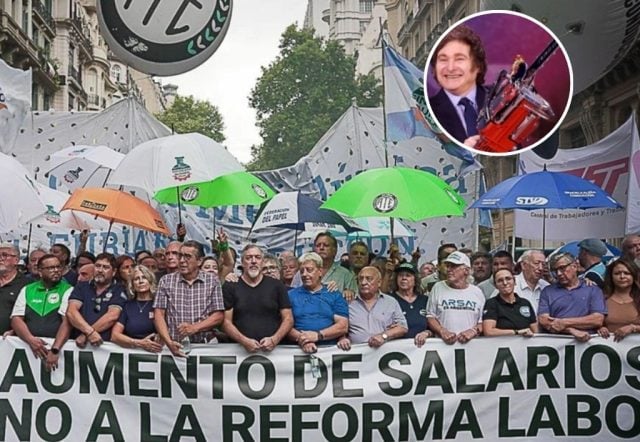
New Nationwide Strike Against Milei: 36 Hours of Protests Over Controversial Labor Reform
Hace 1 mes

Milei's Economic 'Chainsaw': Official Data Reveals 22,000 Businesses and Over 290,000 Jobs Lost
Hace 1 mes