Original article: Comité Nacional de la Conferencia Consultiva Política del Pueblo Chino (CCPPCh) inicia actividades claves
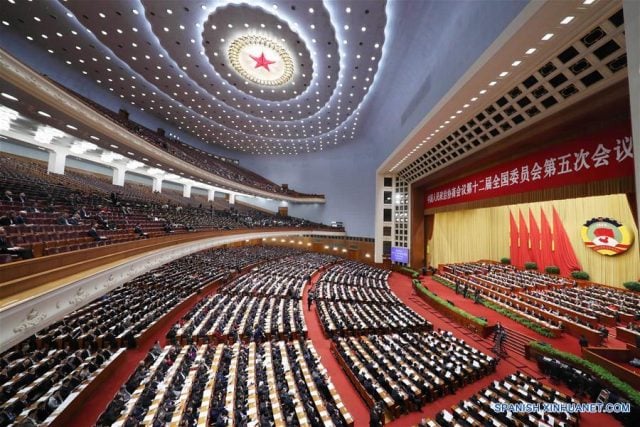
The National Committee of the Chinese People’s Political Consultative Conference (CPPCC), the country’s highest political advisory body, will hold its annual session from March 4 to March 11 in Beijing.
The fourth session of the 14th National Committee of the CPPCC is set to commence at 3:00 PM on Wednesday and will conclude in the morning of March 11, as announced by spokesperson Liu Jieyi at a press conference.
During the session, national political advisors will review and discuss a report on the work of the Standing Committee of the CPPCC, as well as a report concerning the handling of proposals from political advisors, according to the spokesperson.
The advisors are also expected to attend the fourth session of the National People’s Congress (NPC), the country’s highest legislative body, which is scheduled to open on Thursday. They will examine and debate various documents, including a government work report and a draft of the 15th Five-Year Plan for economic and social development, Liu stated.
Additionally, it is anticipated that the advisors will deliberate on and adopt a political resolution from the annual session, a resolution on the work report of the Standing Committee of the CPPCC, a resolution regarding the handling of previous session proposals, and a report on the review of new proposals submitted during this year’s session, as detailed by the spokesperson.
Liu elaborated that the 2026 session of the CPPCC National Committee will include opening and closing meetings, group discussions, and sector-specific consultations. Diplomatic representatives in China will be invited to observe the opening and closing sessions.
What is the National Committee of the CPPCC?
It is the highest body of the CPPCC when not in plenary session and serves as the top governing organ at the national level . To better understand it, one must first know what the CPPCC entails:
- Nature: It is neither a state body nor an ordinary civil organization. It is a body that is widely representative of the patriotic united front of the Chinese people . It serves as a key mechanism for multiparty cooperation and political consultation under the leadership of the Communist Party of China (CPC) .
- Objective: Its primary function is to allow representatives from all sectors of society to engage in political consultation, democratic supervision, and the discussion and management of state affairs .
- The ‘Two Sessions’: Each year, the National Committee of the CPPCC holds a plenary session that coincides with the annual session of the National People’s Congress (NPC). This joint event is known as the ‘Two Sessions’ and is a central moment in Chinese political life .
Structure of the National Committee
The structure is designed to manage its work during its five-year term .
- Term Period: Each National Committee is elected for a term of five years .
- Composition: It comprises representatives from a wide array of sectors, referred to as ‘participating groups’. There are a total of 34 participating groups , including:
- The Communist Party of China (CPC) and the other eight democratic parties .
- Individuals without party affiliation .
- Popular organizations .
- Ethnic minorities .
- Compatriots from the Special Administrative Regions of Hong Kong, Macao, and Taiwan .
- Returned overseas Chinese .
- Prominent figures from all sectors of society and special invitees .
- Key Fact: In the current 14th National Committee (which began in 2023), 60.8% of its 2,172 members are not CPC members, reflecting its representative and inclusive character .
Internal Organs:
- Plenary Session: This is the highest instance. It meets once a year and has, among other functions, the role of electing the Standing Committee and debating major national issues .
- Standing Committee: This is the body that directs work when the Plenary Session is not in session (i.e., for most of the year). It is composed of the president, vice presidents, the secretary general, and other members of the Standing Committee .
- Presidents’ Council Meeting: Composed of the president, vice presidents, and the secretary general. It handles the important day-to-day matters of the Standing Committee .
- General Office: Operates under the leadership of the secretary general and manages daily work .
- Special Commissions: These are working organs established according to needs to address specific issues (economy, culture, legal affairs, etc.) and play a fundamental role in the work of the National Committee .
Role and Function: What Does It Do?
The National Committee of the CPPCC serves three main functions :
- Political Consultation: Before the state adopts significant measures or makes decisions on major issues, it consults with the CPPCC . This happens both in the annual session and during regular meetings between CPC leaders and representatives of other parties . Their opinions are heard to ensure that final decisions consider a wide range of perspectives .
- Democratic Supervision: Supervision is primarily exercised through the submission of proposals (ti-an) .
- How does it work? Members of the CPPCC can submit proposals on any social or political issues at any time .
- What power do they have? Unlike NPC motions, CPPCC proposals are not legally binding . However, they are taken very seriously. The state institutions to which they are addressed are legally obligated to respond within a specified timeframe . In this way, they exercise effective supervision over the work of state organs .
- Participation in Discussion and Management of State Affairs: Members actively engage in studying and debating major national topics. For instance, the Standing Committee may deliberate and approve significant recommendations to be presented to the NPC or the State Council . They also organize inspection visits to various localities to study how policies are implemented and gather public opinions, potentially pointing out deficiencies publicly and suggesting improvements .
In summary, the National Committee of the CPPCC acts as a bridge between the government and society, channeling opinions, advising on policy formulation, and supervising implementation, all within the framework of the multiparty cooperation system led by the CPC .
The Citizen/Xinhua
Relacionados
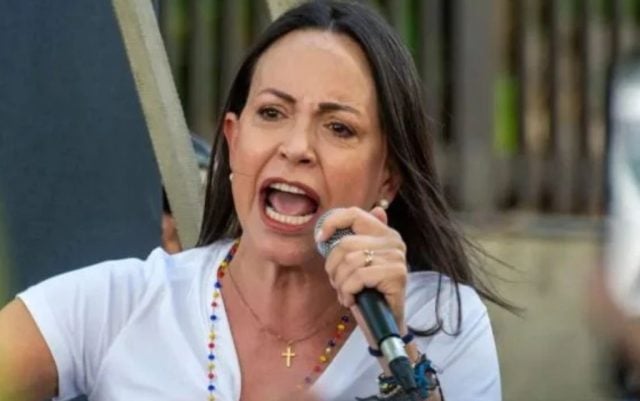
Nobel Peace Prize Awarded to María Corina Machado Sparks Outrage in Norway: "Far from Being a Peace Champion"
Hace 3 meses
Unions Warn of Protests If Election Holiday is Eliminated: "It Would Seriously Impact Voting Rights"
Hace 2 meses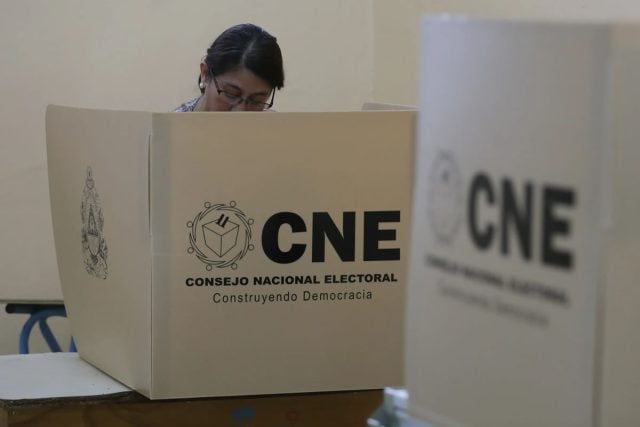
Honduras Electoral Advisor Warns: Any Declaration Without Completed Voting Reports is Null and Void
Hace 2 meses
National Strike in Argentina: Major Labor Union Calls to Halt the Country Over Milei's Labor Reform
Hace 2 semanas
Bolivia's Fuel Subsidy Removal Sparks Protests: President Rodrigo Paz Faces Calls to Resign
Hace 3 meses