Original article: La elección peruana sigue abierta: impugnaciones al voto exterior de EE.UU. y Argentina pueden revertir el actual resultado electoral
The Peruvian second-round electoral process, held on June 7, still lacks a definitive outcome. Initially, leftist presidential candidate Roberto Sánchez enjoyed a clear advantage, but the tallying of votes from abroad has stirred legal controversy that may alter the final result.
In an interview with Javier Pineda, Director of El Ciudadano, on the program «Patria Grande,» Roy Mendoza, a lawyer for Juntos por el Perú, elaborated on the challenges filed against voting stations in the United States and Argentina, warning that foreign votes are marred by irregularities affecting the process’s transparency.
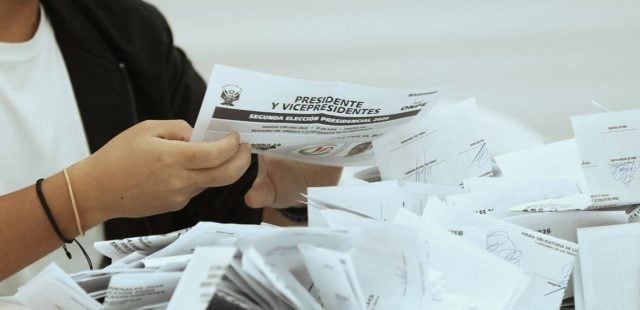
Mendoza explained that electoral law allows for the contestation of voting stations until the third day post-election (June 10), a timeframe which his party utilized to challenge 647 stations in the United States, 1,751 in Lima, and one in Argentina. These challenges are based on modifications to operational guidelines for overseas voting, a change that, according to the lawyer, violates the principle of regulatory intangibility, a cornerstone of any electoral process.
Challenges to Overseas Votes from the U.S. and Argentina
The origin of the controversy lies in a last-minute change. The National Office of Electoral Processes (ONPE) altered the guidelines for overseas voting on June 1—just six days before the elections—changing the procedure for the second round. While in the first round, ballots were scanned, digitized, and signed by the consul, for this second round, they were to be sent by diplomatic pouch without digitization.
«This is what we are contesting. A fundamental principle of the electoral process, the regulatory intangibility, has been violated,» emphasized the lawyer, noting that once the process is called, rules cannot be changed as this threatens political and legal security and transparency.
«Our electoral law states that, as there is no Peruvian personnel abroad, the consular offices must organize this process. However, these consular offices must operate under the guidelines provided by ONPE, and Article 244 of our Organic Elections Law specifies that once the counting is finished, results should be shared immediately and sent to Lima to ensure transparency,» the jurist clarified.
Yet, delays in receiving the ballots from Argentina have raised alarms. Mendoza pointed out that ballots from Buenos Aires arrived in Lima only by 10 PM on July 10—the last business day to file a challenge—despite the short four-hour distance and nine daily flights between the two cities. «
«It is inexplicable why there was such a delay,» he questioned, adding that the absence of digitization and scanning prevents oversight of the chain of custody for the diplomatic pouches, many of which arrived without the appropriate official seals.
The lack of party representatives abroad further complicates the situation. Of more than 92,000 voting stations enabled in the country and 4,000 abroad, neither Juntos por el Perú nor Fuerza Popular managed to cover all with representatives. Mendoza reported that in locations where representatives were present, they were not permitted to approach the voting stations, and there are videos showing polling station members inducing votes in favor of the far-right candidate Keiko Fujimori, evidencing a serious violation of the process.
85,000 Votes at Stake from Abroad
The impact of these challenges is significant: 85,000 votes are at stake, potentially enough to overturn the current trend. Mendoza asserted that his party will extend the request for nullification to all foreign votes, as the observed irregularities are systemic rather than isolated. However, the feasibility of these appeals depends on the decision of the National Jury of Elections (JNE).
The lawyer is hopeful that if the JNE adheres to the law and constitutional transparency, it should rule in favor of the challenges. However, he warns that political pressure on the electoral body is enormous, similar to that exerted during the first round, and does not rule out that the JNE may «kick the board» citing formal issues, such as payment of fees (1,375 soles or 360,000 Chilean pesos per challenged table), to dismiss the appeals, which is why Juntos por el Perú is conducting a solidarity collection.
Behind this legal struggle, Mendoza identified a greater threat: the return of Fujimorismo to power would represent a «takeover of institutions». He recalled that through Parliament, Fuerza Popular has modified laws, persecuted judges and prosecutors, and transformed the Peruvian political system into a «de facto parliamentarism.» «The threat is strong,» he concluded, urging citizens to remain vigilant against a possible return that, in his view, would deepen the institutional crisis.
You can watch the full interview below:
Obtén tu Pasaporte y apoya a El Ciudadano
Elimina la publicidad, accede a contenido exclusivo y sé parte de la comunidad.
Cancela en cualquier momento · Sin permanencia
Artículos Relacionados
Sánchez Accuses Peruvian Electoral Authorities of Manipulating Elections, Plans Action with CIDH
Hace 3 meses