Original article: Lo que esconden los archivos Epstein: la censura convertida en arte revela los rostros del poder
The Epstein files were released under strict censorship, with thousands of words blacked out, reinforcing the impression that significant truths remain hidden from public view.
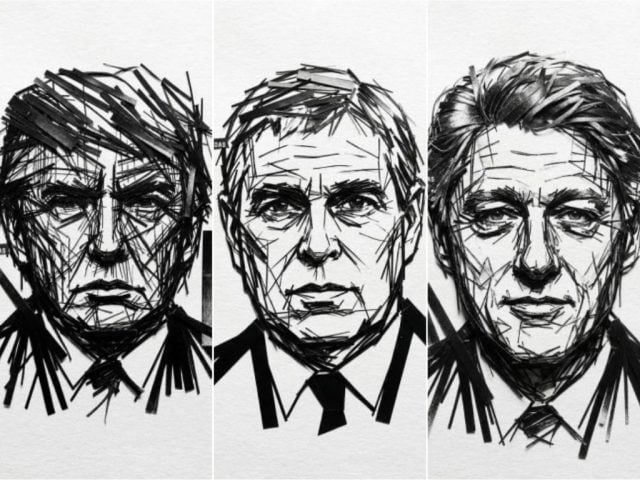
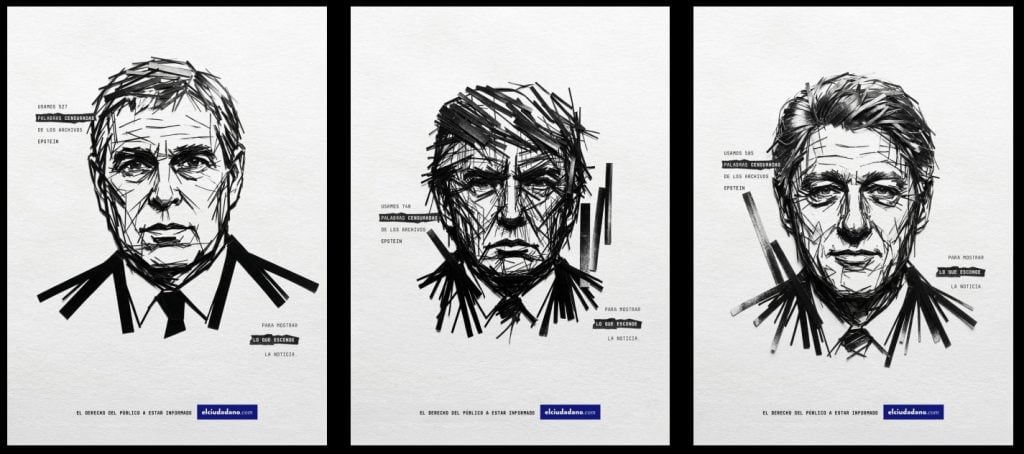
This project, initiated by El Ciudadano in collaboration with creative talents from the advertising sector connected to art, was inspired by this act of concealment. Named the Cheil Project, it takes these black bars—symbols of what was meant to be erased—and turns them into a visual tool to expose what the news still conceals, word by word and censorship by censorship.
Epstein Files Censorship Art: When Concealment Becomes an Image
The concept is as straightforward as it is powerful: cut each of these censorship bars and repurpose them to create portraits. What originally served to obscure names, fragments, and sensitive information is transformed into raw material for a visual denunciation.
The outcome includes four portraits of individuals connected to Epstein: Bill Clinton, Bill Gates, the ex Prince Andrew, and Donald Trump. In each case, the image emerges precisely from what was covered, erased, or blacked out.
This is where the project’s power lies: the same marks used to hide information instead illustrate the faces of figures entangled in a web of power, influence, and silence. What was meant to stay hidden reappears as an image.
Epstein Files Censorship Art: The Faces Behind the Black Bars
More than just a graphic intervention, this proposal aims to open a political and cultural reading of censorship. It is not only about intervened documents but also about how power administers what can be seen and what must remain covered.
In this way, the Epstein files censorship art finds a direct visual translation. The black bars cease to be a mere bureaucratic or judicial resource and become evidence. They no longer serve only as a barrier to accessing information but as a means to demonstrate the extent of the cover-up.
The project thus raises an uncomfortable question: what does it mean that documents of high public interest are disseminated with thousands of redacted fragments? And even more starkly, what type of truth is being managed when access to information is censored, controlled, or outright mutilated?
From Censorship to Visual Denunciation
The effort of El Ciudadano, along with the creative teams, aims precisely in this direction: to transform the language of concealment into a form of revelation.
It is not about filling the gaps with speculation, but about showing that those voids exist, are part of history, and tell something. The black bars do not only hide but also speak. They indicate imposed limits, blocked information, and truth that appears altered before arriving at the public space.
Thus, these portraits not only represent four figures connected to Epstein; they also symbolize how censorship operates when it intersects with cases of power. By doing so, they transform an act of erasure into an image that cannot be ignored.
In times when access to information often comes mediated by filters, blackouts, and silences, this project invites a direct gaze at what has been covered. Because sometimes, what reveals a story is not just what it shows, but also everything it attempts to conceal.
Relacionados
Iran Blames Israel in Epstein Case: "To Promote Political Objectives, Particularly the Israeli Regime"
Hace 4 semanas