Original article: La calle dijo no a la reforma laboral: Milei respondió con violencia y “cacería” de manifestantes con lacrimógenas y balas de goma
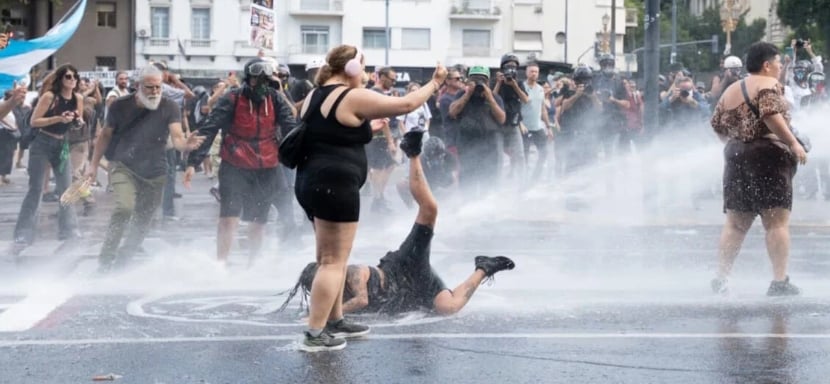
The repression ordered by Javier Milei’s government, which involved water cannons, mounted police, and foot officers, resulted in multiple injuries from rubber bullets, tear gas, and arbitrary arrests. Images circulated on media and social networks illustrate that the mobilization of hundreds of law enforcement personnel was utterly disproportionate and violent against those protesting the controversial labor reform.
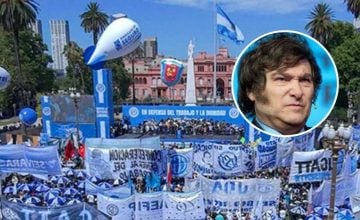
Thousands of workers, primarily from metalworking, oilseed, graphic, teaching, and public sectors, took to the streets on Thursday near Argentina’s Congress to voice their opposition to the contentious labor reform proposed by Javier Milei’s administration.
The coalition of protesters included support from social organizations and leftist parties, maintaining a largely peaceful atmosphere as they gathered in Plaza de los Dos Congresos around 2 PM, coinciding with the government’s achievement of the necessary quorum to advance the controversial bill that limits the right to strike, decreases severance pay, permits work shifts of up to 12 hours, and changes the payment structure for overtime, among other provisions.
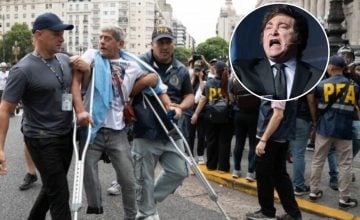
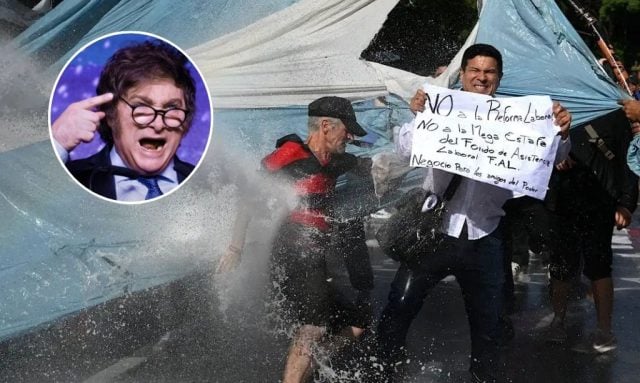
However, what started as a predominantly organized demonstration took a drastic turn in the afternoon. As anticipated by Security Minister Alejandra Monteoliva the previous day, the police operation resulted in yet another brutal crackdown. Even as most labor unions had dispersed, a small group of demonstrators remained when the Gendarmerie and Federal Police moved in with a show of force that included water cannons, tear gas, and rubber bullets.
The crackdown led media outlets like Página/12 to describe it as a «typical persecution and hunt of activists,» which Minister Monteoliva herself referred to as «terrorists» in prior statements. According to the Provincial Memory Commission, at least 70 protesters required medical attention due to injuries from rubber bullets, batons, and gas, in addition to eight arrests. Among those detained was Carlos Dawlowfki, a retired man identified as a supporter of Chacarita, whose arrest quickly sparked outrage.
“A Betrayal to Workers”
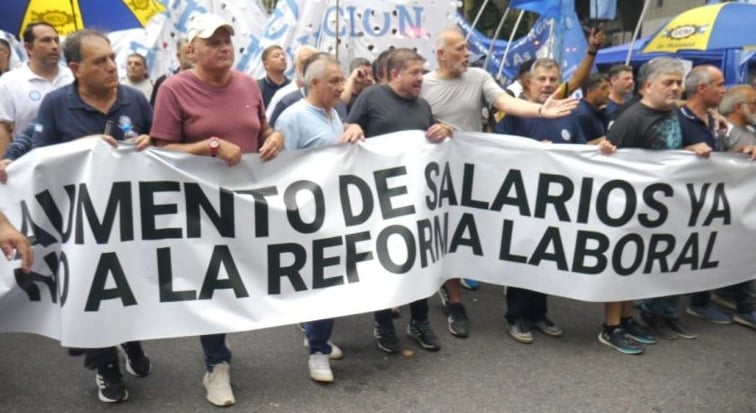
The largest groups on the day were led by the Union of Metalworkers (UOM), who gathered around a stage set up on Avenida de Mayo near Sáenz Peña. From there, the union leader, Abel Furlán, rallied the crowd and delivered a powerful message to both the government and union leadership.
Furlán spoke just minutes after the Congressional session began, voicing his reservations about the official bill.
“This is another display of rebellion against betrayal,” declared the UOM leader to an attentive crowd. “There is nothing good in this bill for the country, the industry, or for us. It is nothing but a loss of dignity,” he continued, in a speech reflecting the discontent of workers.
In his address, Furlán proposed to “intensify the struggle plan” and announced a new 36-hour strike, accompanied by another march next week, when the government’s “libertarian” bill returns to the Senate for a likely final vote.
“We will continue here, giving what we need to give,” he affirmed, clearly resonating with the combative unions’ demands posed to the CGT triumvirate.
The metalworker leader also warned that the conflict would persist beyond the parliamentary discussion.
“What we want to warn is that the fight does not end today nor next week,” Furlán remarked while emphasizing that “what is coming is an uncompromising battle for wages.”
“Mr. President, what was seen in Santa Fe with the police is just a sample. We are starving,” he stated, directly linking the labor reform to the dire economic situation facing Argentine workers.
Finally, Furlán criticized the governors “who sent their legislators to provide quorum,” referring to six crucial votes from the Independence and Elijo Catamarca blocs, tied to two provinces governed by the PJ.
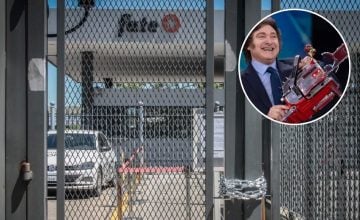
“There is nothing to negotiate, especially behind the workers’ backs. 23,000 companies have already closed; we saw what happened at FATE. The problem is the model. What else has to happen for them to wake up?” he asserted, delivering a harsh message to the provincial leaders who facilitated the progress of the government initiative.
Diverse Sectors Mobilized Against Labor Reform
Surrounding the stage, the labor landscape displayed a wide array of mobilized sectors. Flags, drums, and vests bore the colors and symbolism of the Graphic Federation, various UOM sections (Rosario, Buenos Aires, Córdoba), ASOE (oilseed workers), Medical Visitors, Conadu, Ctera, UTE, and ATE, among other unions and organizations.
Meanwhile, leftist groups maintained a presence on the opposite end of the plaza, near the large barricade cutting through Callao from Rivadavia to Irigoyen, reflecting both tactical differences and a united front against the government project.
«Hunt» of Protesters with Tear Gas and Rubber Bullets
The security operation carried out by the government was deemed “totally excessive compared to the scale of the gathering” by various organizations. For most of the day, the protest was peaceful, with only some isolated moments of tension. However, police forces advanced in the afternoon after the unions and leftist groups had mostly dispersed.
According to Página/12, in statements made on Wednesday, Minister Alejandra Monteoliva had promised sticks and a hunt, and she delivered. It took the knocking down of a barrier erected on Rivadavia for tear gas to start raining down as the Gendarmerie advanced towards the last remaining group of about two thousand people.
The maneuver was carefully orchestrated: the Federal Police, stationed early on the side streets, moved in from the rear, creating the typical «kettle» effect that left demonstrators with no escape.
The initial results were 11 arrests and 70 injuries, though sources on-site claimed the number could be higher. Confrontations with police had already begun early on, with tension in the access cuts to the capital, but nothing had foreshadowed the ferocity of the afternoon operation.
After several hours of tension in Plaza de los Congresos, hundreds of motorized police were sent out to «hunt» protesters who had been protesting since noon against the labor reform. By midnight, the police were again out “clearing” the area in front of the National Congress, in an operation that prolonged the violence for hours.
Witness Accounts of Repression
During the afternoon’s crackdown, it was reported that at least eight people were arrested by the Federal Police and three by the City Police. In sync with the atmosphere inside the assembly, the Gendarmerie had earlier begun spraying water with its water cannon to deter those approaching the fence surrounding Congress. Additionally, tear gas was used, leading to several moments of chaos and regrouping throughout the afternoon.
The Provincial Memory Commission issued a statement denouncing that «at least 70 people were injured and eight arrested» during the protest in the Congress area. «The attack occurred when the large columns had dispersed, and only a few protesters remained in front of the barricade enclosing Congress,» the organization indicated, underscoring the disproportionate nature of the police response.
A particularly violent moment was captured by TN cameras. «It was a moment of much shouting; I heard how they attacked our product and team,» recounted the channel’s reporter after the first attack with the water cannon.
The cannon never stopped shooting water, and during one of its assaults, it injured two women who were being attended to by medical personnel near the Gaumont cinema. According to witnesses speaking to the digital outlet El Destape, one became unconscious and another suffered a possible fracture from the impact with the truck, an incident condemned by human rights organizations.
Minutes after 6:30 PM, the motorized police opened the barricade and spread throughout the plaza. Several gunshots were heard, and new rounds of tear gas were deployed, while the police arrested at least two individuals, as shown in TN’s live coverage, in an escalating repressive action that continued well into the night.
Before the police brutality, the Plaza was packed with representatives from the mobilized unions, sharing a camaraderie and collective concern.
Página/12 was able to gather some testimonies that reflected the mood of the workers and their stance against the controversial labor reform championed by the “libertarian” government.
Marcelo is a delegate from the Stellantis automotive plant in Tres de Febrero. With 33 years at the company, he has a historical perspective to compare the current situation. “There is no turning back; this is a reduction of rights,” he said, explaining that the base salary of 900,000 Argentine pesos is generally supplemented with overtime, and that the proposed hour banking will substantially reduce their salary.
He also noted that 150 layoffs occurred at the end of the year and early vacations due to declining production. When asked if he remembers a worse moment than this, he quickly replied: “2001.”
Gabriel, a delegate at the Maxipack paper mill in Avellaneda, described the atmosphere in the factory as “complicated.”
“Our hours are being changed because there is no production; the base is 800,000 pesos, but the sector agreement is 35 percent lower,” he noted, expressing concern that the employers would exploit the reform to eliminate gains achieved through years of union struggle.
“We will fight as long as we can,” he affirmed with a mix of determination and worry about what lies ahead.
Pablo traveled to the plaza from Rosario. He is a delegate at Molinos Río de la Plata, where he started working in 2008. From his perspective, the oilseed union is becoming “stronger,” but he recognizes that “difficult times are ahead.”
His words regarding the Argentine president are sharp, describing Javier Milei as “a monstrosity.” On the reform, he cautioned that it would not create jobs, as the government promises.
“It’s a fallacy. I’ve always experienced it; with these governments, there is more work, not less,” he asserted, drawing on his own experience in the sector.
Relacionados
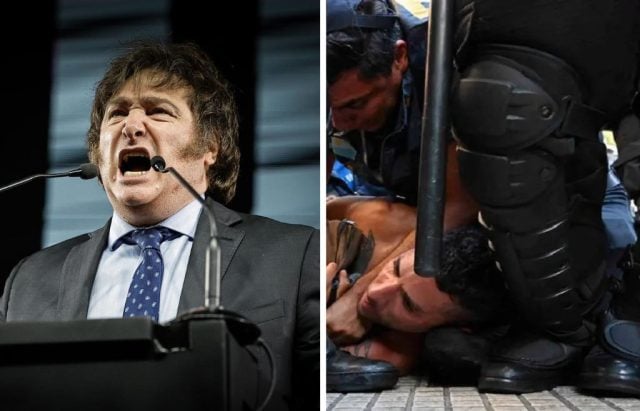
Argentine State Workers Call for National Strike Against Milei's Labor Reform: "They Want to Mess with Us"
Hace 3 meses
"A Sad Christmas Ahead": Retirees and Disability Groups Protest Against Milei Government at Argentina's Congress
Hace 3 meses