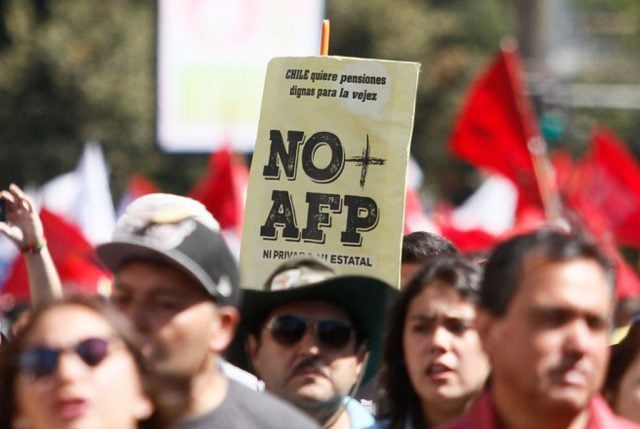
Original article: $100 millones en la AFP y ni siquiera alcanzan para una pensión equivalente al sueldo mínimo: estudio expone límites del sistema de pensiones
The aspiration for a dignified retirement is fading even for those who manage to accumulate significant amounts in their individual capitalization accounts. A recent report by Fundación Sol, prepared by economists Marco Kremerman and Francisca Barriga, discloses that the issue of pensions in Chile goes beyond how much is saved; it is fundamentally about the design of the system and its calculation methods, which render the possibility of maintaining a worker’s standard of living upon retirement a distant dream.
The study «Pensions without Social Security: How are Pension Amounts Calculated in Chile?« specifies that, out of more than 150,000 people who retired last year, half could only self-finance a pension that does not exceed $86,000 monthly without state contributions. This figure, disclosed through transparency from the Superintendence of Pensions, demonstrates that individual savings are inadequate for the majority of the population, as the accumulated savings simply do not yield enough to provide a minimum income. To put this into perspective, even $100 million in the AFP is not enough to secure a pension equivalent to the minimum wage of $529,000.
The situation worsens when considering gender projections and pre-retirement savings levels. According to official statistics, 73.1% of men aged 60 to 64 have less than $50 million in their AFP, while this figure rises to 85.5% among women. This disparity leads to significantly varied pension outcomes: a man with $100 million can expect a maximum pension of $465,851, while a woman with the same amount only reaches $412,387.
The study emphasizes that those who contributed between 35 and 40 years, meaning a complete working life, barely manage a median pension of $290,000, representing only 55% of the current minimum wage. This indicates that, even after a lengthy career, the system offers a replacement rate of 29% of the average salary, showing that individual efforts do not translate into economic security.
Freefall in Fund Profitability
In light of these figures, the debate between defenders and critics of the model intensifies amid the aging population. While the AFP Association attributes deficiencies to labor market factors and proposes increasing contributions and the retirement age, economist Marco Kremerman argues that these quick fixes do not address the underlying issue, which lies in the financial structure of the system and warns that, due to natural demographic growth and aging, the Chilean state will face a «ticking time bomb» in about 15 years where public spending on pensions (PGU) will have to rise from the current 2% to 7.2% of GDP by 2050 just to maintain current purchasing power.
«This situation is exacerbated by the freefall in fund profitability, which has plummeted from 12% annually in the 1980s to a mere 0.2% in the current decade. In numbers, during the 1980s, the average real profitability was 12% annually at the time the system was founded. By the 1990s, it dropped to just under 10% on average; in the early 2000s, it fell to 5.7%, and in the 2010s retroceded to 4.8%. Over the six years of the current decade, it totals 0.2%.», explained the professional from Universidad Católica in an interview with CIPER.
«Covert Redistribution System»
Kremerman dismantled the notion that individual capitalization systems are the only viable option, classifying it as a «covert redistribution system», and argued that, in practice, of every 100 pesos spent on pension benefits, 86.87 are financed by the state, while the AFPs and insurers contribute less than 13 pesos. This contradiction, where administrators collect $13 billion annually but the state must subsidize meager pensions, reveals that the model is not self-sustaining.
In this context, the researcher proposes a redistribution system with technical reserves, which guarantees individuals that «if I contribute for 30 years, I will receive X percentage of what I earned.»
Contrary to the hypothesis that this would harm the capital markets, Kremerman indicated that reserve funds would also be invested in Chile, but with more ethical criteria, and stated that «with the current values in Chile, pensions could be improved much more than what is currently paid, including the PGU and state subsidies.»
Obtén tu Pasaporte y apoya a El Ciudadano
Elimina la publicidad, accede a contenido exclusivo y sé parte de la comunidad.
Cancela en cualquier momento · Sin permanencia