Original article: El ratón de orejas de hoja andino: Pequeño mamífero que evolucionó para sobrevivir a más de 6.700 metros de altura
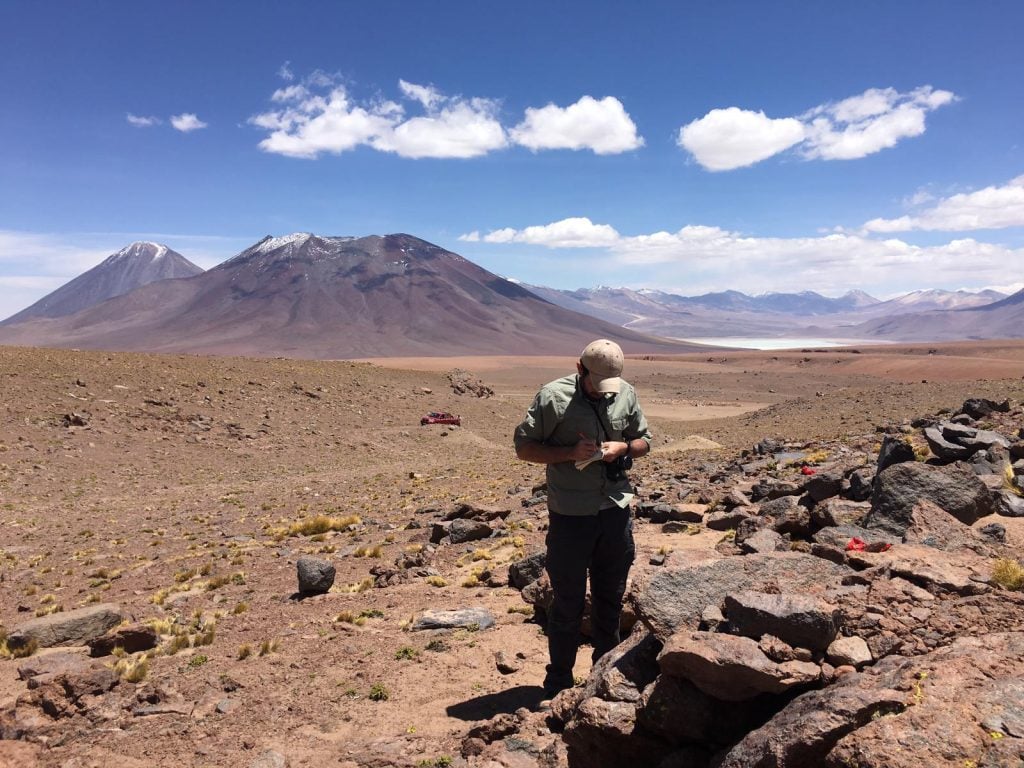
At an elevation exceeding 6,000 meters, the Puna de Atacama presents a cold, desert-like environment. This vast and arid region spans the Andes Mountains between Chile and Argentina.
In Chile, it includes parts of the regions of Arica and Parinacota, Tarapacá, and Antofagasta, as well as northeastern Atacama. It is characterized by salt flats, high-altitude lagoons, giant volcanoes, and extreme climatic conditions.
This area boasts some of the highest mountains in the range, including Volcano Llullaillaco, which rises to 6,739 meters above sea level. The environmental conditions at these altitudes are extreme, with air containing less than 50% of the oxygen found at sea level and temperatures that are nearly always below freezing.
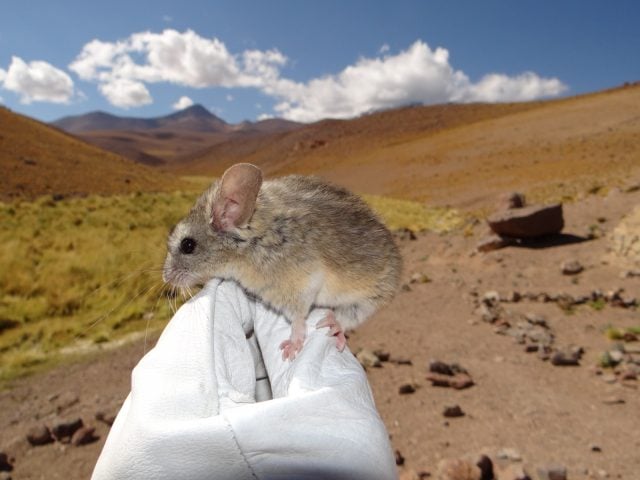
Thus, it’s almost unimaginable to think that mammals could inhabit such an environment. However, there exists one species that defies this expectation: the Andean leaf-eared mouse (Phyllotis vaccarum), recorded as the highest-dwelling mammal in the world.
A recent study conducted by an international team of scientists and published in the prestigious journal Science discovered how this small mammal has adapted to survive in these seemingly inhospitable conditions.
Dr. Guillermo D’Elía, an academic at the Faculty of Sciences at the U. Austral de Chile, is part of a research team from Canada, the United States, and Chile, led by Dr. Jay Storz from the University of Nebraska, who conducted this study.
The research spanned nearly five years, involving several expeditions to high altitudes, experiments analyzing the performance of animals in simulated conditions of varying elevations, and bioinformatics analysis of genomes from specimens captured at low, medium, and high elevations.
The study reveals an unexpected finding: unlike other high-altitude animals, this mouse has not altered its hemoglobin for better oxygen transport. Instead, it has evolved a greater aerobic capacity, facilitated by more efficient mitochondria, the cell’s energy factories. This means these animals generate more heat even under hypoxia, a much more effective metabolic strategy for surviving in extreme environments.
It was observed that, unlike other species such as llamas, alpacas, Andean geese, or even human populations from the Himalayas, where adaptation to high altitudes involves modifications in hemoglobin, the adaptation of these mice to extreme conditions stems from changes in their musculature.
They exhibit increased thermogenesis through shivering, which helps maintain temperature via involuntary muscle contractions.
The Greatest Known Altitudinal Range
The Andean leaf-eared mouse has the greatest known altitudinal range among all mammals, ranging from sea level to over 6,700 meters, with a wide latitudinal distribution on both sides of the Andes from Santiago to San Pedro de Atacama and surrounding areas.
Dr. D’Elía explains that «given such an extensive distribution, one would expect to find significant genetic differences among individuals from various areas, as is usually seen in species with even smaller distributions. However, after analyzing the genomes of many individuals, we found that genetic variation has very little geographic structure, meaning that high-altitude animals are genetically very similar to those in lower regions.
«There is an exception in a small group of genes involved in adaptations that allow survival in extreme environments. Natural selection plays a crucial role in maintaining variants that help cope with local extreme conditions, which are restricted to certain areas of the species’ distribution, such as high elevations,» the researcher noted.
Evolution that Neutralizes Plant Toxins
In high altitudes, available food sources are scarce; in fact, no visible vegetation has been found by researchers, nor insects or other animals.
However, Dr. D’Elía explains that one of the genes showing signs of local adaptation «belongs to a family known as GSTM, which is involved in eliminating toxic molecules generated by low oxygen levels as well as degrading chemical compounds found in plants.»
«This was unexpected, but it somehow makes sense in light of results from a previous study we published with Jay and colleagues from the universities of Antofagasta and Tarapacá, where we used metagenomics and stable isotopes to show that the animal at the top of the volcano has a 100% herbivorous diet,» the expert stated.
Thus, Dr. D’Elía emphasizes, «at high altitudes, Phyllotis not only evolved a response to cope with the cold and low oxygen levels; it has also developed strategies to neutralize plant toxins encountered in its diet.»
This study provides new insights into how mammals might respond to extreme environments, offering clues on how they may face climate change and food availability challenges.
Leading-Edge Research from UACh
Dr. Luis Miguel Pardo, Vice-Rector of Research, Development and Artistic Creation, expressed pride that «the Universidad Austral de Chile has academics who publish in leading journals, especially in the best in the world, on cutting-edge topics that undoubtedly have international repercussions. They open the door to new knowledge and future work where these discoveries can be applied; this is the path of science: scientific discoveries pave the way for more applied science.»
«For example, understanding the physiological capabilities these mice have developed to live at high altitudes can contribute to studies on therapies or treatments to adapt humans to extreme conditions,» Dr. Pardo highlighted.
Obtén tu Pasaporte y apoya a El Ciudadano
Elimina la publicidad, accede a contenido exclusivo y sé parte de la comunidad.
Cancela en cualquier momento · Sin permanencia