Original article: La Argentina de Milei entra al ranking de los 10 peores países del mundo para trabajadores tras retroceso laboral histórico
Under the ultra-right government of Javier Milei, Argentina has reached a concerning milestone. For the first time in its democratic history, it has entered the ranks of the ten countries with the worst conditions for workers, according to the latest edition of the Global Rights Index from the International Trade Union Confederation (ITUC).
This ranking, which assesses 151 countries based on 97 indicators from the International Labour Organization (ILO), places Argentina, Panama, Ecuador, Belarus, Egypt, Tunisia, and Turkey at the lowest tier. Delving into the numbers reveals a troubling reality: while local laws may recognize rights, in practice, workers cannot access them.
The decline is neither random nor recent. Argentina has fallen for the second consecutive year and is now classified as category 5, the lowest rating.
Labor law expert Federico Arabia indicated that the neoliberal reforms driven by the Argentine leader since taking office in December 2023 represent “the worst labor flexibilities in the country’s history.” He noted that the military dictatorship of Jorge Rafael Videla and the 1990s marked regressive times; however, he warned that the current situation is “one of the most regressive in terms of individual and collective rights.”
Among the most serious measures, the government of the so-called «libertarian» has abolished fines for unregistered employment. Any worker performing tasks without a contract no longer incurs an economic penalty for their employer.
“All of this is under the banner of reducing labor costs and facilitating investments,” explained Arabia in statements to
Radio France Internationale, emphasizing that there are “many attacks on the protective legal system for workers.”
Milei’s Plan to Strip Workers of Rights and Restrict Strikes
But this issue extends beyond mere written laws. Roberto Baradel, the General Secretary of the Unified Workers’ Syndicate of Education in Buenos Aires Province, reported a growing restriction on the right to strike.
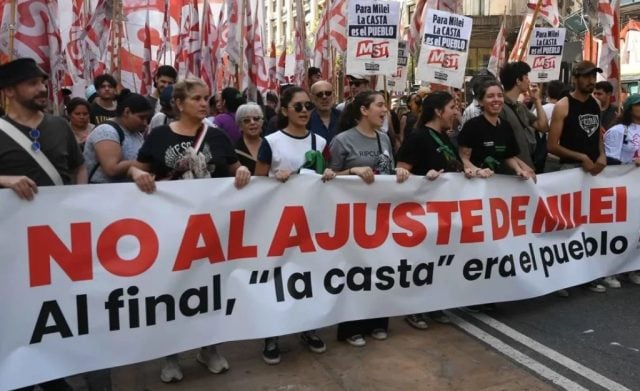
“Milei’s government has a systematic plan to strip workers of rights and attack free expression,” he claims. As evidence, he cites a strike called by three union federations that resulted in a fine of 21 billion Argentine pesos (approximately 15 million dollars at the current exchange rate).
“Strikes are practically non-existent. Or if we do strike, we risk being hit with enormous fines to deter us from proceeding. It’s aimed at dismantling unions,” Baradel stated in a conversation with the mentioned media outlet.
Both the lawyer and the union leader agree on a crucial point: the restrictive measures clash directly with Argentina’s historical tradition. For decades, despite political and economic fluctuations, the southern country has been distinguished by progressive labor legislation with high protection standards. Today, under Milei’s administration, according to the ITUC, that legacy is crumbling.
The libertarian government sets parameters contrary to the ILO’s guidelines on strikes and collective bargaining. Meanwhile, Argentine workers watch as their country starts to be listed among nations with the worst labor conditions.
Obtén tu Pasaporte y apoya a El Ciudadano
Elimina la publicidad, accede a contenido exclusivo y sé parte de la comunidad.
Cancela en cualquier momento · Sin permanencia
Artículos Relacionados
Students in Brazil Condemn Javier Milei's Insults Against Lula Da Silva Amid Diplomatic Crisis
Hace 1 mes