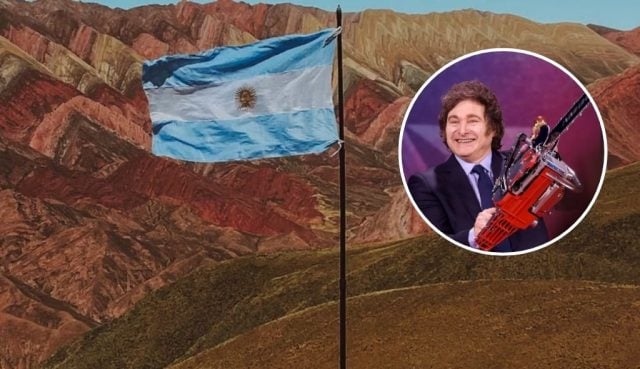
Original article: Mientras Argentina mira el Mundial, Milei y su casta preparan un nuevo saqueo del país: “Tierras sin límites para capitales extranjeros”
Argentina for Sale: Milei’s Government Seeks to Remove Restrictions on Foreign Land Purchases

The government of Javier Milei has reignited political debate with its plan to revise the Rural Lands Law. The administration fell short of securing sufficient votes in the Senate, causing the discussion to be placed on hold until August 6, as reported by Perfil.com.
During the program “QR!” on Canal E, representatives from various organizations harshly criticized the proposal and warned of its potential impacts on national sovereignty.
Host Pablo Caruso welcomed Pablo Volkind, coordinator of the Land Observatory; Nahuel Levaggi, national coordinator of the Land Workers’ Union (UTT); and Gervasio Muñoz, president of the National Tenants Federation. All three agreed that the official project “removes control measures over land ownership and favors the influx of large foreign capital,” as reported by Perfil.com.
“We Have an England Inside Argentina”
One of the strongest criticisms came from Volkind, who stated that the country already faces a significant level of land foreignization: “Today, there are 13 million hectares owned by foreigners in our country, equivalent to the area of England. We have an England within Argentina in private hands,” he asserted on Canal E’s program.
The expert explained that approximately 5% of rural land is currently in foreign hands, while existing law allows up to 15%. He deemed the argument that current regulations hinder investment as “a fallacy.”
The Map of Foreignization
The Land Observatory (Research Program on Agrarian History/UBA) conducted four key reports to analyze the current state of land foreignization, as published by Tierra Viva Agency by Nahuel Lag.
The main task was creating the Map of Land Foreignization, compiled using data from the National Register of Rural Lands (RNTR), National Parks, the National Glacier Inventory (Ianigla), the National Register of Indigenous Lands, and the Mining Projects Portfolio (Siacam).
Key Data from the Map
According to the map, 36 departments already exceed the legal limit of 15% foreignization, with four surpassing 50%. The most extreme cases include: San Carlos (Salta) with 60%, Molinos (Salta) with 58%, General Lamadrid (La Rioja) with 57%, and Lácar (Neuquén) with 54%.
Additionally, Campana (Buenos Aires) has 50%, Iguazú (Misiones) has 40%, and Ituzaingó (Corrientes) has 34%. All these locations feature significant water, mining, or border resources.
Border Areas and Strategic Resources
The Observatory warns that “the over 13 million hectares identified for foreign ownership are primarily concentrated in strategic areas of the country, including border zones, alongside the Paraná River, key logistics nodes, regions with mining potential, territories with water courses in cold areas, strategic aquifers, and extensive areas of native forests.”
The proposal would lift the purchase restrictions in border and riverside areas, which, according to Nahuel Levaggi (UTT), would hinder territorial control and facilitate illegal activities such as drug trafficking, human trafficking, and arms smuggling.
The Project and Its Implications
The project, authored by Deregulation Minister Federico Sturzenegger and negotiated by Senator Patricia Bullrich, removes constraints such as the 15% and 30% limits per nationality; the restriction on purchasing 1,000 hectares in high-value strategic areas; the ban on acquiring riverside or border lands; and the Rural Lands Interministerial Council.
Julieta Caggiano, a member of the Observatory, stated: “This is a law for foreignization, proposing to eliminate all types of limits so that foreign capital can seize our most valuable territories”.
The project is complemented by the RIGI (21 approved projects, mostly mining-related, including Vicuña and Tres Quebradas), modifications to the Glacier Law, and the repeal of the Indigenous Territorial Emergency Law. It will return to the chamber on August 6.
Obtén tu Pasaporte y apoya a El Ciudadano
Elimina la publicidad, accede a contenido exclusivo y sé parte de la comunidad.
Cancela en cualquier momento · Sin permanencia