Original article: Astrónomos miden la cantidad de gas «invisible» desde donde nacen las estrellas
Astronomers Quantify ‘Invisible’ Gas Essential for Star Formation in the Small Magellanic Cloud
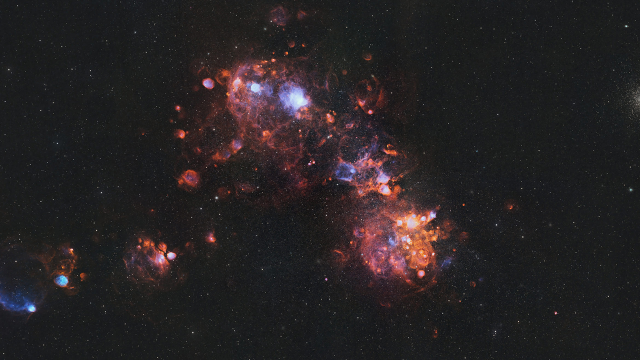
In the cosmic vicinity of the Milky Way, two enormous and enigmatic structures known as the Magellanic Clouds exist.
One of them, the «Small Cloud,» serves as an ideal location for studying the birth of stars. Karla Rodríguez Ambler, a master’s student in astronomy at the University of Concepción and a member of the Millennium Nucleus of Galaxies (MINGAL), led a study revealing that 77% of the gas responsible for star formation was «hidden» and could not be detected using conventional observation methods.
How does the gas remain hidden? “Stars are born within large clouds that contain a gas called molecular hydrogen. This gas is difficult to see directly with telescopes,” explains Karla Rodríguez.
Therefore, astronomers often look for another gas, known as carbon monoxide (CO), which is generally easier to detect and is frequently found alongside hydrogen. “It’s like trying to find a person by the shadow they cast,” adds the researcher.
However, in regions with low interstellar dust and heavier elements, like the Small Magellanic Cloud, the light from young stars can destroy carbon monoxide. Although the molecular hydrogen remains ready to form new stars, it becomes invisible to telescopes.
Mónica Rubio, an astronomer from the Department of Astronomy at the University of Chile and a team member, highlights that “this is the first time we have quantified the mass contribution of molecular gas in the areas where stars are born in the Small Magellanic Cloud, which contains only 20% of the components needed to study these regions.”
To uncover this hidden gas, the team utilized another clue: a type of carbon known as IONIZED CARBON.
Thanks to this, they were able to accurately calculate the amount of invisible gas present in that area. They achieved this by combining data from several telescopes: SOFIA, APEX, ASKAP, Parkes, and Herschel, each providing a unique piece of the puzzle.
“We obtained this data through observations I conducted aboard NASA’s stratospheric plane (SOFIA). I flew to New Zealand where the plane was and was able to fly two consecutive nights for the observations. It was an unforgettable and unique experience. We flew all night toward the South Pole, and I could be in the cockpit with the pilots during takeoff. It was fantastic, and while we made our observations, I saw southern lights,” explains Dr. Rubio.
Why Is This Discovery Important?
The Small Magellanic Cloud resembles how galaxies appeared when the universe was very young, shortly after the Big Bang. Therefore, this discovery may also aid in studying much more distant and ancient galaxies.
If similar conditions exist in distant galaxies, it suggests that scientists might have been underestimating the available gas for star formation in the early universe.
According to Rodrigo Herrera Camus, director of MINGAL, an astronomer at the University of Concepción, and Karla’s supervising professor, this research brings us closer to “understanding how galaxies formed their stars, from the first galaxies after the Big Bang to our own galaxy, which remains one of astronomy’s greatest challenges.”
“From MINGAL, we contribute to answering this question by combining observations from powerful observatories such as ALMA and APEX in Chile, and SOFIA, the infrared observatory that flew aboard a plane,” emphasized Herrera Camus.
“This contribution of molecular gas, measured through the emission of the ionized carbon atom [CII], allowed us to determine that 70% of the mass is in what we call ‘dark’ carbon monoxide (CO) gas. This helps us understand how small galaxies with few chemical elements could form stars in the early Universe,” adds Dr. Mónica Rubio.
The team now plans to study more areas of this galaxy to refine their calculations further.
“The results could also aid in interpreting observations of primitive galaxies made with ALMA and the James Webb Space Telescope (JWST), as well as improving star formation models for low-metallicity environments,” concludes Karla Rodríguez.
Publication
This research compiled data collected over nearly 10 years, from 2016 to 2025. The study was led by Rodrigo Herrera Camus alongside Mónica Rubio and was published in the scientific journal Astronomy & Astrophysics under the title “Tracing the hidden molecular gas in the Small Magellanic Cloud with SOFIA and APEX,” which can be accessed via this link.
Cover Image: Manuel Peitsch
Obtén tu Pasaporte y apoya a El Ciudadano
Elimina la publicidad, accede a contenido exclusivo y sé parte de la comunidad.
Cancela en cualquier momento · Sin permanencia