Original article: Canadá no cede ante Trump: contraataca con aranceles de hasta 50% y rechaza límites a su soberanía comercial
Canada Stands Firm Against Trump: Responds with Tariffs Up to 50% and Rejects Limits on Trade Sovereignty
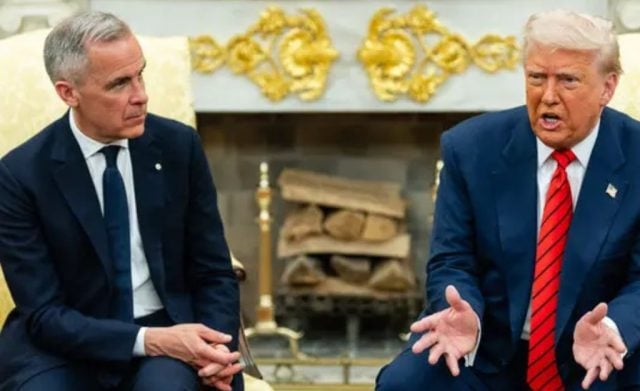
The Canadian government is not yielding to pressures from Donald Trump. Following the collapse of bilateral negotiations due to insurmountable differences, Prime Minister Mark Carney confirmed on Saturday the imposition of tariffs that will reach up to 50% on key products from the United States, a measure set to take effect on September 8.
This decision, which affects sectors such as steel, dairy, the paper industry, agricultural machinery, and electronics, aims to match dollar for dollar the tariffs that Washington previously imposed on Canadian imports valued at around $20 billion.
Carney labeled the offer from the U.S. president as a “bad deal” that is economically and politically unfeasible, emphasizing that Canada will not capitulate to demands deemed disproportionate that limit its trade sovereignty. In a public statement, the Prime Minister revealed that in recent days, Washington attempted to impose last-minute conditions which, in his view, aimed to restrict Ottawa’s ability to sign new agreements. “In summary: they asked for too much and offered too little,” stated Carney, outright rejecting the new terms proposed by the White House.
Tensions escalated further when the Canadian leader directly accused Trump of initiating a deliberate confrontation. “You are at war when you are attacked. We have been attacked,” Carney asserted, highlighting the extreme strain between the two neighboring countries. The Prime Minister made it clear that his administration will not accept the conditions offered nor yield to the demands.
“We cannot accept what they have offered nor will we yield to what they have demanded,” he affirmed.
Trump’s response was swift, taking to his platform Truth Social to attack Canada, questioning its trade status. “Canada wants the benefits of a [U.S.] state without being one!!!” the far-right president wrote, adding that for years the neighboring country has imposed high tariffs on U.S. farmers, declaring: “It’s over!!!” This exchange of statements underscores the breakdown of dialogue and the hardening of positions between the two nations.
Beyond the economic aspect, Carney mentioned that the negotiations included “threats against the French language” and “Quebec culture,” adding an identity dimension to the conflict and reinforcing the perception of a comprehensive offensive against Canadian sovereignty.
From Washington, Trade Representative Jamieson Greer dismissed any new round of dialogue and warned of retaliatory measures, although he noted that their offer included reductions for steel, aluminum, and cars, in addition to removing a tariff on lumber, which would have provided Canada with “the most preferential treatment among all trade partners,” as he stated to The New York Times.
The future of the bilateral relationship looks uncertain, especially since modifications to the USMCA still need to be agreed upon, which Trump has rejected in its current form.
Carney has insisted that relations with the U.S. have changed forever and that Ottawa must reduce its reliance on the U.S., to which 70% of Canadian exports currently head. This is compounded by the repeated threats from the Republican leader to annex Canada as state number 51, a scenario the Ottawa administration considers unacceptable and has motivated its stance of total resistance.
Obtén tu Pasaporte y apoya a El Ciudadano
Elimina la publicidad, accede a contenido exclusivo y sé parte de la comunidad.
Cancela en cualquier momento · Sin permanencia