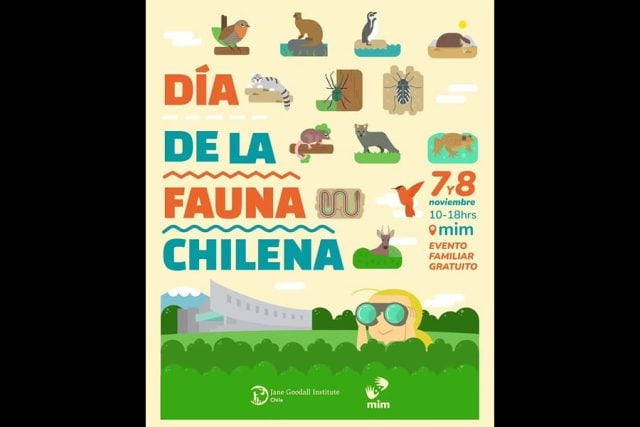
Original article: 7 y 8 de noviembre: Día de la Fauna Chilena se celebra en el MIM de manera gratuita
The Interactive Museum Mirador (MIM), located in the heart of La Granja, Santiago, invites the community to come together to celebrate Chilean Wildlife Day on November 7 and 8.
«For two days, the museum will transform into a grand gathering spot both indoors and outdoors, featuring booths from organizations, family activities, and learning spaces for all ages,» the invitation states, adding that «this is an environmental education event aimed at bringing children and their families closer to our native wildlife so they can learn to recognize, appreciate, and contribute to its conservation.»
Entry is entirely free: tickets must be downloaded by Friday, November 6, at portal.mim.cl.
Chilean Wildlife Ambassador 2027
One of the organized activities is the election of the Chilean Wildlife Ambassador 2027: «Caring for our wildlife is everyone’s responsibility, and we have the power to choose who represents it,» MIM officials stated.
Voting is available online at diadelafauna.cl until Sunday, November 8, or in person on Chilean Wildlife Day, November 7 and 8, at MIM.
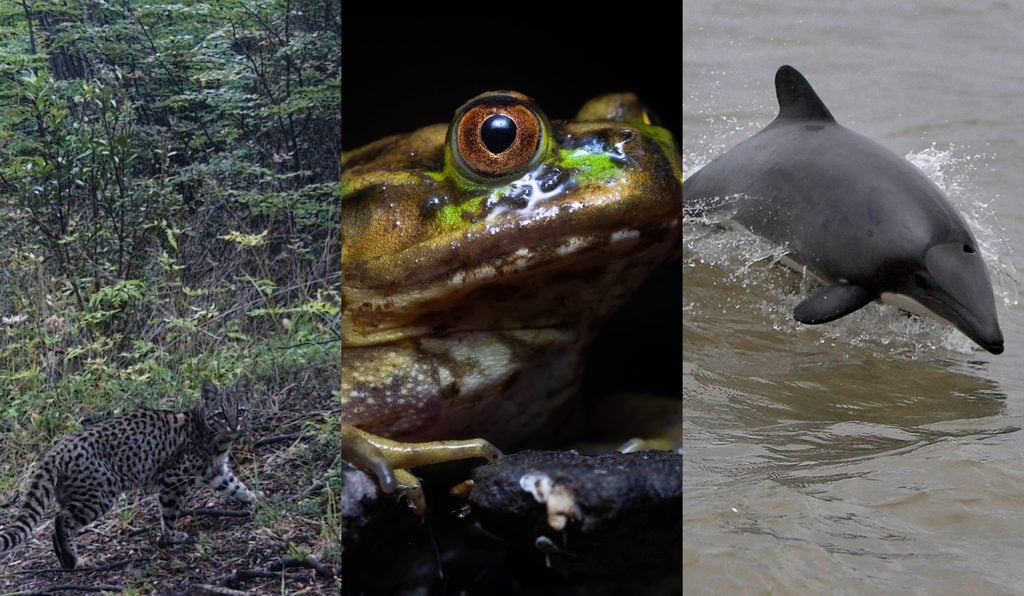
The candidates are:
1. Geoffroy’s Cat: A medium-sized wild feline that inhabits Chile’s border areas of Aysén and Magallanes. Weighing between three and five kilograms, it has a body covered with black spots over a gray or yellowish-brown base. Solitary and nocturnal, it preys on rodents, hares, and small reptiles. It is endangered in Chile due to habitat destruction, vehicle collisions, and the impact of domestic dogs.
2. Chilean Frog: The largest native amphibian in the country, endemic to the central-southern region between Coquimbo and Los Lagos. Its vulnerability stems from being captured for consumption, the degradation of waterways due to prolonged drought, pollution, and habitat loss.
3. Chilean Dolphin: The only cetacean endemic to Chile, it ranges from Valparaíso to Cape Horn, residing in shallow coastal waters, channels, fjords, and river estuaries. Recognizable for its robust dark body, it has a white patch on its belly and rounded fins. It feeds on small coastal fish, crustaceans, and cephalopods.
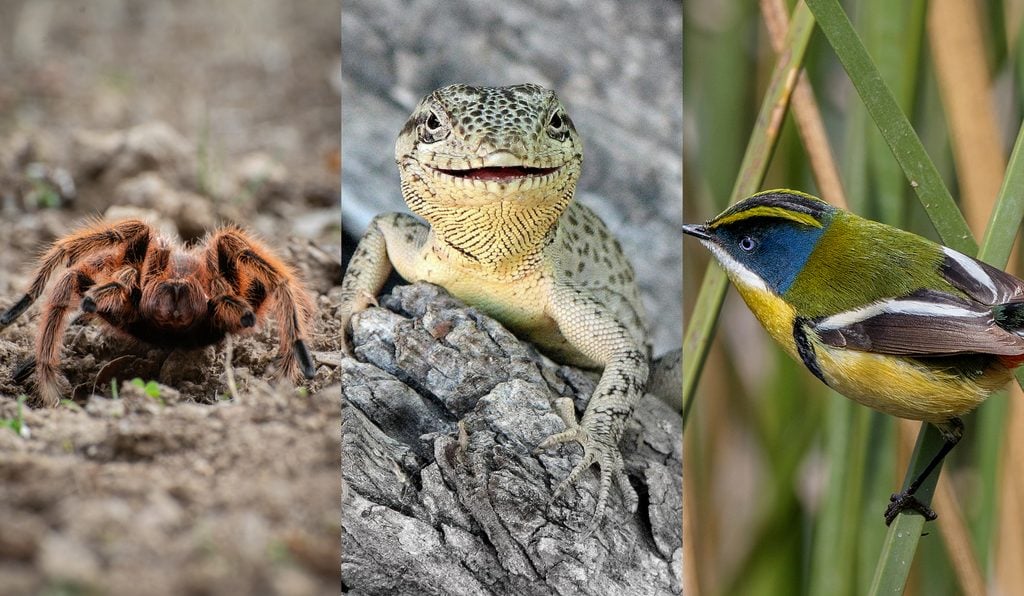
4. Pink Tarantula: A type of tarantula native to Chile, it lives in rocky soils and sclerophyllous shrublands. Nocturnal by nature, it spends the day in dens under stones or logs and ambushes insects and small invertebrates. Females can live many years. Their venom causes only temporary localized pain and poses no danger to healthy individuals. It is vulnerable due to urbanization and illegal pet trade.
5. Valeria’s Lizard: An endemic lizard from Chile found in the Cantillana Highlands and Coastal Mountains. Heavily built with a broad head, it exceeds 80 mm from snout to cloaca (not counting its long tail) and feeds on ground-dwelling insects and spiders. Threats include the fragmentation of sclerophyllous forest, wildfires, and livestock presence.
6. Seven-Colored Bird: A small and robust bird with a short tail and multicolored plumage, residing in wetlands and bulrushes in central and southern Chile, it hunts small insects and larvae. Its primary threat is the draining and destruction of wetlands due to urban and agricultural expansion.
In Memory of Jane Goodall
Alexandra Guerra Ramírez, executive director of the Jane Goodall Institute Chile, reveals that the concept of commemorating Chilean Wildlife Day originated in 2013 after the first visit of renowned British scientist and conservationist Jane Goodall to Chile.
«Chilean wildlife is unique and beautiful and has evolved alongside our territory. It was essential to educate children and youth about the animals we share our environment with because only then can we truly appreciate and protect them,» she states.
Thus, Chilean Wildlife Day was born, supported by a dedicated volunteer team from the Jane Goodall Institute Chile, along with many NGOs and initiatives that promote knowledge about our wildlife through research, science, and art.
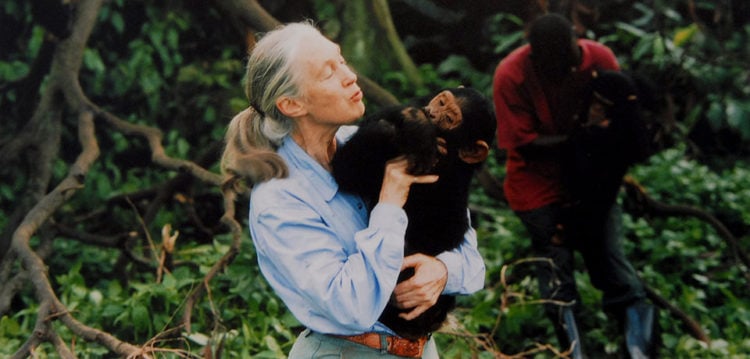
Regarding Jane Goodall, Andrea Caiozzi, president of the foundation that maintains her legacy, recalls that «she went to Tanzania to study chimpanzees in their wild habitat when no one had done so before, at least not anyone from the Western world.»
«She had no formal studies related to it, but her mentor, the famous anthropologist Louis Leakey, asked her to go because he needed someone without the scientific biases of the time,» Caiozzi explains.
At that time, Leakey was «keen on studying chimpanzees to better understand human behavior, as they are the genetically closest species to humans in terms of behavior and everything. And well, she went and spent many months with the support of her mother, who also accompanied her,» reveals the president of the Jane Goodall Institute Chile.
Another notable milestone in the scientist’s career was founding the «Roots & Shoots» program in 1991, a space that supports young people, children, and adolescents in pursuing their environmental protection objectives.
Among her many achievements, Caiozzi highlights, «Jane earned her doctorate along the way. Moreover, she was awarded honorary doctorates at numerous universities in over 50 countries, including the University of Chile during her last visit to Chile.»
» She was also awarded the Pablo Neruda Peace Medal by the Chilean government in 2024 during her visit. She was declared a peace messenger by the United Nations,» Caiozzi points out.
Jane passed away on October 1, 2025. «She was a remarkable conservationist, scientist, and an incredible inspiration for young women, gender minorities, and sexual diversities, demonstrating that there is a space for women in science at a time when it was incredibly challenging to be a woman in the 60s, 70s, and 80s,» Caiozzi emphasizes.
Animal Protection
Animal protection was another significant aspect of Jane Goodall’s legacy.
The foundation emphasizes that «she was a strong advocate for animal welfare and the protection and well-being of animals under professional care. She played a key role in ending experiments on great apes in the United States because they were kept under deplorable conditions.»
She also actively promoted more animal-friendly dietary systems, such as veganism and vegetarianism.
Obtén tu Pasaporte y apoya a El Ciudadano
Elimina la publicidad, accede a contenido exclusivo y sé parte de la comunidad.
Cancela en cualquier momento · Sin permanencia