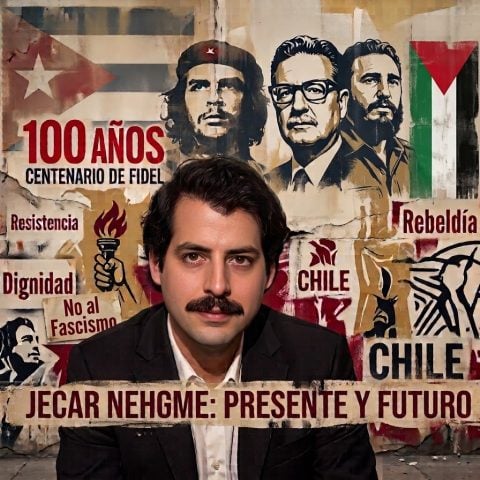
Original article: Desafío al tutelaje: Pensamiento insumiso de Jecar Nehgme
By Águeda Sáez Fick, Journalist (*)
Santiago, Chile, September 2026
As party leaders, the Pentagon, and the Pinochet dictatorship solidified the constraints of a transition confined to the 1980 Constitution, the MIR leader Jecar Nehgme Cristi proposed a bold rupture: to challenge the agreed guardianship by organizing social resistance, self-defense, and popular mobilization.
His assassination by the CNI on the eve of the 1989 elections was not an anachronistic overflow, but rather a preemptive state crime planned to secure the continuity of the dictatorial model and to decapitate the project of an autonomous, humanist, and unitary revolutionary left.
Today, in the face of the ultra-right’s offensive and the drifts of contemporary neo-fascism, his ideology and emancipatory ethics resurface as an essential compass for the reconstruction of Chile’s popular project and the left.
- The Tenacity of Memory and the Shielded Closure
There is an underground dialectic in historical processes: against the amnesia managed by institutional structures and consensus rhetoric, the memory of resistances survives as a radical challenge to the present order.
The emancipatory projects truncated by state violence are not archaeological remnants; they operate instead as open fractures that evade the structural locks and social discipline imposed by contemporary democratic transitions.
In the political trajectory of the Chilean left during the civic-military dictatorship, the figure of Jecar Antonio Nehgme Cristi (1961–1989) embodies a central strategic knot: the organic transition between clandestine resistance and the open eruption of popular mobilization against tyranny.
His summary execution—carried out on September 4, 1989, on Bulnes Street by members of the Blue Brigade of the National Intelligence Center (CNI)—was not an outdated excess of a retreating apparatus but a preventive and disciplining operation, planned at the very threshold of the electoral itinerary by the civil and military leaders responsible for safeguarding the agreed and consummated transition with the Pentagon’s consent, aimed at ensuring that the economic and institutional model implanted by the dictatorship would remain intact into the new political cycle.
This crime also condensed a tragic historical and intergenerational continuity of state terrorism.
On October 26, 1973, during the foundational phase of the repressive apparatus instituted after the military coup, his father—the public health expert and socialist leader Jecar Nehgme Cornejo—was executed in Temuco. Sixteen years later, just weeks before the elections that would initiate concertacionist governance, state bullets claimed the life of the MIR leader in downtown Santiago.
The immediate media framing, which attributed the murder to a fictional «September 11 Command,» carried a heavy symbolic load: it not only sought to judicially cover for the repressive leadership behind a supposed paramilitary vendetta but also to reactivate the foundational myth of the coup to warn that the frontiers of «protected democracy» remained monitored by the original violence of the regime.
Through this criminal act, the tyranny aimed to set the unassailable limits of the coming order, guaranteeing the survival and structural projection of its model under the confines of a rigorously tutored transition.
- Displacement and the Genesis of Critical Thought
Jecar Nehgme Cristi’s formative matrix transcends conventional doctrinal frameworks, rooting itself in the material experience of state violence and the subsequent community recomposition of popular sectors.
After the summary execution of his father in 1973, the family experienced internal exile: a forced displacement of more than six hundred kilometers from La Araucanía to Santiago, guarding his father’s remains in a coffin as a stark testimony to the repressive asymmetry established by the military junta.
In the metropolitan periphery—specifically in the population network adjacent to the emblematic Villa Francia, in the Estación Central commune—a support network was structured under the leadership of his mother, Milagros, and his grandmother, Marina.
This matriarchate of survival not only materially protected Jecar and his sisters from impoverishment and siege but also preserved the value of life, dignity, and affection in a twelve-year-old boy exposed early to the rigors of political persecution.
This environment shaped a subjectivity where human warmth, humor, and intellectual discipline acted dialectically against the precarity imposed by the neoliberal model.
The rigorous study of national history, combined with an early assimilation of the truncated experience from the early seventies, did not lead to a nostalgic or testimonial appeal but rather to an organic reading aimed at situating the living contradictions of workers, the unemployed, women, students, and residents at the very core of the hegemonic dispute.
The methodical approach to Marxism and heterodox currents of critical theory, along with the examination of anti-colonial struggles in Africa, Asia, and Palestine, fostered in Jecar an antidogmatic conception of political praxis. Rather than conceive theory as an inert catechism, he recognized that strategic answers must emerge from the questions posed by the concrete experiences of the territories in struggle.
- The Affective Trench: Militant Coherence and Unmasked Praxis
In the fissures opened by popular reorganization and the extension of anti-dictatorial resistance in the early 80s, the union between Jecar Nehgme and Águeda Sáez outlined a militant experience where the boundary between the intimate sphere and political confrontation was subverted.
Instead of subordinating affection to the sacrificial logic imposed by clandestinity or traditional conservative couple conventions, the relationship created territories of freedom, intellectual complicity, mutual love, and transformative commitment.
The joint decision to abandon clandestine compartmentalization to engage in unmasked militancy continuously strained the margins of survival under the state of exception. Daily life had to articulate routine with a methodical rigor that combined analytical serenity, composure in the face of daily hostility, revolutionary passion, and an uninterrupted state of alertness.
Over a decade, the couple operated with strict theoretical and ethical self-demand regarding their militant responsibilities, avoiding self-satisfaction and demanding profound ideological solvency from each other in the face of resistance challenges.
This rigor did not erode the realm of human containment. At the epicenter of the siege, the shared upbringing of Catalina and their son, Jecar, alongside the preservation of intimate affections and tenderness, acted as an ethical dam against the dehumanization programmed by the regime.
The shared life and militant experience demonstrated that the revolutionary dispute does not culminate in organic structures or public propaganda: it is fundamentally anchored in an experience where the construction of supportive and unalienated relationships prefigures the emancipated social order for which they fight.
- Critical Humanism and Overcoming Dogmatism
This ethical prefiguration rooted in affections and deep love for the people constituted the ontological and political foundation from which the MIR leader assumed a greater theoretical challenge: the necessity and urgency to comprehend the immensity of the human condition—its sensitivity, impulses, intelligence, and behavior—and to integrate it organically into the materialist analysis of history.
Instead of reducing Marxism to a deterministic mechanics of productive forces or to an inert catechism, Jecar articulated his thought at the living confluence of two major strands of emancipatory critical Marxism: on one hand, the heterodox European tradition emanating from Karl Marx’s foundational texts; on the other, the Amerindian liberation current forged in the heat of anti-colonial struggles, continental revolutions, and Latin American social theory.
In the first strand, Jecar drew upon the radical critique of alienation as expressed in Marx’s early Economic and Philosophic Manuscripts of 1844, engaging fruitfully with the developments of European critical theory.
He found in Erich Fromm’s psychoanalysis the theoretical tools to unveil the authoritarian «social character» and to untangle the psychic mechanisms that sustain voluntary servitude; he incorporated Herbert Marcuse’s astute warning concerning the refined devices of impulse domestication and repressive desublimation by which advanced capitalism neutralizes the emancipatory potential of desire; and he assimilated the rigorous political economy of Ernest Mandel, whose dissection of late capitalism demonstrated how the logic of capital colonizes and commodifies even the most hidden recesses of daily life and individual psyche.
He supplemented this knowledge with Antonio Gramsci’s teachings on cultural hegemony, the construction of common sense, and the understanding that class domination reproduces itself primarily within the framework of culture and civil life.
Dialectically combined with this matrix, the second strand nurtured his praxis with critical thought and the insurgent memory of Our America. Jecar recognized in Simón Bolívar’s unifying and anti-imperialistic vocation and in José Martí’s foundational imagery the undeniable demand to think from one’s own reality—upholding Martí’s premise that continental political creation must emerge from our roots without mirroring foreign models.
In the same continental stream, he integrated the developments of the Marxist Dependency Theory articulated by Vania Bambirra, Theotônio Dos Santos, and Ruy Mauro Marini, whose theoretical and militant work during their stay in Chile had provided indispensable keys to decipher the dependent, super-exploitative, and structurally subordinated nature of peripheral capitalism.
This reading fused with the vibrant pulse of continental revolutions: the ethical-political imprint of Ernesto «Che» Guevara regarding moral incentives and the forging of «new men and women,» in permanent reciprocity with Fidel Castro’s strategic conception of the «battle of ideas,» the irreducible value of social consciousness, and the certainty that popular victory resides in the moral strength and organized dignity of the people.
From this fertile synthesis, Jecar understood that the recovery of subjectivity was not an idealistic diversion nor a petite-bourgeois concession, but an intrinsic dimension of class struggle: no revolutionary project was viable if it severed the material laws of accumulation from the affective, ethical, and spiritual needs of the collective subject called to transform history.
This radical humanism systematically distanced Nehgme from mechanistic interpretations, Stalinist corsets, and doctrinal schematics historically lodged in sectors of the Latin American Marxist left.
For Jecar, the Pinochet dictatorship and neoliberal restructuring were not limited to wage compression and armed coercion: they constituted a planned biopolitical assault against the bonds of reciprocity and the dignity of the people.
Thus, his analytical production projected this emancipatory lens onto Third World liberation struggles, the decolonization processes in Asia and Africa, the South African apartheid regime, and the Palestinian resistance, affirming a militant internationalism where revolutionary love operated as a categorical imperative against the structural dehumanization of global capital.
Under this dual theoretical perspective, the ideological dispute assumed a rigorous methodological and formative character: the confrontation of ideas ceased to be a punitive feud or a factional quarrel over bureaucratic hegemonies and elevated itself to a liberating practice in the construction of popular self-awareness.
Inspired by Fidel’s conception of constant pedagogical dialogue with the people, Marcuse’s critique of one-dimensional conformism, and Mandel’s unwavering defense of grassroots socialist democracy, Jecar promoted open deliberation, a plurality of perspectives, and the value of fraternal debate as antidotes against dogmatic ossification and enlightened vanguardism.
Only through situated criticism, stripped of catechisms, could a revolutionary strategy for Chilean emancipation be forged; a construction capable of organically dialoging with the popular idiosyncrasies and linking with the dense traditions of struggle accumulated over centuries in the national territory: from the irreducible historical resistance of indigenous peoples to the foundational moral and labor pedagogy of Luis Emilio Recabarren, through to the democratic dignity and socialist horizon embodied by Salvador Allende.
- Popular Power, Leadership, and Frontist Convergence
Jecar Nehgme’s militant identity was forged within the Revolutionary Left Movement (MIR) and through the vision of the founding generation led by Miguel Enríquez.
For Jecar, the birth of the MIR in 1965 did not constitute a mere tactical split on the political board of the time, but an epistemic and revolutionary rupture: the emergence of a new left questioning the reformism, the stepwise conception of social change, and dogmatism.
This foundational MIR matrix dialogued from the outset with critical theory and Marxism, placing the social subject at the center: the people as conscious, sovereign artisans and protagonists of their own liberation.
Just as in the theses of the Frankfurt School concerning emancipatory autonomy and in sync with Dependency Theory’s warnings about the super-exploitative nature of peripheral capitalism, MIR thought assumed that emancipation in Our America required an audacious renewal of the historical subject, incorporating “the poor from the city and the countryside” as driving forces articulated to the historical working-class axis.
It was not about diluting the working class but broadening the horizon of class struggle, assuming that domination in a dependent country penetrates and fragments the entirety of social life.
Heir to this theoretical accumulation, Jecar articulated a rigorous conception of the role of organization: the revolutionary party is never an end in itself, but a historical and indispensable tool for political and strategic leadership.
For Nehgme, the party justified its existence as a guiding tool, not a supplanting one, whose moral vanguard was not decreed by doctrinal investiture but conquered at the forefront of people’s struggles.
With this wealth of knowledge, Jecar faced the internal fractures that shook the MIR towards the end of the 1980s, rejecting both the liberal capitulation to the regime and the militaristic drifts that reduced revolution to clandestine armed confrontation and isolation.
In his reading, Miguel’s formulated political-military strategy never conceived material force as an end in itself nor armed detachments as a substitutive vanguard.
Instead, military politics should dialectically subordinate to the advancement of social struggles under the principle of combined development: popular military strength operating as a protective shield and multiplier of organization and mobilization, burying the distortion that reduced the social movement to a mere logistical rear.
This primacy of the social was accompanied by an undeniable conception of popular autonomy. In the doctrine of Enríquez and in Jecar’s practice, popular power was not a testimonial assembly experience nor a marginal refuge, but the embryo of a new democratic and socialist institution forged from below.
Thus, class independence did not mean self-margining from political circumstances. On the contrary, it implied the tactical and unembarrassed occupation of legal gaps—such as the construction of the Broad Socialist Left Party (PAIS) or entering electoral rolls—as one means to contest the meanings of the crisis, eroding the trajectory set by Pinochet and preventing social discontent from being expropriated by the consensual arrangements of the elite.
Firmly rejecting any attempt at political co-optation, Nehgme embodied this self-determination in the material trench of the territories.
His leadership role in the founding of the National Union of Democratic Students (UNED) after his university expulsion in 1980, his commitment to the Committee for the Defense of People’s Rights (CODEPU), and his articulating role in communal kitchens, land occupations, sectoral strikes, and national protest days demonstrated this.
In every space, Jecar maintained that revolutionary consciousness is forged in community reciprocity, self-management of needs, and organized confrontation against the dominant order.
In his experiences of building forces from the grassroots, he nurtured a frontist vocation for majorities and an audacious alliance policy.
As the national leader of the Democratic Popular Movement (MDP), later as a key figure in the United Left in 1987 and promoter of PAIS in 1988, Jecar pushed for the organic convergence of communists, socialists, miristas, revolutionary radicals, and left-wing Christians.
His bet was to safeguard the articulation of the popular block without yielding to transformative profiles or the socialist horizon, to, from that autonomous and cohesive correlation of forces, extend tactical convergence bridges with liberal and social-democratic sectors capable of isolating the regime and breaking the authoritarian lock.
This path alongside the bases cemented a mass leadership that significantly transcended the party boundaries of mirismo. Jecar became an undisputed reference figure for the entire left and for broad popular sectors, who recognized in him a combination of profound theoretical stature united with everyday simplicity, accessibility, and fraternity.
This moral authority stemmed from his material consequence: the resilience to face street battles head-on and the sharpness to wage the battle of ideas, both in the internal tensions of his organization and in the strategic debate of the popular movement.
From this earned legitimacy, and far from endorsing the fraudulent 1980 Constitution, Nehgme envisioned participation in the plebiscite and the 1989 elections as a mass trench aimed at surpassing the agreed transition, breaking the locks of impunity, and paving the way for a sovereign constituent assembly that would return to the Chilean people the reins of their own history.
- The Unfinished Horizon and the Struggle for Popular Sovereignty
The assassination of Jecar Nehgme Cristi—executed with the direct knowledge of the dictator and under the civil administration of an Interior Ministry led by Carlos Cáceres, a future executive of influential transnational economic conglomerates—was a response to a precise disciplining calculation.
What the tyranny and its security apparatus sought to cut off was not a testimonial residue of armed struggle, but the emergence of a young political leadership, sophisticated in theory, rooted in social movements, and endowed with a unifying vocation capable of challenging the terms of tutored governance.
The regime astutely perceived the implicit threat posed by a revolutionary who dismantled clandestinity to publicly appeal to the masses, articulating political-institutional disputes with the popular resistances constructing territorial and sectoral sovereignties.
In light of contemporary processes of popular recomposition, Jecar Nehgme’s trajectory eludes any confinement in the inert archives of defeat.
His praxis condenses a pathway of pending futures: the dialectical certainty that no democratic transition is legitimate if it enshrines depoliticization, organizational disarmament of society, and the safeguarding of the socio-economic model imposed by force.
His legacy survives not as liturgical nostalgia but as a living call to communities that persist in constructing a social order necessarily defined by popular sovereignty, distributive justice, unrestricted freedom, and the historical protagonism of their people.
Águeda Sáez Fick
(*) Author’s note: While the author actively participated in this history and in Jecar’s life, adopting the third person constitutes a deliberate decision: it does not seek to evade living memory or feign neutrality, but to subordinate the autobiographical testimony to the political and theoretical reconstruction of a collective project of resistance and emancipation, so that the ideals and praxis of an entire generation of fighters engage, with due urgency, in the battles we must confront today.
Obtén tu Pasaporte y apoya a El Ciudadano
Elimina la publicidad, accede a contenido exclusivo y sé parte de la comunidad.
Cancela en cualquier momento · Sin permanencia