Original article: Partidos chilenos se dividen frente a intervención de EE.UU. en Venezuela
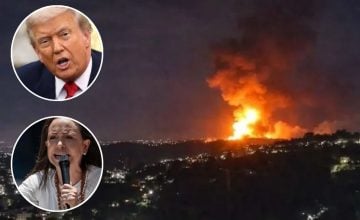
On January 3rd, a U.S. military operation led by President Donald Trump was revealed, resulting in the capture of Nicolás Maduro and his wife, Cilia Flores, in Venezuelan territory. This event sparked swift reactions across the Chilean political landscape, with parties from various backgrounds expressing divergent views on the U.S. intervention and the future of Venezuela.
Widespread Political Rejection of U.S. Intervention
The Frente Amplio issued an official statement denouncing the U.S. attack, asserting that the action represented a blatant violation of the sovereignty of a Latin American country and a breach of international law.
Furthermore, they indicated that the intervention reflects a historical policy of U.S. domination and raised concerns about the normalization of unilateral military force. They called for a democratic and sovereign resolution for Venezuela, urging Chile to uphold a foreign policy of non-intervention, multilateralism, and respect for international law.
In a similar vein, the Communist Party condemned the U.S. military action, labeling it a criminal aggression that jeopardizes regional peace and stability. They demanded an immediate response from the Chilean government, a call for CELAC, and UN intervention to halt the escalating violence.
They also warned that the intervention undermines the sovereignty of nations, recalled the history of U.S. interference in the region, and insisted on protecting Nicolás Maduro’s life, stating such actions must not go unpunished by the international community.
Meanwhile, the Socialist Party reiterated its condemnation of the Venezuelan regime and human rights violations, but argued that this does not justify U.S. intervention or the use of unilateral force. They emphasized that military operations violate sovereignty, international law, and threaten regional stability.
The party advocated for a peaceful, political solution to the Venezuelan crisis based on internal dialogue and multilateral support, rejecting the militarization of conflicts due to its impact on civilians.
The Party for Democracy (PPD) also condemned the use of foreign force in Venezuela, rejecting violence as a means of political resolution. While they labeled Nicolás Maduro a dictator and acknowledged the democratic crisis, they maintained that the solution must be peaceful, democratic, and multilateral.
Similarly, the Christian Democratic Party (DC) expressed concern over the situation in Venezuela and condemned human rights violations by Nicolás Maduro’s regime, but rejected the use of force and stressed the necessity of respecting international law.
The party contended that the crisis should be resolved through peaceful and multilateral means, through democratic processes that allow the Venezuelan people to restore their institutions.
The Humanist Action Party condemned the military action by the U.S., labeling it a violation of self-determination and international law. They rejected the use of force, considering the motivations to be economic interests, and called on democratic sectors to oppose the normalization of war as a political tool in the region.
The Liberal Party of Chile expressed their concern about the Venezuelan crisis and reaffirmed their rejection of all forms of foreign intervention. They emphasized that the resolution must be peaceful and determined by the Venezuelan people, in respect of self-determination, democracy, and human rights.
The Radical Party criticized the dictatorial nature of Nicolás Maduro’s regime and his human rights violations but warned that his capture sets a concerning precedent for international law. The party rejected unilateral use of force, called for statements from multilateral organizations, and asserted that Venezuelan transition must be democratic, without external tutelage and with full respect for sovereignty.
Lastly, the Equality Party condemned the bombings by the U.S. in Venezuela and labeled the kidnapping of Nicolás Maduro and his wife as terrorism, denouncing it as a serious foreign interference. They also demanded his release, reaffirming their defense of sovereignty and calling for mobilization and solidarity with the Venezuelan people against U.S. intervention.
Support for Maduro’s Capture and Call for Democratic Transition
Conversely, the Libertarian National Party valued Maduro’s arrest as a turning point against the Venezuelan dictatorship and an opportunity to restore the rule of law. They expressed solidarity with the Venezuelan people and supported a democratic transition.
The National Renewal labeled Nicolás Maduro a narcodictator and viewed his arrest as good news for Venezuela and the region. They also called for a peaceful transition that allows for the return of democracy, the rule of law, and a legitimate government in the country.
In this context, the People’s Party showed support for the Venezuelan people, highlighting decades spent under a dictatorship characterized by human rights violations, the exodus of Venezuelans, repression, persecution of opponents, fraudulent elections, and the validation of drug trafficking. They expressed hope for the restoration of peace and democracy.
From UDI, although they did not issue an official statement, various party members made declarations appreciating Nicolás Maduro’s capture as a blow to drug trafficking and the Venezuelan dictatorship, indicating it opens an opportunity to recover democracy. They agreed on the need for a peaceful and rapid transition that allows the Venezuelan people to freely choose their authorities and move towards respecting human rights.
The Republican Party labeled Nicolás Maduro the leader of a narcodictatorship and praised his capture for the charges against him. The party stated that his downfall opens an opportunity to regain freedom and democracy in Venezuela and expressed their willingness to assist in that process from Chile.
Finally, from EVOPOLI, they condemned Nicolás Maduro’s government, which they described as a dictatorship, and the human rights violations, stating that his regime caused a severe political and humanitarian crisis. The party called for promoting, alongside the international community, a democratic and orderly transition that restores the rule of law in Venezuela and prevents an escalation of violence.
Among the parties that have not commented on the matter are the Christian Social Party, the Green Regionalist Federal Federation, Democrats Chile, the Popular Green Alliance Party, the Yellow Movement for Chile, the Humanist Party, the People’s Party, and the Green Ecologist Party.
For their part, the Revolutionary Workers Party, although they have not issued an official statement, condemned the U.S. intervention in Venezuela through various posts on their social media.
Relacionados
Argentina Leads Alliance of Ten Nations to Block CELAC's Condemnation of U.S. Actions in Venezuela
Hace 2 meses
Political and Social Organizations Condemn Trump's "Imperialist Aggression" in Venezuela
Hace 2 meses
Roger Waters Issues Strong Condemnation of Trump Over Venezuela Assault and Maduro's Abduction
Hace 2 meses
U.S. Department of Justice Drops 'Cartel of the Suns' Accusation Against Maduro, Reports NYT
Hace 2 meses