Original article: Kast llega a China para reunirse con Xi Jinping: la decisión de Chile ante la disputa estratégica entre Washington y Beijing
Chilean President Kast Arrives in China for Key Talks with Xi Jinping Amid US-China Rivalry
The arrival of Chile’s president in Shenzhen, during APEC 2026, marks a significant new phase in Chile’s relationship with the world’s two leading powers. While the Trump administration seeks to counter China’s technological and geopolitical expansion in Chile, Santiago must uphold its economic ties with Beijing, its largest trading partner. Kast’s visit comes at a crucial time as Chile’s decisions in the context of the strategic competition between Washington and Beijing will be pivotal. His meeting with Xi Jinping is set against a backdrop of disagreements surrounding the trans-Pacific submarine cable, a cancelled astronomical observatory, and Valparaíso’s bid to host the High Seas Treaty Secretariat, among other pertinent issues.
By Bruno Sommer
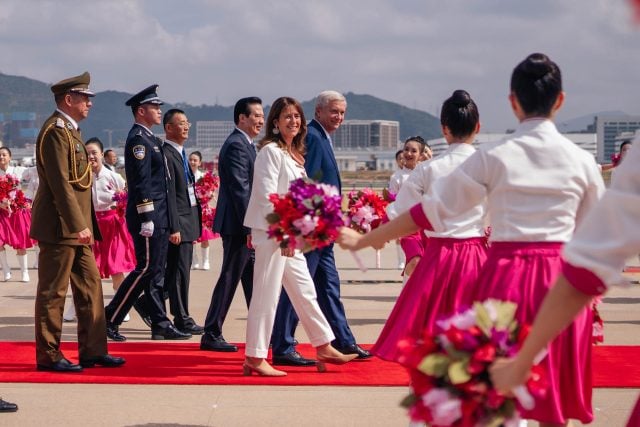
President José Antonio Kast arrived in Shenzhen, southern China, on Tuesday, November 17, to participate in the APEC 2026 Leaders’ Week and hold his first bilateral meeting with Chinese President Xi Jinping since taking office in March.
His arrival occurs amid widespread disapproval of his mandate in Chile. Kast’s landing, recorded at 10:55 local time at Shenzhen Bao’an International Airport, marks one of the most significant diplomatic moments of his first official tour of Asia, which began in Vietnam and will continue to Japan.
The meeting with Xi Jinping, scheduled for 17:00 local time on Tuesday (06:00 in Chile), takes place in an international landscape defined by the escalating competition between the United States and China for global economic, technological, and geopolitical leadership, particularly emphasizing Latin America, which serves as a crucial source of key supply chain materials such as copper and lithium.
For the Chilean government, this visit poses a challenge that goes beyond diplomatic protocols: how to maintain a strategic relationship with Washington without compromising the economic ties built over decades with Beijing. Kast and his team must demonstrate whether he is a president advocating for Chile’s general interests or serving the interests and agenda of the America’s Shield in the region.
In this context, the meeting between Kast and Xi will be closely watched as a first indicator of Chile’s foreign policy direction amid increasing rivalry between both powers.
A Visit Marked by Tensions Between Washington and Beijing
Kast’s arrival in China comes after several months during which the new Chilean government has shown signs of political and strategic rapprochement with the United States.
One significant gesture was Chile’s adhesion to the so-called America’s Shield, an initiative promoted by the Trump administration to strengthen regional cooperation on security.
This approach occurs while Washington is implementing a policy to contain Chinese influence, particularly in sectors considered strategic such as digital infrastructure, artificial intelligence, telecommunications, critical minerals, energy, and supply chains.
To this end, the U.S. administration has not hesitated to send studies to the Chilean Foreign Ministry since Boric’s government, labeling Chinese projects as national security threats, aiming to undermine China and benefit the U.S.
In Latin America, these concerns have particularly manifested in port projects, telecommunications networks, data centers, and submarine cables.
On its part, China has rejected what it sees as U.S. attempts to hinder its economic and technological development, defending commercial cooperation and the right of countries to establish economic relations without external pressures.
Chile’s position is particularly relevant because the country has a deeply intertwined economic relationship with the Chinese market. A potential rupture or deterioration of those ties would have repercussions for exporting sectors reliant on Asian demand.
Thus, Kast’s visit tests his government’s ability to develop a foreign policy that preserves national interests amid increasingly intense international competition.
The Submarine Cable: An Infrastructure Turned Geopolitical Issue
One of the most pressing issues regarding the relationship between Santiago and Beijing is the Chile-China Express project, an initiative spearheaded by the state-owned China Mobile to connect Hong Kong with the Valparaíso Region through a submarine fiber optic cable.
The project involves an extension of nearly 20,000 kilometers and an estimated investment of 500 million dollars.
Its importance goes beyond telecommunications; submarine cables are essential infrastructures for internet functionality, international financial communications, digital services, and information exchange across continents.
While public attention often focuses on satellites and wireless networks, submarine infrastructure carries a significant portion of international data traffic.
The Chinese initiative faced obstacles during the previous administration when authorities revoked the concession granted for the project’s development. This decision was made amid U.S. warnings regarding potential security risks associated with the involvement of a Chinese state-owned enterprise in a strategically significant infrastructure.
Beijing questioned this decision, with the Chinese ambassador in Chile, Niu Qingbao, stating earlier in November that the project remained valid and characterized its previous suspension as unfair, attributing it to U.S. pressure.
The diplomat also confirmed that final details for the meeting between Kast and Xi Jinping were being finalized.
Valparaíso vs. Xiamen: The Contest for the High Seas Treaty Secretariat
Another issue potentially impacting bilateral talks is the competition to host the Secretariat of the High Seas Treaty, known as BBNJ, an international agreement aimed at protecting marine biodiversity in areas outside national jurisdictions.
Chile has promoted Valparaíso’s candidacy and recently agreed to coordinate a joint proposal with Belgium, which entails distributing specific institutional functions between Valparaíso and Brussels.
China, on the other hand, is backing Xiamen as the host city for the Secretariat.
The controversy acquired diplomatic dimensions after Beijing raised objections to the Chilean-Belgian agreement, questioning its organization, operation, and costs, warning against the potential politicization of the process.
For Chile, Valparaíso’s candidacy represents an opportunity to strengthen its international position in ocean governance and solidify its identity as a maritime nation and protector of the oceans.
For China, securing Xiamen as the Secretariat’s home would enhance its presence in international bodies linked to maritime governance.
The dispute illustrates that competition between the two countries extends beyond trade and technology; it also influences multilateral spaces and the capacity to affect international institutional architecture, where Chile’s role as a foothold for influence in Latin America is well documented.
According to reports from the Chilean press, the Kast government does not plan to prioritize these two issues in its meeting with Xi Jinping, though the president is prepared to present Chile’s position if the Chinese president raises them.
China: The Trading Partner Chile Cannot Ignore
The economic dimension is the main structural element of the bilateral relationship.
China is Chile’s largest trading partner and a key destination for its exports of copper, lithium, agricultural products, food, and natural resources.
This relationship has developed across various governments and political orientations. Chile was the first South American country to establish diplomatic relations with the People’s Republic of China in 1970 and later became one of the region’s first countries to sign a free trade agreement with Beijing, effective since 2006.
The relationship also acquired an integrated strategic character a decade ago, precisely in 2016.
This history explains why Kast’s visit holds significance that transcends ideological differences between governments.
The Chilean economy remains significantly exposed to Chinese demand, particularly in the mining sector. Copper is a fundamental input for electrification, energy grids, industrial infrastructure, and technological transition, while lithium is a strategic resource for batteries and energy storage.
In the case of copper, the expansion of electrical networks, electromobility, data centers, and the tech industry keeps Chile relevant within the global supply chains.
Lithium, for its part, directly connects Chilean mining interests with China’s battery and electric vehicle industry.
The relationship also extends to the food industry. Exports of cherries, wines, seafood, fruits, and other food items are part of a trade relationship that has allowed Chile to diversify its markets and expand the presence of its products in Asia.
In 2025, Chilean exports to China, excluding copper and lithium, reached 9.585 billion dollars, an increase of 5.2% compared to the previous year, according to figures released during ChileWeek China.
Therefore, any strategy for commercial diversification must recognize that China is not just an alternative market but a central component of Chile’s export structure that cannot be overlooked.
APEC 2026: The Business Arena Where Another Part of the Dispute Unfolds
The presidential visit coincides with the APEC CEO Summit, one of the most significant business gatherings in the Asia-Pacific economic calendar.
The meeting, taking place between November 17 and 18 in Shenzhen, will feature representatives from 115 companies listed in the Fortune Global 500, according to the Chinese Council for the Promotion of International Trade.
Participation is also expected from leaders of twelve APEC economies, including Xi Jinping.
A particularly significant detail is that U.S. companies constitute the largest foreign business delegation, making up nearly 20% of the total foreign companies participating.
This figure reflects a reality that coexists with the political rivalry between Washington and Beijing. Even amid tensions in trade and technology, major U.S. corporations continue to view China as a critical market and industrial space.
Kast is scheduled to speak at the panel titled «Building a New Paradigm for Sustainable Development in the Asia-Pacific,» focusing on the challenges of sustainable development in the region.
For Chile, the gathering represents an opportunity to showcase its strengths in mining, energy, food, services, innovation, and technology, as well as establish connections with companies and investors operating in key Asian markets.
The business agenda is complemented by ChileWeek China, an initiative organized by ProChile running from November 16 to 20 in Beijing, Shenzhen, and Shanghai.
The eleventh edition of ChileWeek includes promotional activities, business meetings, and visits to companies and technology centers. The delegation includes representatives from both the public and private sectors, as well as Chilean tech companies.
Pragmatic Diplomacy Amid Ideological Differences
Kast’s Asian tour also highlights a feature of his foreign policy: the willingness to separate his personal ideological positions from institutional relations between states.
During his visit to Vietnam, the Chilean president participated in a floral tribute ceremony at Ho Chi Minh’s mausoleum, despite having previously labeled the historic Vietnamese leader as a «murderer» and «genocidal.»
Obtén tu Pasaporte y apoya a El Ciudadano
Elimina la publicidad, accede a contenido exclusivo y sé parte de la comunidad.
Cancela en cualquier momento · Sin permanencia