
Original article: Se dispara el “sueldo de Chile”: el cobre marca nuevo máximo y cruza la barrera de US$6
«Chile’s salary» began 2026 with a remarkable surge, as the price of copper hit a new high on Tuesday, January 6, crossing the $6.00 barrier due to a situation where demand exceeds supply.
This was highlighted by the New York futures market (COMEX), where the value of a pound of metal surpassed this figure, indicating more than just a psychological milestone; it reveals the premium the United States is willing to pay for immediate availability.
The same trend occurred on the spot market of the London Metal Exchange (LME), where the price per ton finally broke the $13,000 mark, reaching a peak of $13,269.
The jump in copper prices in this market is attributed to perceptions of temporary scarcity and operational fragility in major mines, with reports highlighting potential disruptions due to labor conflicts and contingencies at key sites.
According to official data from the Chilean Copper Commission (Cochilco), the price of red metal settled at $6.02 by the close of LME, representing an increase of 2.99%, thus establishing a new nominal historical maximum.

As a result, the average price of copper rose to $5.85 during the first six days of 2026, a figure significantly higher than the $3.97 average from the same period last year.
Impact on Exchange Rates
The strength of the nation’s primary export has had an immediate and powerful effect on the local currency market. The dollar again broke through the support level of $900, trading at $896 at the time of this publication, a low not seen since May 2024.
Favorable Winds for Fiscal Revenues
The impressive performance of the red metal means only good news for the government in the short term, due to the surpluses that Codelco provides to the state and higher taxes that large private mining companies must pay.
However, analysts urge a view beyond the bullish cycle. Pablo Müller, an academic from the Faculty of Management and Business at the U. Autónoma, contextualized by noting that «for example, Escondida pays more in taxes than Codelco does in gross income. But there is also an important detail regarding our dependence on the red metal. Thus, when the price cycle changes, volatility can rebound and worsen fiscal revenues very abruptly,» La Tercera reported.
Supply Under Pressure and Structural Demand
The current spike is due to a combination of factors. On the supply side, there are structural global restrictions, diminished inventories, and new operational shocks.
This week, the situation worsened due to a strike that started at Mantoverde, Capstone Copper’s copper mine in Chile, which produced 57,700 metric tons in 2024. Additionally, the Chinese Tongling Nonferrous Metals Group announced last Sunday that there is a delay in the startup of the second phase of its Ecuadorian mine, raising alarms about the availability of the metal.
On the demand side, the energy transition, electromobility, and increased technological usage continue to support a solid consumption floor, despite some signs of cooling from the main global buyer. According to Reuters, high prices have reduced purchases by China. The Yangshan copper premium (SMM-CUYP-CN), a key indicator of Chinese consumers’ appetite for imported copper, fell to $43 per ton on Monday, down from over $50 at the end of 2025.
Cochilco’s Expectations
The higher spot price coexists with more conservative average projections for «Chile’s salary» from the Chilean Copper Commission (Cochilco), which has estimated a lower average price for 2026 than the current levels seen in international markets.
It is worth remembering that last November, Mining Minister Aurora Williams, along with interim Executive Vice President of Cochilco Claudia Rodríguez, presented the Copper Market Trends report for the third quarter of last year, including price, demand, and supply projections for 2025 and 2026.
On that occasion, Williams highlighted that the commission had raised its average copper price projection to $4.55 per pound for 2026, surpassing the previous estimate of $4.30 per pound.
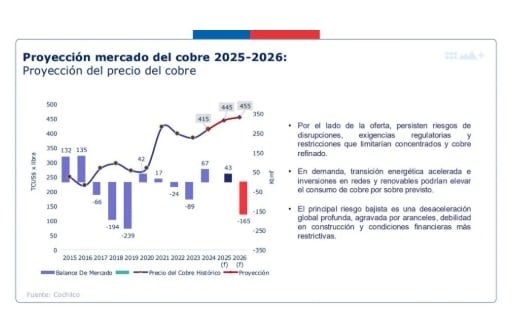
«These upward adjustments in the copper price projection for this year and next are due to a lower supply of copper in the market, expectations of rate cuts by the U.S. Federal Reserve, a dollar trending towards depreciation, and persistent geopolitical and trade uncertainty,» the state secretary explained.
Rodríguez also indicated that a global copper deficit of 165,000 tons is anticipated for 2026, as the supply of the metal is expected to grow by only 1.4%, while consumption will increase by around 2.1%, in a context of reduced scrap availability.
Relacionados

Chile's Copper Prices Set to Hit Record Highs: Cochilco Predicts Historic Averages for 2025 and 2026
Hace 3 meses
Copper Prices on the Rise: Cochilco Projects US$4.95 per Pound in 2026 and US$5.00 in 2027
Hace 2 semanas
Copper Prices Reach Historic High Amid Supply Issues and Stockpile Concentration in the U.S.
Hace 2 meses
U.S. Designates Copper as Critical Mineral: Chile Takes Center Stage in Global Supply Chain
Hace 4 meses
Safe Haven or Liquidity? Divergence in Silver Prices Between Shanghai and New York Tests Market Confidence
Hace 2 semanas