Original article: Seguridad a cualquier precio: la derecha se impone en Costa Rica y consolida el continuismo de Chaves
Reports suggest that Fernández plans to adopt the anti-gang strategies employed by Nayib Bukele and reform Costa Rica’s Political Constitution to allow for consecutive re-election. Progressive sectors have warned that this represents a scheme to establish absolute power reminiscent of the Salvadoran president.
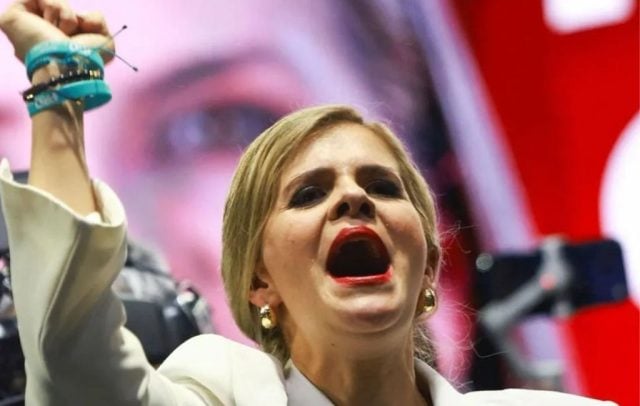
With over 93% of polling stations counted, Laura Fernández from the Sovereign People Party emerged as the virtual winner of the presidential elections in Costa Rica.
During her campaign, the 39-year-old right-wing political scientist presented herself as the «heir» to incumbent president Rodrigo Chaves, vowing to take a tough stance against crime and insecurity.
According to preliminary results, the ruling party candidate obtained 48.33% of the votes following the counting of 93.79% of stations.
Data from the Supreme Electoral Tribunal indicates that Fernández exceeded the 40% support threshold required to win in the first round, defeating candidate Álvaro Ramos from the National Liberation Party, who has garnered 33.42% of the preferences.
Electoral records show that Fernández received a total of 1,156,735 valid votes, while Ramos secured 799,875.
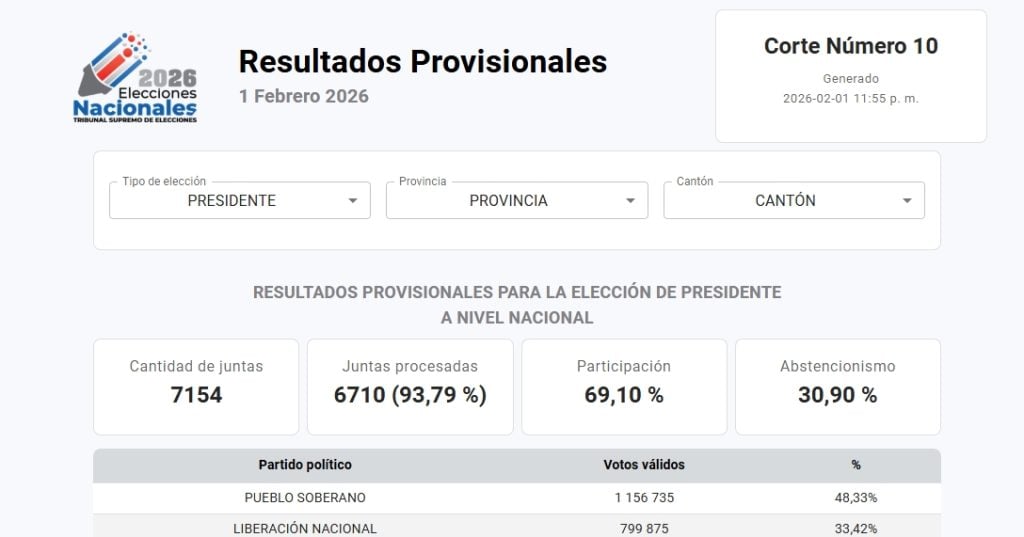
The elections witnessed a participation rate of 69.10%, while abstention stood at 30.90%.
Chaves’ Heir and Her Right-Wing Policies
A political scientist and expert in public policy and democratic governance, Fernández becomes the second woman to ascend to the presidency in Costa Rica’s history after Laura Chinchilla, who led from 2010 to 2014 representing the Social Democratic National Liberation Party.
She built her professional and political career as a legislative advisor and official linked to state reform projects until in 2022 she was invited to join Rodrigo Chaves’ cabinet, serving as Minister of Planning and Chief of Staff.
In both roles, she coordinated economic policies and administrative reforms spearheaded by Chaves, including the controversial Jaguar Law, aimed at reducing oversight on public works, which was ultimately halted by the Costa Rican judiciary due to its unconstitutionality.
Throughout the campaign, she presented herself to voters as Chaves’ “heir,” responsible for continuing his initiatives.
“From day one, you believed in me and valued my merits, allowing me to be the elected president of Costa Rica,” Fernández communicated to Chaves in a televised phone call after the election results were announced.
Costa Rica Takes a Page from Bukele
Her campaign focused on tackling insecurity and the rise of drug trafficking, proposing to establish a state of emergency in conflict zones.
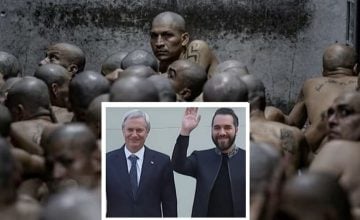
Reports indicate that Fernández intends to replicate Bukele’s anti-gang strategies and reform the Political Constitution to facilitate consecutive re-election, prompting progressive sectors to raise alarms about a potential plan to consolidate absolute power in a manner akin to the Salvadoran president.
In fact, Bukele congratulated her via phone, calling her «president-elect.»
Relacionados
Cuba Links Ecuador's Diplomatic Expulsion to U.S. Pressures Ahead of Miami Summit: "Not a Coincidence"
Hace 1 semana