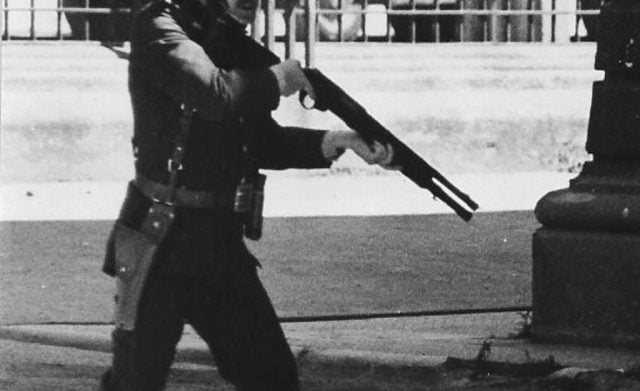
Original article: Se valió del uniforme: Corte eleva a 18 años condena a exoficial de Carabineros por crimen de lesa humanidad en dictadura
The Second Chamber of the Appeals Court in La Serena has increased the sentence of former Carabinero lieutenant L.A.V.Z from 12 to 18 years in prison. This decision was made after determining that his status as a public official was crucial in the commission of the murder of R.O.R.O., which took place on September 13, 1973, in Antofagasta during the dictatorship of Augusto Pinochet.
In a unanimous ruling that modifies the previous sentence, the appellate court concluded that the maximum prison sentence should be what the convicted individual ultimately faces. This resolution upholds the conviction for qualified homicide and introduces a significant change in the assessment of the penalty by considering an aggravating factor that was overlooked by the lower court: the abuse of his official position to commit the crime (article 12 No. 8 of the Penal Code).
Judges Marcela Sandoval Durán, Jimena Pérez Pinto, and attorney Pía Bustos Fuentes agreed that the context of the crime’s execution cannot be separated from the power and means the accused held due to his rank within the Carabineros.
The incident, which occurred in the days following the military coup, took place at the Third Police Station in Antofagasta. The victim, a jockey known to the police, entered the facility on September 13, 1973, presumably seeking shelter from the curfew or to collect a debt. However, once inside, specifically in the unit’s courtyard, R.O.R.O. was shot multiple times by an automatic weapon, suffering cranioencephalic and thoracic trauma that caused immediate death. That night, despite the ongoing curfew, Carabinero personnel moved the body outside the city, leaving it by the Pan-American Highway, where it was found the next day by military personnel stationed at Polvorín Carrizo.
The Appeals Court’s decision was based on a thorough review of the evidence supporting L.A.V.Z.’s authorship. The court confirmed not only the direct accusations from other police officers at the station but also reinforced the conviction of his involvement with four additional corroborating methods: his own statements placing him at the scene and time of the events, accounts from his subordinates referencing the context and his character, evidence regarding the weapon used, and subsequent cover-up actions orchestrated by the officer.
Human Rights Crime Committed During Dictatorship
The ruling dismissed defense arguments regarding errors in evidence assessment or violations of rights, further affirming the classification of the crime as a human rights violation.
The key point of the ruling lies in the application of article 12 No. 8 of the Penal Code, which increases criminal liability when the perpetrator exploits their public character. The appellate court emphasized that this aggravating factor is not only applicable but inherent to how the murder was perpetrated.
It stated that the convicted individual was, at the time of the events, an active lieutenant of the Carabineros de Chile, serving specifically as the guard officer at the Third Police Station in Antofagasta on September 13, 1973, and the early hours of the following day, a fact he acknowledged in his investigative statement and was duly proven in the records.
«In terms of the execution phase of the homicide, the subjective-functional element also exists, as the accused exploited the restricted-access police facility to which he had free access due to his position, the institutional weaponry, and the subordination of the personnel to his orders, to the extent of having ordered a contract officer to shoot at the light bulb illuminating the courtyard to darken the area before executing the victim,» the ruling detailed.
«All of this allowed him to control the environment, neutralize any interference, and carry out the crime against a defenseless civilian utilizing the means and position his role conferred upon him,» it stated.
The aggravating factor was further solidified by the actions taken after the crime, where the officer, again leveraging his rank, ordered his subordinates to erase all traces of the murder and evade prosecution, demonstrating a systematic abuse of his position to ensure the act was concealed.
By applying article 69 of the Penal Code, which allows for adjusting the penalty within the legal range considering the greater extent of harm caused, the court justified the increase of the sentence to 18 years.
