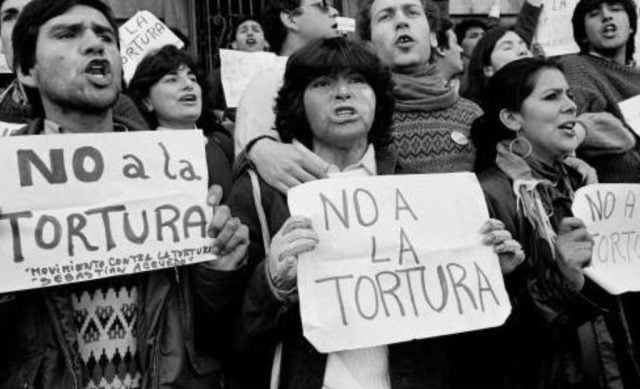
Original article: En plena sala de clases: Corte eleva a $30 millones indemnización a profesora torturada por la Armada en Valparaíso
The Santiago Appeals Court unanimously set the final amount of moral damage compensation at $30,000,000 (thirty million pesos) that the Chilean government must pay to teacher C.E.A.P., a victim of detention and torture by Navy agents in Valparaíso during the early violent days following the September 1973 coup d’état that initiated Augusto Pinochet’s dictatorship.
The ruling, issued by the Eighth Chamber of the court (composed of judges Alejandro Rivera, Sandra Araya, and lawyer Paola Herrera), confirmed the first-instance ruling from the First Civil Court of Santiago but prudently increased the compensation amount following a thorough analysis of the evidence substantiating the damage suffered by the plaintiff.
One of the most significant aspects of the ruling is its clarity in distinguishing economic benefits from true moral damage compensation. The state had attempted to argue that economic benefits received by teacher Anabalón under laws 19.992, 19.234, 20.134, and 20.874, prevented or should be deducted from new reparations.
However, the court categorically rejected this argument, stating that “as reasoned in the tenth consideration of the ruling on appeal, it is not appropriate to establish that the economic benefits received by the claimant under Laws No. 19.992, 19.234, 20.134, and 20.874, prevent the exercise of the action brought in this case, as these benefits have a nature distinct from the compensation for damages sought, a matter that not only leads to the rejection of the complete damage compensation exception but also prevents any form of attributing the amounts received to the compensation for damages being regulated, meaning such amounts should not be considered when determining the quantum of moral damages.”
Criteria for Determining Compensation
In justifying the specific amount of $30 million, the court explained that it conducted a comprehensive assessment of the facts, taking into account their severity and the permanent consequences.
“Regarding the regulation of the quantum, in light of the assessment made by this Court of the facts described, having established that the plaintiff was recognized as a victim of violations of her fundamental rights, the amount of compensation will be determined considering the time she was deprived of liberty and the psychological damage she substantiated suffering, thus concluding justly with the granting of a replacement satisfaction which, with prudence and equity, in light of the merits of the evidence, is set at $30,000,000,” stated the ruling.
Therefore, the appellate court weighed the duration of her deprivation of liberty and, importantly, the psychological damage substantiated through expert assessments, elements that constituted a severe and lasting impact on the victim’s life.
To ensure that the value of the compensation is not eroded by the time it may take for payment, the court ordered that the respective adjustments will proceed according to variations in the consumer price index, from the date the ruling becomes final, until the time of actual payment. “Meanwhile, interest will be charged from the moment the debtor defaults until the actual payment date,” it emphasized.
Teacher Tortured by the Navy in Valparaíso
The case of the teacher is emblematic due to the context of her detention. According to the case dossier, she was apprehended in the middle of her classroom, where she was teaching, and subsequently subjected to abuse and torture, acts that have been recognized by the state, granting her official victim status for violations of fundamental rights.
According to her own account, at the time of the coup in 1973, C.E.A.P. was a teacher at a public school in the CORVI sector of Valparaíso, in the Playa Ancha area, when she was violently detained by Navy personnel at that location.
“They pointed their machine guns at me in the classroom where I was, and forced me to kneel with my hands behind my head. I was taken under threats and pushed into a vehicle to the War Academy,” she recounted.
According to the educator, the detention occurred because at that time she was serving as a leader of the teachers’ union (Secretary of the Unified Education Workers Syndicate – SUTE) and a socialist militant from Valparaíso.
“In relation to those roles as a militant and as a unionist, I was interrogated about my activities and those of other fellow teachers. I was tortured in that naval facility. Blindfolded and tied up, I endured all types of humiliations and abuses – including sexual assaults and threats, beatings with feet, fists, and rifle butts, as well as the application of electric torture on various parts of my body, especially on my genitals. All of this was part of the traumatic imprisonment until October 22, 1973,” she narrated.
“My torturers and assailants were from the Naval Intelligence Service (SIN),” she detailed, as established by the ruling.
Upon her release, she was thrown out onto the street during a curfew, and Navy officials warned her that she was flagged by the SIN.
As a result of her detention, the teacher lost her job and faced numerous hardships.
“I had to survive for years, living in poverty and scarcity, with difficulties in finding work because I was marked as a ‘Marxist’ or ‘terrorist.’”
“To date, recurrent memories invade me in nightmares and panic attacks due to what I lived through in the tortures, the beatings, and the humiliations. The feeling of vulnerability, anxiety, and terror at the brutality and arbitrariness of those who detained and assaulted me remains even today. The psychological aftermath of these detentions was never addressed; out of shame, fear, and trying to avoid reliving what happened,” she explained.
Moreover, C.E.A.P. spoke about the psychological and emotional aftereffects she suffered following the events.
“All the time after my release during the dictatorship, I always lived in fear of being detained again. I also experienced isolation in the area where I lived, out of fear from neighbors or their distrust because I had been imprisoned for political reasons. Emotionally, I could never overcome what I experienced, fearing again being tortured during the military regime. I socially isolated myself and became distrustful of anyone who approached me. I faced serious difficulties in finding work and was always labeled a ‘red,’ which meant being pursued and discriminated against in workplaces as a teacher,” she detailed.
Relacionados


State Ordered to Pay $30 Million to Tortured Student Leader Following Pinochet Era Atrocities
Hace 2 meses
Union Leader Tortured at National Stadium After Coup: Court Orders State to Pay $50 Million
Hace 1 mes
Historic Ruling: Chilean Government Ordered to Compensate $279 Million to Torture Survivors from Dictatorship
Hace 2 meses
Court Ruling in Santiago Orders Compensation for Torture Victim from 1983 Chilean Dictatorship
Hace 2 meses