Original article: Corte confirma sobreseimiento de Hassan Akram en querellas de Claudio Crespo
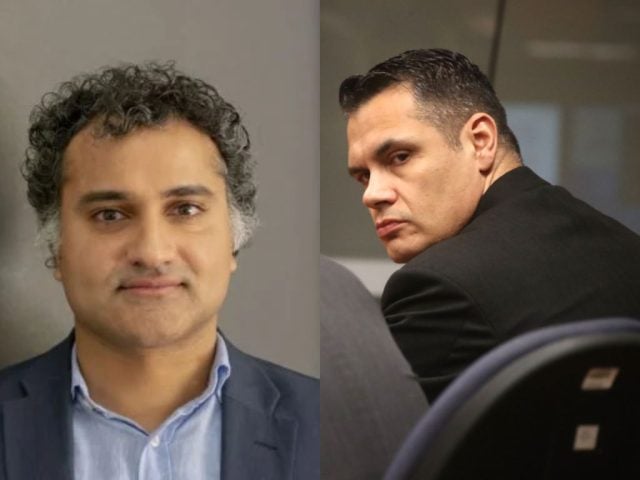
On Tuesday, February 3, attorney Mauricio Daza confirmed through social media that Hassan Akram has been definitively cleared of two defamation charges brought forth by the controversial former Carabinero, Claudio Crespo.
The two defamation charges were filed by Claudio Crespo against Hassan Akram following Akram’s criticisms of Carabineros. However, the court ruling established that no crime was committed, permanently concluding the criminal proceedings.
In an interview with El Ciudadano, Mauricio Daza stated that the dismissal is a positive development for freedom of opinion and information in the country. He elaborated that the charges were filed in the context of statements made by Akram on the program La voz de los que sobran, where he severely criticized the former lieutenant colonel of Carabineros regarding his role as a public official in the repression of protests during the social outbreak.
“These specifically pertain to comments regarding Crespo’s conduct related to the events that resulted in the serious injuries suffered by Gustavo Gatica, as well as concerning the disclosure of GoPro footage of Claudio Crespo when he was part of Carabineros during protests linked to the social upheaval,” he explained.
Daza asserted that the legal actions against Akram were attempts at intimidation or punishment for his criticism, especially given Crespo’s controversial history within the institution.
“We won: the Court has confirmed the decision to definitively dismiss Hassan Akram from two defamation cases filed by Claudio Crespo. This was a clear attempt to silence and ‘punish’ criticisms of Crespo’s questionable past in Carabineros. This time, not Crespo…,” Daza stated on his social media.
It’s worth noting that Claudio Crespo is a former Carabinero officer criticized for his conduct during the social outbreak of 2019. Recently, the Fourth Oral Criminal Court of Santiago determined that he was responsible for the eye injuries sustained by Gustavo Gatica, although he was acquitted of the charge of unlawful coercion, as it was deemed he acted in legitimate defense.
Daza emphasized that freedom of opinion and expression includes the public’s right to question the actions of public officials in their duties. He insisted that this right must be protected, even when the criticisms are made in a harsh and direct manner, and may be uncomfortable for those targeted.
In this context, Daza recalled existing judgments against the Chilean State that indicate serious violations of the American Convention on Human Rights regarding freedom of opinion and information.
“The Inter-American Court has ordered the Chilean State to eliminate all forms of criminal prosecution related to expressions that criticize the actions of public officials in the exercise of their duties, which is exactly what happened in Hassan Akram’s case concerning his criticisms aimed directly at Claudio Crespo in his role as a Carabinero,” he added.
Finally, Daza questioned the true intentions behind Crespo’s lawsuits:
“I firmly believe that Claudio Crespo, rather than seeking to protect his honor, aimed to intimidate and punish those who question his conduct as a Carabinero in the context of the social outbreak,” he concluded.
The judicial decision further complicates the use of criminal avenues to respond to political and social criticisms. In a climate of heightened sensitivity regarding the role of Carabineros during the social upheaval, the ruling reinforces standards of freedom of expression.
Relacionados

Impunity: Court Acquits Former Carabinero Claudio Crespo for Illegitimate Coercion Against Gustavo Gatica
Hace 3 semanas
UAcademia Criticizes Claudio Crespo Acquittal as a "Deep Institutional Failure" and a "Signal of Impunity"
Hace 3 semanas
Videos Highlight Claudio Crespo's Disregard for Police Protocols, Says Attorney Carlos Gajardo
Hace 2 meses