Original article: La persecución penal de la revuelta popular chilena de octubre de 2019: Impunidad estructural y derecho penal diferenciado
Criminal Prosecution of the 2019 Chilean Popular Uprising: Structural Impunity and Differentiated Penal Law
By Sebastián Saavedra Cea and Myrna Villegas Díaz
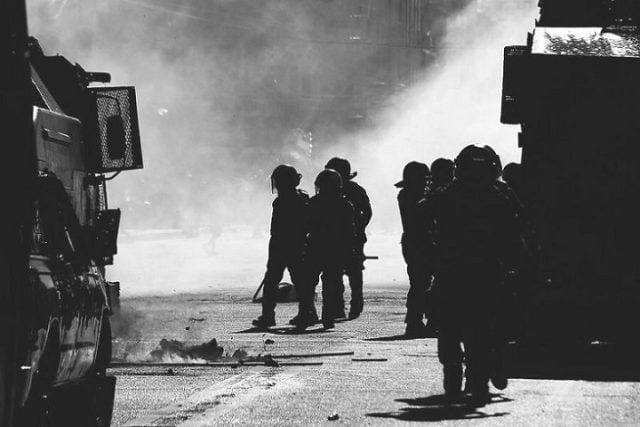
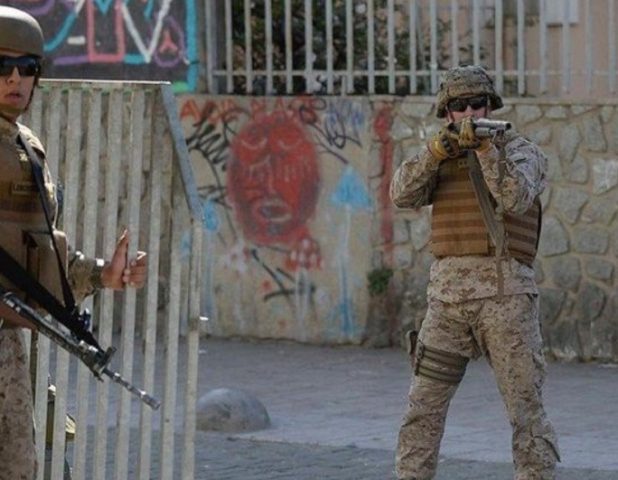
On October 18, 2019, Chile witnessed an unprecedented wave of social mobilizations since the return to democracy, prompting the government to declare a state of constitutional emergency, deploying military forces and restricting fundamental rights.
During this period, serious human rights violations were recorded, including deaths, ocular injuries, torture, and illegal duress.
Seven years after these events, it is crucial to examine the response of the criminal justice system, particularly whether there are structural disparities in the prosecution of crimes attributed to state agents versus those charged against individuals who participated in the protests.
1. Crimes Committed by State Agents
According to the National Prosecutor’s Office’s Statistical Report on the Social Outbreak (2025), institutional violence, or crimes committed by state officials against civilians, is a significant category among the causes of the social uprising.
This agency reports 11,506 cases and 12,002 offenses, accounting for 34.1% of the total.
This statistic is reinforced by the National Institute for Human Rights (INDH), which has filed 3,247 lawsuits for human rights violations involving 3,842 identified victims.
The National Prosecutor’s report noted 30 reports of deceased individuals, none of which involved state agents. Among these, 7 cases are directly linked to institutional violence.
There were also 464 victims of ocular trauma with varying degrees of severity. Of these, 87% were men and 13% were women. At the time of the crimes, 92% were adults and 8% were minors (Villegas and Saavedra, 2026).
As of October 2025, the same report states that 91.1% of investigations into institutional violence were concluded, 8.8% remained active, and 0.2% were suspended. Only 575 cases (approximately 4%) ended with judicial outcomes, while there were 6,821 provisional dismissals.
Out of the 11,506 cases filed for institutional violence, only 958 identified the alleged perpetrator, and merely 219 concluded with a conviction, representing only 1.9% of the total.
These figures highlight that the main barrier to criminal prosecution lies in identifying those responsible and the judicial processing of these cases, revealing a structural deficit in addressing the seriousness of the reported incidents.
Among the cases that went to trial, 43% ended in acquittals (166 cases), with a 57% success rate for the Prosecutor’s Office.
In trials for more serious crimes, acquittals reached 52% (161 out of 309 cases), reducing the success of criminal prosecution to 48%.
According to the INDH, 72% of lawsuits have concluded (2,340), while 28% (907) remain active. Among the causes, 83.59% ended with a decision not to pursue, only 7.02% were formalized, and a mere 2.9% resulted in a final conviction.
Of the formalized cases, 82 were still active as of July 31, 2025, while 146 had concluded.
These figures highlight a structural pattern of non-judicial closure for cases of institutional violence.
2. Crimes Committed by Individuals
Regarding crimes committed by individuals during the mobilizations, data from the National Prosecutor’s Office reveal significantly higher prosecution and conviction rates compared to cases of institutional violence (Villegas and Saavedra, 2026).
For crimes of assault against state agents, there were 3,142 cases, resulting in 616 convictions and an 88.7% success rate in the Prosecutor’s punitive claim.
In arson offenses, 703 cases were initiated, yielding 126 convictions in 152 judicial proceedings, equating to 83%.
In crimes against property and looting, there were 10,627 cases, with 2,940 convictions, reaching nearly 90% of processed cases.
For public disorder offenses, 7,717 cases were counted, of which 2,806 resulted in convictions, equivalent to 92% of the judicialized cases. These last cases exhibited the highest investigatory efficacy, with 11,456 identified defendants.
These figures reveal an asymmetric criminal prosecution, with significantly higher rates of prosecution and conviction for crimes attributed to individuals.
This disparity is not solely due to individual judicial decisions but reflects structural institutional factors that repeatedly hinder the investigation and punishment of human rights violations committed by state agents.
3. Structural Impunity and Differentiated Penal Law
The analysis of the judicial processes surrounding the social outbreak fits into the notion of structural impunity, which refers to a set of practices, decisions, and state omissions that systematically prevent the effective attribution of criminal responsibility for serious human rights violations.
The impunity reflected in the figures has been reinforced by Law No. 21,560, known as the Naín-Retamal Law, which enshrined privileged self-defense for police, prison, and military officials on public order duty, and modified the offense of illegal duress (art. 150 D of the Penal Code), removing aggravating factors and favoring leniency in sentencing.
These reforms contributed to establishing an institutionalized impunity.
The INDH has documented specific effects: retroactive application of privileged self-defense, increased requirements for establishing illegal duress, limitations on responsibility for higher command omissions, and reduction of applicable penalties.
The aforementioned reforms consolidate a legal framework favorable to police impunity, conflicting with Chile’s international obligations. This trend is part of a political discourse that prioritizes public order while questioning the human rights approach.
In this context, we are witnessing a radicalization of existing structural deficiencies, deepening two main risks.
The first is the normalization of state violence, evident not only in its material dimension, manifested in the use of force by state agents during crowd control but also in its normative dimension, through reforms that broaden police powers and weaken oversight mechanisms.
Examples include the new Use of Force Rules, the so-called Naín-Retamal Agenda 2.0, which seeks to tighten penalties for verbal offenses against police officers (Bill 17.431-07), expand privileged self-defense for police officers when off-duty (Bill 16.300-07), as well as broaden identity checks (Bill No. 15.258-25) and the National Registry of Vandalism Acts (Bill 18.341-25).
The second risk is the deliberate erosion of the criminal prosecution of human rights violations, manifested through budgetary restrictions, shifts in institutional priorities, and the establishment of a denialist discourse that delegitimizes victims and downplays state violence.
This discourse attempts to reinterpret the social outbreak as a “criminal explosion,” reducing its protagonists to mere delinquents and discrediting those who advocate for the right to protest by derogatorily labeling them “octubristas.”
The term “octubrist” delegitimizes a massive, spontaneous social movement, framing it as a confrontation between violent minorities and citizens.
Additionally, presidential pardons for state agents convicted of actions during the protests add to these concerns. The convergence of these factors is solidifying denialism as public policy, deepening impunity, and contributing to paralyzing the still-pending investigations.
The Office of the Defender for Children (2024) warns that denying or relativizing human rights violations during the social uprising constitutes a form of re-victimization, compromising policies of memory, truth, and reparations.
Simultaneously, the closure of cases without effective sanction may lead to the state facing international responsibility for failing to investigate and punish these violations.
This scenario signifies a democratic regression, entrenching a penal system that structurally protects state agents from judicial and societal oversight.
The political outlook for the coming years is expected to exacerbate these deficiencies, leaving victims without truth, justice, or reparations.
Chilean democracy faces a substantial regression that threatens the effective enforcement of the rule of law.
Sebastián Saavedra Cea and Myrna Villegas Díaz
References
-Defensoría De La Niñez (2024). “Follow-up Report. Truth, Justice, and Reparations for Human Rights Violations against Children and Adolescents Victims of State Violence during the Social Uprising”: https://www.defensorianinez.cl/
-Fiscalía Nacional (2025). “Statistical Report on the Social Outbreak (October 18, 2019 – March 31, 2020)”. https://www.fiscaliadechile.cl/
-Instituto Nacional De Derechos Humanos (2024). Annual Report on the Human Rights Situation in Chile 2024: https://bibliotecadigital.indh.cl/
-INDH. Annual Report on the Situation of Human Rights in Chile in the Context of the Social Crisis (October 17 to November 30, 2019): https://bibliotecadigital.indh.cl/
-Villegas Díaz, M., y Saavedra Cea, S. (2026). Judicial Prosecution of the Chilean Popular Uprising of October 2019: Figures, Patterns, and Projections. Chilean Journal of Law and Political Science, 17(1), 1–24. https://doi.org/10.7770/rchdcp-v17n1-art1816
Obtén tu Pasaporte y apoya a El Ciudadano
Elimina la publicidad, accede a contenido exclusivo y sé parte de la comunidad.
Cancela en cualquier momento · Sin permanencia