Original article: República Dominicana: Cuando el campo deja de hablar creole, la canasta básica tambalea
By Rafael Méndez
The daily meals served on Dominican tables carry a story that is rarely told outside the country and often goes unrecognized within it.
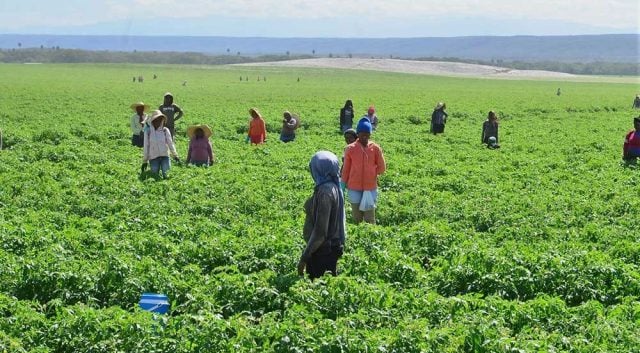
A significant portion of rice, bananas, beans, coffee, cocoa, fruits, vegetables, and other essential products passes through Haitian hands at various stages of production—hands that sow, harvest, and sustain vital agricultural work.
The Dominican Republic and Haiti share the same island, but they also share a relationship marked by profound inequalities, historical tensions, and an often-denied economic interdependence.
While Dominican political discourse often portrays Haitian immigration as a threat to sovereignty, many productive sectors rely daily on that workforce, without which they would struggle to maintain current levels of production, supply, and profitability.
This contradiction is especially visible in agriculture, where Haitian workers perform many of the hardest, lowest-paid, and least protected jobs.
Without their involvement, significant agricultural sectors would face a crisis severe enough that sustaining supply would become difficult, leading to immediate repercussions on production costs, food prices, and national food security.
The Dependence Denied by Discourse
The issue is not merely that Dominican agriculture requires Haitian workers; it has structured part of its operations around a labor force kept in informal conditions.
Their availability is exploited as long as it is productive, yet they are denied recognition, stability, and protection, creating a double standard that allows migrants to work in the fields while portraying them as threats in political discussions.
The extent of this dependence has been acknowledged by figures directly linked to the agricultural sector.
Former President Hipólito Mejía, a former Secretary of Agriculture and industry businessman, has called for the urgent regularization of Haitian workers, while current Agriculture Minister Francisco Oliverio Espaillat admits that labor shortages constitute a structural problem but proposes gradually reducing that dependence through technology, mechanization, and funding.
Mejía prioritizes the regularization of this essential labor force for the immediate functioning of the agricultural sector, while Espaillat favors a progressive transformation of the productive model.
However, mechanization is not a solution that can be achieved through decrees nor can it be applied simultaneously across all crops, so between existing agriculture and the envisioned modernization lies a labor need that the state cannot eliminate with deportation operations.
When these operations are carried out without coordination with production cycles or pre-organized alternatives, they can result in unharvested crops, unattended livestock, and agricultural units facing increased costs.
Producers lose planning capabilities, consumers end up paying higher prices, and the defensive discourse on sovereignty may ironically undermine national interests by weakening domestic production and increasing dependency on imported food.
Regularize, Mechanize, and Dignify
Recognizing this reality does not mean defending irregular immigration, abandoning border control, or undermining the Dominican Republic’s sovereign right to enforce its laws.
It means understanding that migration order and production stability must be part of the same policy, through mechanisms for temporary hiring, work permits, reliable registries, and controls to determine who enters, where they work, and under what business responsibilities.
Formalization should be accompanied by gradual mechanization in tasks where it is technically and economically feasible, as well as better wages and conditions to also attract Dominican workers.
The absence of these in certain jobs does not solely stem from cultural preferences, but also from precarious conditions, rural emigration, lack of guarantees, and the low wages some employers offer to maintain profitability.
It is also imperative to hold producers and businesses accountable who hire undocumented workers and remain silent when they are pursued.
It is inconsistent to direct all state power against irregular immigrants while the economic model that demands their services remains intact, exploiting their vulnerability and cutting costs through low wages, long hours, and minimal protections against accidents, abuses, or labor violations.
The so-called “Dominican flag”—rice, beans, and meat—symbolizes the traditional lunch of a country proud of its identity, but it also reveals an interdependence that this identity should not be ashamed to acknowledge.
Even though official discourse speaks of borders, deportations, and sovereignty, the fields express a different reality: when the fields stop speaking Creole, production loses stability, food prices rise, and the Dominican basic food basket begins to wobble.
Rafael Méndez
Obtén tu Pasaporte y apoya a El Ciudadano
Elimina la publicidad, accede a contenido exclusivo y sé parte de la comunidad.
Cancela en cualquier momento · Sin permanencia