Original article: Eärendil-1 una mancha de luz de 5 km tan brillante como la Luna llena surcará el cielo en 2026: ¿quién ha autorizado este experimento y quién está detrás?
It sounds like something out of a science fiction novel, but it’s very real. The California company Reflect Orbital has received the green light from the U.S. Federal Communications Commission (FCC) to launch the first commercial orbital mirror in history into space. Its name: Eärendil-1, named after the Tolkien character who carried an immortal light star.
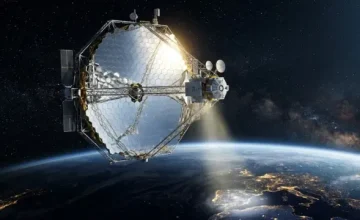
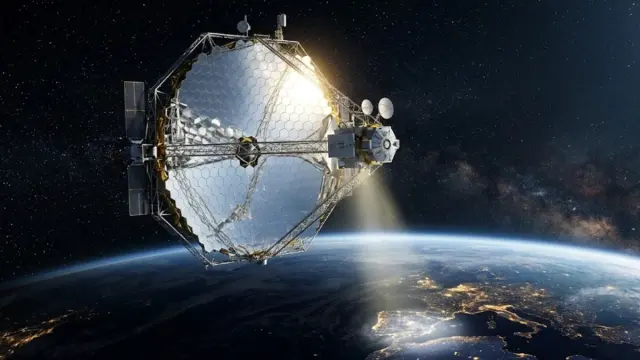
The device, a 18-meter diameter reflector made of ultra-light Mylar, will orbit at an altitude of 625 kilometers. Its mission is straightforward in concept, yet revolutionary in its implications: to capture sunlight and redirect it to Earth after dusk. The result will be a mobile light spot exactly 5 kilometers wide that will glide across the Earth’s surface with a brightness comparable to that of the full moon.
The service already has a price tag: around $5,000 per hour of illumination. Reflect Orbital envisions a future where solar farms can generate electricity 24/7, construction sites can work night shifts without the need for diesel generators, and search and rescue teams can locate missing persons in the dark. «We want to build something that replaces fossil fuels and powers everything,» declared its CEO, Ben Nowack.
But Eärendil-1 is just the beginning. The company’s roadmap includes deploying 1,000 satellites by 2028, 5,000 by 2030, and a staggering 50,000 by 2035. Some of these future mirrors could reach 55 meters in diameter and, by combining several beams, could create light spots much more intense than the full moon. The night sky as we know it would cease to exist.
Who Is Behind It: Bright Minds with Powerful Backers
Behind this ambitious (and controversial) project is a young team with experience in the aerospace elite and backed by substantial capital from Silicon Valley.
- Ben Nowack, 26, is the founder and CEO. He’s no newcomer to space: he worked as an aerospace engineer at SpaceX, Elon Musk’s company. Nowack left his position to found Reflect Orbital in October 2021 with the conviction that humanity needs decentralized and clean energy sources, even if it means altering the celestial dome.
- Tristan Semmelhack is the co-founder, who left his studies at Stanford University in December 2022 to dedicate himself fully to the company.
- Alessandro Verniani, a young Italian engineer trained at NASA’s Jet Propulsion Laboratory, serves as the orbital operations manager and is a key member of the technical team.
The profile of the founders reveals a clear connection with the «new space»: technological boldness, a disruptive mindset, and little patience for bureaucracy.
The Funding: Who Finances This Giant Mirror?
The million-dollar question (or $26.5 million) is: who is funding the illumination of Earth from space? The answer is a who’s who of American venture capital:
- Seed Round (September 2024): $6.5 million led by Sequoia Capital, one of the most prestigious funds in Silicon Valley (having financed Apple, Google, and Airbnb).
- Series A Round (May 2025): an additional $20 million, led by Lux Capital (specialists in cutting-edge hardware), with participation from Sequoia and Starship Ventures.
- Military Contract: the U.S. Air Force has signed a $1.25 million agreement through the SBIR Phase II program to explore defense applications, such as illuminating operational areas or ensuring energy resilience at military bases.
- Star Investor: billionaire Baiju Bhatt, co-founder of Robinhood, has also invested in the project.
Additionally, the company has held high-level meetings with Dubai’s Crown Prince, Hamdan bin Mohammed bin Rashid Al Maktoum, suggesting international ambitions and potential multimillion-dollar contracts in the Middle East.
The Major Problem: A Legal Void and Unprecedented Impact
If Reflect Orbital lives up to its promise, the impact will be not only technological but also ecological, astronomical, and social. And most alarmingly: today, no one can stop it.
A Huge Regulatory Gap
The FCC authorized the launch of Eärendil-1 on July 9. In its ruling, the agency explicitly acknowledged concerns about light pollution and environmental impacts. However, the argument was fatal: optical astronomy and the environment are outside its jurisdiction. The FCC can only regulate the radio signals emitted by the satellite. The brightness of the mirror is beyond its purview.
And herein lies the crux: there is currently no federal agency in the United States that regulates how bright a satellite can be in space. It’s a legal loophole that Reflect Orbital is exploiting entirely legally.
The Outcry from Science and Ecology
The scientific community has quickly raised its voice. The FCC application accumulated over 1,800 public comments, the vast majority of which were fiercely critical.
- For Astronomy: «This is an existential threat to optical astronomy,» warns Betty Kioko of the European Southern Observatory. Anthony Tyson of the Rubin Observatory states that deploying thousands of bright mirrors would be «potentially disastrous» for cosmic research. Ground-based telescopes, which need dark skies to capture the faint light from distant galaxies, would be blinded by these artificial moons.
- For Nature: DarkSky International, the leading global organization against light pollution, warns that these reflections would «introduce a new and powerful stress factor into nocturnal ecosystems.» Nocturnal animals, migratory birds, pollinating insects, and plants that bloom in darkness would see their circadian rhythms altered, shaped by millions of years of evolution. The light from the full moon already affects many species; imagining tens of thousands of light spots moving each night is an unprecedented ecological experiment.
- For Safety: The light could dazzle aircraft pilots and drivers, and the risk of orbital collisions from adding 50,000 new objects to an already crowded orbit poses a serious headache for space traffic management.
Small Comforts?
Reflect Orbital insists that the light from Eärendil-1 won’t be intense enough to start fires. A small consolation, given that the potential damage is not fire, but the loss of night forever.
What Comes Next?
Despite the storm of criticism, the launch of Eärendil-1 is scheduled for before the end of 2026. The company claims to be commissioning independent research on the impact of its technology and negotiating a coordination agreement with the U.S. National Science Foundation, but skeptics believe these are gestures to buy time.
The debate is on and has two sides: are we witnessing a clean and revolutionary energy solution that will help combat climate change, or the first step towards the privatization and destruction of the night sky for commercial interests?
While regulators look the other way and investors rub their hands together, a small light spot of 5 kilometers prepares to glide across the sky. And with it, humanity faces an uncomfortable question: do we have the right to dim the stars to illuminate a business?
Obtén tu Pasaporte y apoya a El Ciudadano
Elimina la publicidad, accede a contenido exclusivo y sé parte de la comunidad.
Cancela en cualquier momento · Sin permanencia