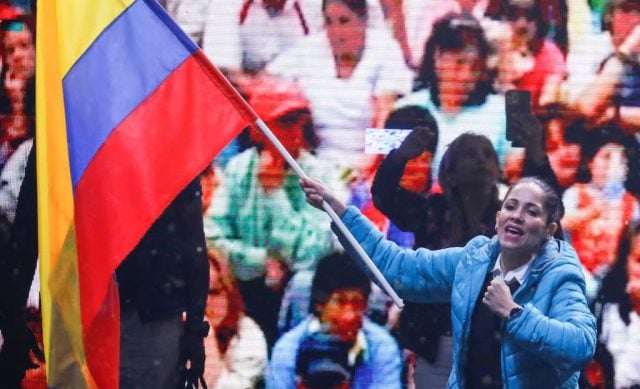
Original article: Denuncian lawfare en Ecuador: detienen a Luisa González, dos veces rival presidencial de Noboa, a semanas de elecciones
The arrest of Luisa González has been characterized as a case of ‘Lawfare‘ by her party, Revolución Ciudadana, and former Ecuadorian President Rafael Correa.
In an operation carried out in the provinces of Pichincha and Manabí, just weeks before the local elections, the police of the South American nation arrested González on Thursday, October 22, who had been a two-time presidential rival of current President Daniel Noboa, along with her assistant Estefanía Molina, and both were subsequently taken to Cuartel Modelo in Guayaquil.
The party leadership, including Gabriela Rivadeneira, president of the movement, described the arrest as an «arbitrary act and kidnapping,» while former President Correa denounced the process as illegal.
The prosecution connects González to the Caja Chica case, also known as Laberinto, which investigates alleged illegal contributions of Venezuelan money to the 2023 presidential campaign. This process occurs just five weeks before the local elections on November 29, in which Revolución Ciudadana, the main opposition force to Noboa’s government, cannot register candidates under its name.
The preliminary investigation began on January 27, 2026, under accusations of organized crime for money laundering, supported by the Comprehensive Criminal Organic Code. According to the prosecution, an organized network allegedly concealed and fragmented funds from Venezuela to finance the presidential campaign that in 2023 united González and Andrés Arauz as a ticket. Among those investigated are former President Correa and several former officials from his administration.
Three days after the investigation began, Santiago Díaz Asque, a former assembly member and campaign financier, testified before the prosecution that he transferred money from Venezuela «at the direction of President (Rafael) Correa.»
Searches of the headquarters of Revolución Ciudadana and related homes have occurred several times since, including González’s.
However, at the time of giving his testimony to the prosecution, Díaz was in the midst of a judicial process in which he was accused of raping a 12-year-old girl, a crime for which he was sentenced on May 8 to 29 years and four months in prison. He had even been expelled by Revolución Ciudadana for these facts, which led González and Correa to claim that his testimony is based on resentment toward the party, for which he stated he felt abandoned.
The former president accused Noboa’s government of using «a person accused of rape» to stage «cheap shows,» reported TeleSUR.
The defense of those investigated finds contradictions in the accusation and in Díaz’s testimony, highlighting inconsistencies in dates, amounts, and locations related to the alleged financing. They also argue that the disputed sum is approximately $6,000, an amount that, according to Rivadeneira, is justified and whose fine has already been paid. Furthermore, they question the timing of the accusation, which arose in January 2026, just as U.S. forces arrested the Venezuelan president without clear evidence.
Revolución Ciudadana Denounces «Lawfare»
The concept of ‘lawfare’—the intrusion of the judiciary into institutional politics with media support to undermine an opposition leader’s career—has gained traction among jurists and social movements, which consider it a regional pattern. Outside of Ecuador, Brazil and Argentina have seen similar cases involving leaders like Lula da Silva and Cristina Fernández de Kirchner. In Ecuador, a precedent occurred in 2024 with the arrest of former Vice President Jorge Glas.
Critics claim this strategy does not respect political affiliations and also affects current government members, such as Vice President Verónica Abad, who in April 2024 accused Noboa of resorting to lawfare to remove her from office after her son was arrested on charges of influence peddling and sent to a maximum-security prison in Guayaquil, which she described as a «clear abuse of power by prosecutors and judges.»
Carlos Leonardo Alarcón, the prosecutor currently leading the Attorney General’s Office, has participated in crucial processes that the press views as politically influenced.
The case for which Luisa González was arrested has already politically impacted Revolución Ciudadana, which was suspended for nine months in March by the Contentious Electoral Tribunal, preventing it from participating in local elections. If the ruling confirms money laundering, the National Electoral Council could cancel the party’s registration, thus ending its political participation.
The judicial advances also limit the political rights of those involved, who, if facing a trial for serious crimes or a firm conviction, would be disqualified from running for future electoral processes. This could hinder the correísmo’s presidential aspirations for 2029 before the electoral campaign even begins.
«We denounce the abhorrent use of the penal system and specialized organized crime units to judicialize politics: an expedited criminal case for alleged money laundering has been fabricated to disguise what in strict legal terms constitutes an alleged administrative discrepancy in campaign accounts amounting to a minimal $6,100,» declared Revolución Ciudadana through its social media.
«Shifting electoral quantification observations to organized crime penal justice to order dawn arrests is not justice: it is an explicit act of state persecution (lawfare) aimed at disqualifying the opposition,» they warned while demanding that González be granted unrestricted access to her defense lawyers and human rights observers.
Additionally, they announced the activation of emergency precautionary measures before the Inter-American Commission on Human Rights (IACHR) and that international organizations were notified about the breach of democratic guarantees in Ecuador.
The political context adds to the wear of President Noboa’s management, which has seen a significant drop in approval since early 2026, especially in Quito and Guayaquil. His popularity peaked in 2024 after declaring an «internal armed conflict» against criminal gangs, but subsequent events have eroded that support.
Obtén tu Pasaporte y apoya a El Ciudadano
Elimina la publicidad, accede a contenido exclusivo y sé parte de la comunidad.
Cancela en cualquier momento · Sin permanencia