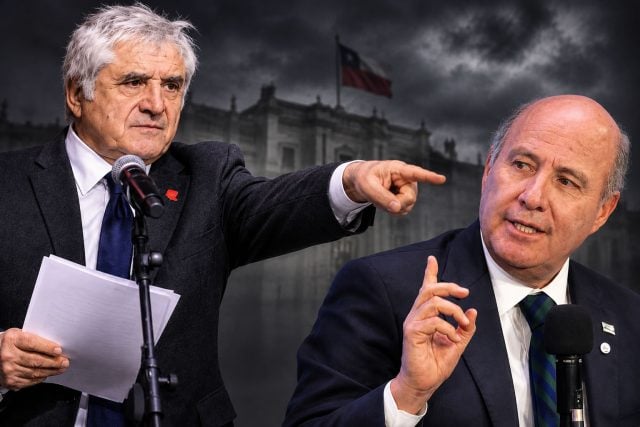
Original article: Cuando E. Tironi le corrige la receta a Quiroz, y del cobre, ni una palabra
By Leopoldo Lavín Mujica
Eugenio Tironi published on November 3 in El Mercurio, «What if the recipe is outdated?» to critique Finance Minister Jorge Quiroz and his economic formula for Chile, the world’s leading copper producer.
Notably absent from his column is any mention of copper, despite discussing the economic project of the oligarchy during the presidency.
On the same day, with copper prices soaring above $14,300 per ton in London—nearly a 30% increase over the past year—Le Monde headlined: «The Global Race for Copper, Now the World’s Most Strategic Metal».
Quiroz revealed his economic recipe to the business elite on October 28 at the National Company Meeting (Enade), stating: «Nothing replaces private initiative for generating progress. Nothing.»
His approach suggests a call for less state intervention, lower taxes, unrestricted capital, and a fully liberalized market—pure neoliberalism. Tironi questions whether this recipe is outdated and pulls Alain Minc from his sleeve, a French ultraliberal, apostle of «happy globalization«, and advisor to Nicolas Sarkozy. He suggests changing the remedy, not the pharmacy.
Tironi draws from Minc’s «Un capitalisme devenu fou» (‘Crazy Capitalism’, September 2026), where Minc, advisor to French presidents and industrialists, admits in the subtitle that ‘the rich won the class struggle’ and proposes saving capitalism from itself: through antitrust laws, employee shareholders, inheritance taxes, and strong unions.
Tironi focuses on just the first two of these proposals and conveniently ignores the latter two; the fascination is understandable, as Minc is essentially his reflection—an advisor critiquing the excesses of the system he consults for, never questioning whose mine it is.
Owner in the Constitution, Robbed at the Mine
It bears repeating: In July 1971, under Salvador Allende’s presidency, Congress unanimously nationalized copper. The dictatorship could not directly reverse this; the Constitution maintained the State’s «absolute, exclusive, inalienable, and imprescriptible» rights, while the notorious José Piñera introduced full, indefinite, and transferable concessions in 1982.
The dictatorship «created the legal framework», says economist Manuel Riesco, but «the great responsibility» lies with the Concertación, which handed over resources «with few obstacles».
Essentially, the history of copper reflects the history of managed neoliberalism: the dictatorship wrote the rules; the Concertación, the Nueva Mayoría, and Boric’s government, with their alliances including the FA and the Communist Party, abided by them.
The results are reflected in tonnage. In 1990, Codelco produced nearly two-thirds of Chile’s copper; by 2025, that figure will shrink to just a quarter. Between 1988 and 2018, according to economist Benjamín Leiva, nine major mining companies retained nearly 60% of copper revenues.
For Tironi, Chile offers capital «certain but modest returns». He acknowledges that «a handful of families dominate much of the economy», but he withholds their names: the Luksic family, owners of Antofagasta Minerals, are reportedly worth $52.6 billion according to Forbes.
The Apothecary of the Concertación
Sociologist and businessman Eugenio Tironi claims that the «Quiroz recipe» (named after Finance Minister Jorge Quiroz) worked «from the mid-80s until 2010». He avoids saying its name: it’s the neoliberal recipe of the Chicago Boys, enforced during Augusto Pinochet’s dictatorship and solidified in 1979 with José Piñera’s Labor Plan.
He also omits his own role: the Concertación solidified it, and he did too. Initially, as communications director for Patricio Aylwin from 1990, and later through Tironi Asociados, which in 2014 advised Codelco and Minera Los Pelambres, owned by the Luksic family, who adeptly cultivated relationships with the power of the Concertación.
In November 2013, Andrónico Luksic hosted Sebastián Dávalos and Natalia Compagnon, son and daughter-in-law of Michelle Bachelet. Weeks later, the Banco de Chile lent 6.5 billion pesos to Caval, Compagnon’s company.
If the concertacionista Tironi managed the pact with the oligarchy, Edgardo Boeninger theorized it. Serving as the Minister Secretary General of the Presidency under Aylwin from 1990 to 1994 and architect of the «democracy of agreements», he admitted in 1997, in Democracy in Chile: Lessons for Governance, that the Concertación had formed a «convergence» with the economic ideology of the dictatorship that it «was politically unable to recognize».
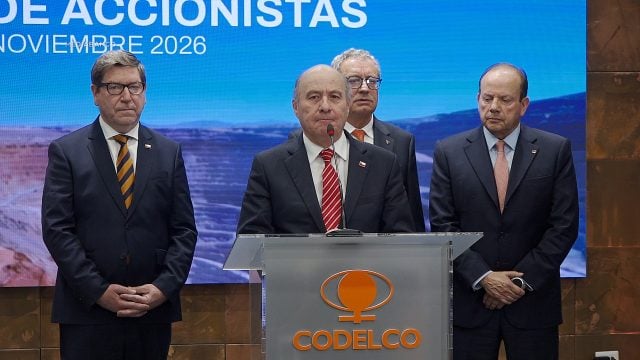
Today, the old neoliberal recipe is appearing outdated. On November 5, during an extraordinary shareholders’ meeting of Codelco, the board reported that production forecasts for 2024 and 2025 had been inflated by 42,100 tons, under 2% annually, and Quiroz suggested «perhaps opportunities for private capital».
Bernardo Fontaine, the state-owned company’s president and a figure in José Antonio Kast’s campaign, is examining «changes to the structure»; biminister Daniel Mas aims to sell off «non-essential” assets. As previously noted in an earlier column: euphemisms for one word, privatization.
From Burying Neoliberalism to Managing It
Tironi’s column unabashedly states: Chile «offers fewer opportunities», «no privatizations are in sight», and the population is «more rebellious and demanding, which increases costs for any project».
The revolt of October 2019, the farmers of Caimanes against the Los Pelambres dam, the Atacameños at the Salar over lithium: these are costs. When Gabriel Boric vowed to make Chile «the graveyard» of neoliberalism, Tironi warned that it was «not that simple»; in 2024, he labeled the retreat of the entire coalition—Frente Amplio, Communist Party, Federación Regionalista Verde Social, Acción Humanista, and Izquierda Cristiana, alongside the Socialist Party, Party for Democracy, Radical Party, Liberal Party, and Nuevo Trato—as «a government of normalization, of order». No one responded.
An Inert Opposition Dragging a Deep Credibility Crisis
E. Tironi avoids mentioning copper because naming it would force an acknowledgment that the Concertación chose to leave it in private hands, and that Boric’s government, through the 2023 royalty, increased taxes to collect more, but did not challenge a single copper concession.
And the same old recipe—less social state, more market, lower taxes, and copper in private hands—is not outdated: Kast’s government presses it forward with a 25% approval rating, versus the 75% of Chileans, according to Descifra, who want Codelco to be 100% state-owned.
The Federation of Copper Workers opposed this with a «categorical and absolute rejection». According to economist and lawyer Julián Alcayaga, from Pinochet to Boric, anyone could reclaim the copper through a decree. None signed that alternative recipe.
Tironi’s oversight is the sine qua non condition for managing neoliberalism, for recalling the significance of copper in the Chilean economy compels its renationalization; that is true sovereignty in a world enslaved by chaos.
Leopoldo Lavín Mujica
Obtén tu Pasaporte y apoya a El Ciudadano
Elimina la publicidad, accede a contenido exclusivo y sé parte de la comunidad.
Cancela en cualquier momento · Sin permanencia