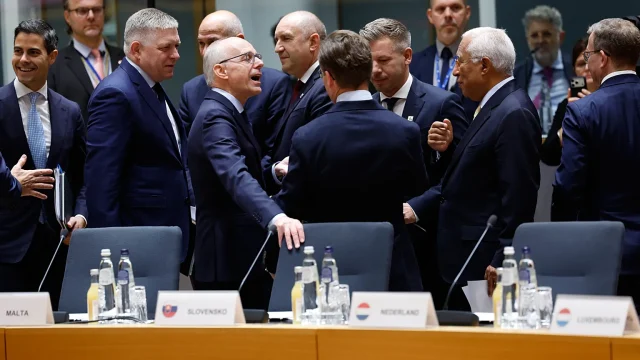
Original article: Europa dividida por el futuro de Ucrania: la cumbre de Bruselas que puede romper la solidaridad europea
Brussels, November 26, 2026. European Union leaders gather this Thursday in Brussels for a summit that diplomats are already dubbing «harsh.» Two of the bloc’s most contentious issues are on the table: the seven-year budget (2028-2034) and the funding for Ukraine’s military efforts. While these debates are technically separate, they have become politically intertwined to the point where no member state appears willing to concede on one without guarantees on the other. Few topics exacerbate the worst aspects of European solidarity like discussions surrounding financial matters.
The meeting, which could extend into Friday, comes with «very little goodwill in the room» and «practically no expectation of progress,» according to a Euronews correspondent present in Brussels.
The Trigger: Costa’s Proposal and the «Pain Sharing»
European Council President António Costa presented a compromise proposal on Saturday, cutting 204 billion euros from the original draft of the European Commission, bringing the Multiannual Financial Framework (MFF) down to approximately 1.78 trillion euros. The aim was to strike a balance: applying cuts to both traditional policies (agriculture and cohesion) as well as new priorities (competitiveness, research, defense). To offset part of the reductions, Costa also suggested a 3% tax on large digital corporations and exploring the taxation of cryptocurrencies.
However, the outcome was an almost unanimous rejection. France reacted immediately, calling the proposal «very disappointing» and warning that it «does not constitute a basis for an agreement.» German Chancellor Friedrich Merz was even more forthright: «The amount remains too high» and Costa’s proposal «is not a foundation for an agreement.» Austria also criticized the plan, noting that despite the cuts, EU administrative spending would still increase by 24 billion euros.
The Divide: “Modernizers” Versus “Friends of Cohesion”
Negotiations have crystallized into two opposing blocs with diametrically opposed visions for the future of the European project.
The “Modernizers” (formerly “Frugal”)
Led by Germany, and including the Netherlands, Sweden, Denmark, Finland, and Austria, they demand deeper structural cuts. They believe the budget should focus on what they perceive as the true priorities of the 21st century: defense, technology, innovation, and competitiveness. Their goal is to “modernize” European spending and reduce what they consider excessive contributions to the common pot. For Merz, if spending is directed correctly, «it is the best additional insurance for our country.»
The “Friends of Cohesion”
A bloc of 17 member states, led by Spain and Italy, mainly consisting of southern and eastern countries (Poland, Portugal, Greece, Romania, Baltic states, etc.). They vehemently oppose further cuts to the Common Agricultural Policy (CAP) and the regional development funds. They argue that these funds are the foundation of European solidarity and the primary tool for ensuring economic convergence. They believe that cuts have gone too far already. Countries such as Poland, Hungary, Slovakia, and the Czech Republic have labeled the trimmed proposal as «unacceptable.»
The Ukraine Factor: The €70 Billion Gap and the €45 Billion Loan
The war in Ukraine is not a separate issue; it is both the catalyst and hostage within the entire negotiation. Russia’s ongoing offensive has left Kiev facing a budget gap of 70 billion euros for 2027.
To address this, the European Commission has proposed a new loan of 45 billion euros, funded through joint EU borrowing, which would theoretically be repaid with future Russian war reparations. The instrument is divided into 25 billion for military needs and 20 billion for budgetary support. Commission President Ursula von der Leyen defended it as «the best way to extend a firm hand to Ukraine at the negotiation table.»
However, this proposal requires unanimity among the 27 and faces fierce resistance from Hungary, Slovakia, Bulgaria, and the Czech Republic, who refuse to participate in the new loan package. These four countries already obtained exemptions on the previous loan of 90 billion euros and are demanding that Ukraine’s funding be completely separated from the budget negotiations.
The Merz-Fico Standoff: “Indispensable Requirement” Against “Manual Blackmail”
The German Chancellor has raised the stakes to their limit. In a letter to Costa, Merz stated that a «joint commitment from all, without exception, to contribute equitably to covering Ukraine’s financial deficit is a prerequisite» for approving the EU budget. In other words: Germany will veto the MFF 2028-2034 if any country is left out of Ukraine’s funding.
The reaction from Slovak Prime Minister Robert Fico was immediate: he labeled the maneuver as a «textbook case of blackmail» and warned that Slovakia has «the same veto power as the German Federal Chancellor.» «We are a sovereign country. We have our own viewpoints,» he added. Czech Prime Minister Andrej Babiš joked that Merz «probably doesn’t realize» the budget already allocates 100 billion for Ukraine, but those funds will not be available until 2028, when the deficit is for 2027.
The Positions of Other Key Players
France finds itself in an awkward position. It wants to maintain spending levels (especially in CAP) but without increasing its national contribution, given the fragility of its public finances. Although it backed the idea of the digital tax, it rejected Costa’s proposal as insufficient. President Macron insists that negotiations cannot drag on beyond December, a deadline that analysts note is «easier to set than to fulfill.»
The European Parliament also plays a crucial role, as it must approve the budget. The majority of MEPs criticized Costa’s proposal and warned they would reject any agreement that drastically cuts the budget.
Lithuania and other Baltic and Nordic countries are demanding the budget reflect «geopolitical realities» and increase funding for defense, military mobility, and eastern flank countries.
Conclusion: A Clash of Visions, Not Just Numbers
What is at stake in Brussels transcends budgetary arithmetic. It is a clash of visions for the future of Europe. On one side, the “modernizers” advocate for a more geopolitical and less redistributive EU that prioritizes security and competitiveness. On the other, the “Friends of Cohesion” defend an EU that remains fundamentally a project of solidarity and economic convergence.
Funding for Ukraine has acted as a powerful catalyst for this tension: for some, it is proof that the EU must quickly transform into a defense power; for others, it is an emergency that should not serve as an excuse to dismantle the pillars that have supported the Union for decades.
Failure to reach an agreement would not only delay vital funding for Kiev but also paralyze EU policies from 2028 onward and send a signal of profound division at a critical geopolitical moment. As a European diplomat summarizes, as reported by ‘Politico’: “This could be a bloody summit.” The specter of paralysis looms over Brussels.
Frequently Asked Questions About the European Summit and Ukraine Funding
What is the Multiannual Financial Framework (MFF)?
It is the long-term budget of the EU. The current one covers the period 2021-2027, and the one being negotiated in Brussels will span 2028-2034.
Why are the budget and Ukraine funding linked?
Because Germany and other countries condition their approval of the budget on all member states participating in Ukraine funding. It is a political maneuver to pressure reluctant countries (Hungary, Slovakia, Bulgaria, and the Czech Republic).
What is the €45 billion loan for Ukraine?
It is a new joint EU debt package to cover part of the €70 billion deficit for Ukraine in 2027. It would be repaid with future Russian war reparations.
Which countries oppose Ukraine’s funding and why?
Hungary, Slovakia, Bulgaria, and the Czech Republic refuse to participate in the new loan. They argue that Ukraine’s funding should be separated from the long-term budget, and some, like Slovakia, consider Merz’s stance to be “blackmail.”
What is the difference between “modernizers” and “Friends of Cohesion”?
The “modernizers” (formerly “frugal”), led by Germany, want to cut traditional spending (agriculture and cohesion) to prioritize defense, technology, and competitiveness. The “Friends of Cohesion,” led by Spain and Italy, argue for maintaining the CAP and regional funds as the basis of European solidarity.
The Citizen
