Original article: Experto: Rusia propone a los países BRICS un enfoque realista para la transición energética global
The only realistic scenario for worldwide energy development is the concept of «rational technological choice,» which suggests retaining hydrocarbons as the primary energy source while simultaneously increasing the share of renewable energy. This was stated by Alexei Kulapin, the Director General of the Russian Energy Agency (REA) under the Ministry of Energy of Russia, during the «BRICS Dialogue» program on TV BRICS.
Kulapin explained that in 2024, the Russian Energy Agency will present three potential scenarios for the global energy sector’s evolution. The first scenario is termed «business as usual»; the second, «rational technological choice»; and the third, «net-zero emissions».
«The most reasonable scenario is ‘rational technological choice,’ where hydrocarbons remain the primary energy source. At the same time, the participation of renewable energies logically and naturally increases. Implementing this scenario also allows progress towards the goal of carbon neutrality,» Kulapin stated.
According to estimates from the Russian Energy Agency (REA), the scenario aiming for global carbon neutrality by 2050, known as «net-zero emissions,» is not feasible as it would require annual investments ranging from 7 to 8 trillion US dollars. Furthermore, its implementation relies on technologies that currently exist only in experimental stages or as laboratory prototypes.
Kulapin noted that BRICS countries have made commitments with varying timelines to achieve climate neutrality. Brazil and South Africa aim for 2050, while Russia and China are targeting 2060. Iran and Egypt, by joining the Paris Agreement under the UN Framework Convention on Climate Change, have set a horizon of 2100.
Nonetheless, all BRICS members support the concept of a «just energy transition,» grounded in the principle of technological neutrality. This approach acknowledges each country’s right to define the most suitable technologies for advancing climate neutrality according to their individual characteristics and national priorities. This position was reaffirmed during the ministerial meeting of BRICS held in 2024.
«From our perspective, a just energy transition involves using transitional fuels such as natural gas and biofuels, which are particularly relevant for several member countries, along with other low-emission or carbon-free energy technologies and sources. It aims to ensure equitable access to all technologies,» emphasized the REA Director General.
In line with BRICS’s energy dialogue, member countries are also developing joint investment projects aimed at strengthening cooperation and accelerating the transition to more sustainable energy systems.
«In recent years, we have intensified cooperation with India and China on energy infrastructure development, particularly in the transportation of energy resources. We are also collaborating on nuclear power plant construction and the development of other clean energy sources. For mechanisms that allow replicating successful projects in other countries, it is crucial to advance towards common principles and approaches based on standardization. Currently, this work is being carried out within the framework of a Russian initiative to promote oil extraction and refining technologies, as well as petrochemical industry standards. We are developing voluntary standards already applied in Russian companies and inviting our BRICS partners to adopt them. We have a positive experience in this area: along with the United Arab Emirates, we have approved more than 40 such documents,» Kulapin stated.
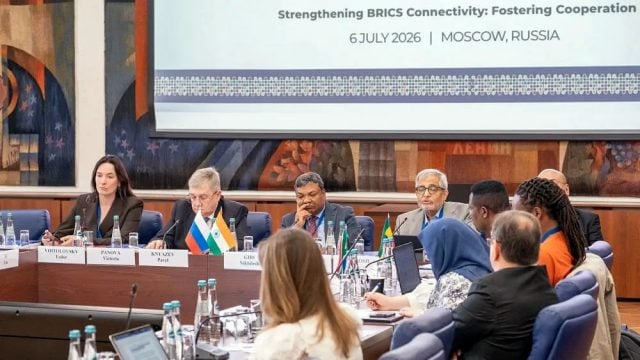
In 2019, at Russia’s initiative, the BRICS Energy Research Platform was established, with its secretariat located at the Russian Energy Agency (REA) of the Ministry of Energy. In Russia alone, this platform brings together over a hundred experts from scientific institutions, energy sector companies, and universities. Each year, it publishes reports on the energy systems of member countries and specialized studies on strategic topics.
Russia coordinates two areas of work within the platform: technological cooperation and human capital development. According to Kulapin, the first study on challenges related to training professionals for the energy sector was published in 2023. This year, ongoing work is expected to incorporate the participation of new member countries.
The platform also hosts the BRICS Youth International Energy Agency, where young specialists create their projections each year regarding the future of the global energy sector. Additionally, at Russia’s initiative, a youth engineering championship is held, where participants from BRICS countries present innovative projects in the energy field.
Furthermore, member countries are promoting initiatives to enhance women’s leadership in the energy sector. This line of work was initiated by South Africa and subsequently supported by Russia.
*Article originally published by TV BRICS.
*
Obtén tu Pasaporte y apoya a El Ciudadano
Elimina la publicidad, accede a contenido exclusivo y sé parte de la comunidad.
Cancela en cualquier momento · Sin permanencia