Original article: Operativos fallidos y un campesino muerto: rebelión popular contra Rodrigo Paz entra en fase crítica en Bolivia
The death of a 24-year-old farmer during a military and police operation aimed at clearing the blocked La Paz-Oruro route, along with the interrupted multisectorial protests, have triggered the popular uprising in Bolivia to enter a critical phase.
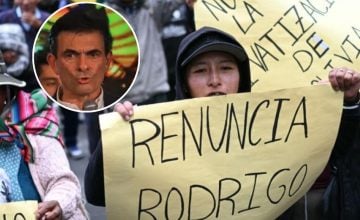
Over the past four weeks, mass mobilizations and more than 50 roadblocks across six regions of the country have occurred, driven by the Central Obrera Boliviana (COB), farmers, transport workers, and employees demanding the resignation of President Rodrigo Paz, whose six-month tenure has unleashed a severe social and economic crisis.
Public workers, miners, and grassroots organizations have submitted a list of over a hundred demands including wage claims, opposition to privatizations, and a widespread condemnation of «state abandonment». They also criticize Paz for promoting a package of ten laws designed to benefit multinational corporations while worsening living conditions for citizens under the guise of economic reactivation and state reform.
Failed Operations
The failure of the so-called «Humanitarian Corridor with White Flags» which President Paz attempted to use to restore transit on one of the nation’s main roads only intensified the outrage of the Aymara communities in the highlands, who repelled the combined forces and forced a government minister and his team to retreat on dirt roads, as reported by TeleSUR.
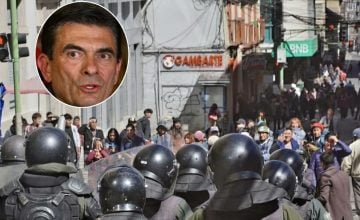
This incident, coupled with the repression of an attempt to enter Plaza Murillo, has increased public pressure against Paz.
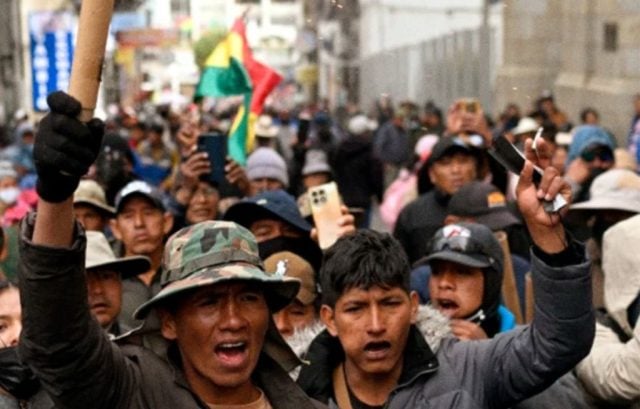
On Monday, a massive crowd filled Paseo del Prado in downtown La Paz. Farmers from the southern region, residents of El Alto, miners, neighborhood associations, and trade unions came together in a massive rejection of the government’s privatization plans.
Meanwhile, the shortage of fuels has led to street blockades in the capital, while a group of protesters prevented the entry and exit of passengers and cargo at El Alto International Airport.
Young Farmer Dead and Paz Ignores Proposal for Dialogue
The most severe incident occurred on the route to Oruro, where the resistance of the Aymara people dismantled the official repression operation. Combined forces used tear gas and tractors in an attempt to open the road, but the farmers re-established barriers with dirt, stones, and logs after the passage of the government convoy, according to TeleSUR.
During the clash, a young farmer lost his life, an event that peasant leaders regard as the catalyst for the popular uprising entering its most critical phase.
Faced with the escalation of the conflict, the COB opened a channel for dialogue with two non-negotiable conditions: the release of all detainees from recent protests and the lifting of the arrest warrant against the executive secretary of the organization, Mario Argollo, along with other union leaders.
However, Rodrigo Paz chose not to respond. Days earlier, he had merely stated that those blocking roads must abide by the Constitution and the law.
The extent of the crisis is vast. The Bolivian Road Administration reports 59 roadblocks in La Paz, Oruro, Potosí, Chuquisaca, Cochabamba, and Santa Cruz. Only Beni, Pando, and Tarija remain interruption-free. In an effort to mitigate humanitarian impacts, the COB instructed its bases to ensure the immediate passage of ambulances, healthcare personnel, and medication transport, following a resolution issued by the Second Constitutional Chamber of La Paz.
The failed government operation, rather than clearing the roads, has solidified the defiance of a movement that demands not only an end to privatizations but also the resignation of the president. With one farmer dead, military operations on the retreat, and silence from the government as the only response, the crisis in Bolivia is becoming increasingly severe.
*Featured Photo: Última Hora.
Obtén tu Pasaporte y apoya a El Ciudadano
Elimina la publicidad, accede a contenido exclusivo y sé parte de la comunidad.
Cancela en cualquier momento · Sin permanencia
Artículos Relacionados
Rodrigo Paz Fails to Quell Protests: COB Maintains Roadblocks and Opens Humanitarian Corridor in Bolivia
Hace 3 meses