Original article: Petro empuja la Asamblea Constituyente y asegura que “no se hará en época electoral” ni durante su mandato
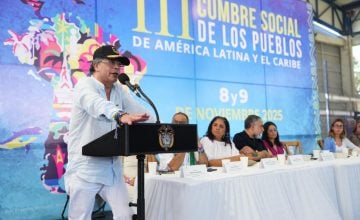
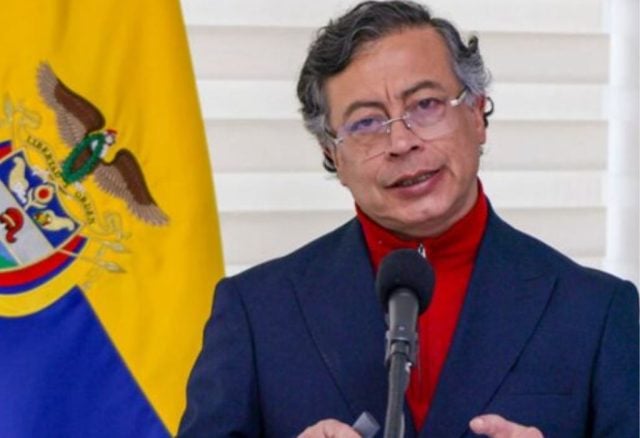
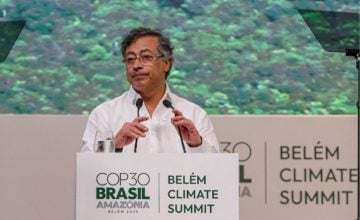
The President of Colombia, Gustavo Petro, affirmed that the proposed Constituent Assembly will not take place during the electoral period, as critics of his government have warned.
According to the president, the timing for the Assembly does not align with next year’s elections.
“The signature collection is just beginning, and it will last for three months. It will be presented after July 20 to the new Congress of the Republic, which will be elected in March. By then, the new presidency will have been chosen,” he explained in a message shared on his social media account.
Petro further clarified that discussions will occur when there are no ongoing electoral processes.
“It will be debated in the new Congress once elections are over, and if approved there and by the Constitutional Court, it will have a date for the constituent elections set by the Court, no later than three months afterward,” he stated.
“This means that neither the constituent assembly, its elections, nor meetings will coincide with the current elections,” he added, highlighting that his proposal is for the assembly to meet for three months during the recess of the new Congress to avoid disruption.
Topics Proposed by Petro for the Constituent Assembly
The president outlined that the topics to be discussed in a potential Constituent Assembly are already included in the draft law that will be submitted for public signature, addressing reforms that have stalled in Congress for over 33 years due to entrenched interests.
Among the key areas he mentioned are social reforms blocked during his term, such as pension reform, healthcare reform, changes to the mining code, transforming public services to be universal and linked to actual costs, and a profound overhaul of the education system.
Specifically, the proposal includes:
1- The social reforms that have been blocked by the current government: pension reform, healthcare reform, improvements to the mining code, and making public services universal, efficient, and tied to real costs rather than speculation.
The education reform, its content, and financing to achieve a knowledge society, advancing public education to the frontiers of human knowledge, sovereignty over data, and artificial intelligence.
2- A more profound agrarian reform. Protecting food production. No peasant will be landless in Colombia.
3- Adapting to and mitigating Colombia’s climate crisis. Real care for its natural balance. Water is the core element to preserve.
Access to drinking water must be raised to a fundamental right, with a legislative act guaranteeing it.
The Constituent Assembly could reorganize future terms without violating existing contracts to prioritize drinking water, restore jungles, and transform mass transit towards electrification and rail systems, as well as drive decarbonization in industry, agriculture, and services.
4- The new territorial organization of Colombia and the legislative act concerning regional competencies and resources. Increasing regional autonomy with citizen control, recognizing indigenous and Afro descent territories, and ending exclusions based on race, gender, and sex.
The special regime of San Andrés Islands. The municipality as a real space for citizen participation. Empowering territories in light of the climate crisis. Liberating spaces related to water and structuring around it. The role of urban construction in expanding public space and the nation’s natural reserves.
5- Judicial reform. Only the Constitutional Court will remain unchanged. The judiciary must be free from political influence and private interests, serving the citizens and their control. Judges and prosecutors should be accessible in communities.
6- Political reform: electoral system, financing of parties and campaigns, mandatory free voting, referendums, oversight of software and elections, and an independent electoral authority.
7- The right to peace. Immediate legislative actions for implementing peace agreements and addressing drug trafficking.
8- Integral security for Colombia and its citizens.
9- Colombia on the global stage: the Gran Colombian Nations confederation, promoting peace in the Americas, real control over a 200-mile ocean zone, scientific research, management of the electromagnetic spectrum and geostationary orbit, and space exploration by the Air Force.
Gustavo Petro’s announcement and explanation occur amid a political and legal debate regarding the feasibility of a Constituent Assembly in Colombia, its scope, and the limitations imposed by the current Constitution.
Registration of the Constituent Assembly Promoter Committee
The government of the progressive leader supported the registration of the promoter committee that will drive the signature collection for convening the Constituent Assembly, which consists of nine individuals from various sectors of the country and will have eight business days to ensure legal requirements are met.
“The citizen committee for the National Constituent Assembly has been registered at the National Registry,” Petro highlighted in another message on social media.
In the same post, he emphasized: “The people should not let go of their power to transform Colombia and progress.”
From right-wing sectors, political figures like former director of the National Administrative Department of Statistics (DANE) and presidential candidate, Juan Daniel Oviedo, insist on preserving the 1991 Constitution and question the government’s intentions.
“Colombia does not need a new Constitution. It needs a new government that respects the law and enforces it,” Oviedo stated on X, further defending the current legal framework by declaring: “The @GranConsulta is clear: No to the Constituent Assembly of @petrogustavo. Yes to the 1991 Constitution. We do not need a dictator, let’s preserve the rule of law.”
In response, the Colombian president replied on X with several messages. “I will not be a dictator. Do not insult; the Constituent Assembly will not occur during my government,” wrote the president, denying assertions about authoritarian intentions.
Regarding Oviedo’s criticisms, he recalled the former official’s ties to the previous administration: “You led the Duque government, which alongside Uribe is one of the greatest detractors of the Social State of Law under the 1991 Constitution. There are reminders of thousands of disappearances, young people assassinated and imprisoned. What were you doing as a member of Duque’s government during the youth uprisings?”
He noted that during the social unrest, detained youths were presented as “terrorists paid by Venezuela” to U.S. intelligence.
“The constituent power of the people is essential for implementing the reforms that Congress has failed to enact for 34 years,” Petro defended on X.
The president added: “I invite you not to confuse the Social State of Law with crude neoliberalism. Nor democracy with the dictatorships of those who sought to ‘refound the homeland’ in the old dictatorial constitution of 1886,” he concluded.
Relacionados
Ecuador's Constitutional Referendum: Noboa's Push for Power Concentration Amid Institutional Tensions
Hace 3 meses
Colombian President Petro to Publicly Disclose Financial Records Following Trump's Controversial Labeling
Hace 3 meses