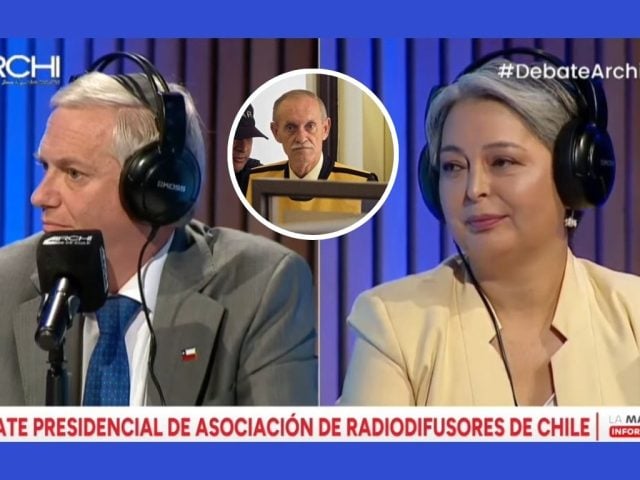
Original article: “Los criminales de lesa humanidad como Krassnoff no se merecen misericordia”: Jara descarta beneficios en debate Archi
The Presidential Debate of the Association of Broadcasters of Chile (Archi) 2025 brought together Jeannette Jara and José Kast on Wednesday in one of the most crucial meetings before the runoff on December 14. Among the most sensitive topics discussed was how both candidates would handle potential requests for pardons or prison benefits for individuals convicted of crimes against humanity, particularly the case of Miguel Krassnoff, one of those responsible for kidnappings, torture, and disappearances during the military-civic dictatorship who currently holds over a thousand years of sentences.
The inquiry about whether she would pardon Krassnoff arose in consideration of a potential scenario in which the families of victims could obtain relevant information regarding the disappeared detainees in exchange for benefits.
Jara’s response was firm: «I will not pardon anyone during my term.»
She added: «Criminals against humanity like Krassnoff do not deserve mercy; they deserve justice.»
This statement marked one of the most powerful moments of the debate, framing a stance that directly connects historical memory with current democratic practice.
The Dilemma of House Arrest for Those Over 70
When asked about the legislation under discussion that proposes house arrest for individuals over 70 with terminal illnesses, Jara emphasized that this measure should not apply to those convicted of crimes against humanity. «I believe there should be a limit. Crimes against humanity, where women were violated, people were burned alive, and thrown into the sea, [those convicted] cannot serve their sentences at home,» she argued.
Kast Takes a Step Back
José Kast, for his part, avoided directly answering the journalist regarding whether he would pardon Krassnoff: «The rules are the rules. I answered those.» Additionally, the far-right candidate mentioned that in cases of terminal illness, humanitarian criteria could be evaluated. «Justice also involves treating people with terminal illness, who no longer have consciousness, with respect. Because you can imprison a body, not the consciousness,» he said.
Human Rights as a Dividing Line in the Campaign
The contrast between their positions reflects a debate that runs through Chile’s recent history: the relationship the state establishes with perpetrators of serious human rights violations and how to ensure that these crimes are never repeated.
Jara insisted that justice is not negotiable, especially when it comes to crimes whose victims are still waiting for complete truth about their relatives’ fates. Kast, on the other hand, focused on extreme health situations.
Both positions highlight a profound difference regarding the role of the state in preserving memory and defending human rights.
A Debate That Reopens Wounds and Defines Positions
The case of Miguel Krassnoff—convicted of homicides, torture, kidnappings, and enforced disappearances—is more than just a name in a debate; it symbolizes the repressive apparatus of the dictatorship. Jara’s response, situated from that perspective, reinforces a political and ethical message: human rights are non-negotiable.
For memory organizations, survivors, and victim families, these kinds of definitions are not rhetorical; they are minimum conditions for advancing toward a more just society. In the Archi debate, this discussion once again occupied a place that is often attempted to be sidelined.
With the second round just days away, the conversation regarding justice, memory, and guarantees of non-repetition emerges as a key dividing line between the candidates.
Relacionados

Unusual Tactics: Pro-Kast Troll Accounts Blame Journalists for Candidate's Debate Struggles Against Jeannette Jara
Hace 3 meses