Original article: Observadoras de DDHH denuncian estrategia del Ministerio de Justicia para liberar anticipadamente a criminales de lesa humanidad
Human Rights Observers Expose Justice Ministry’s Strategy to Prematurely Release Humanity Crimes Convicts
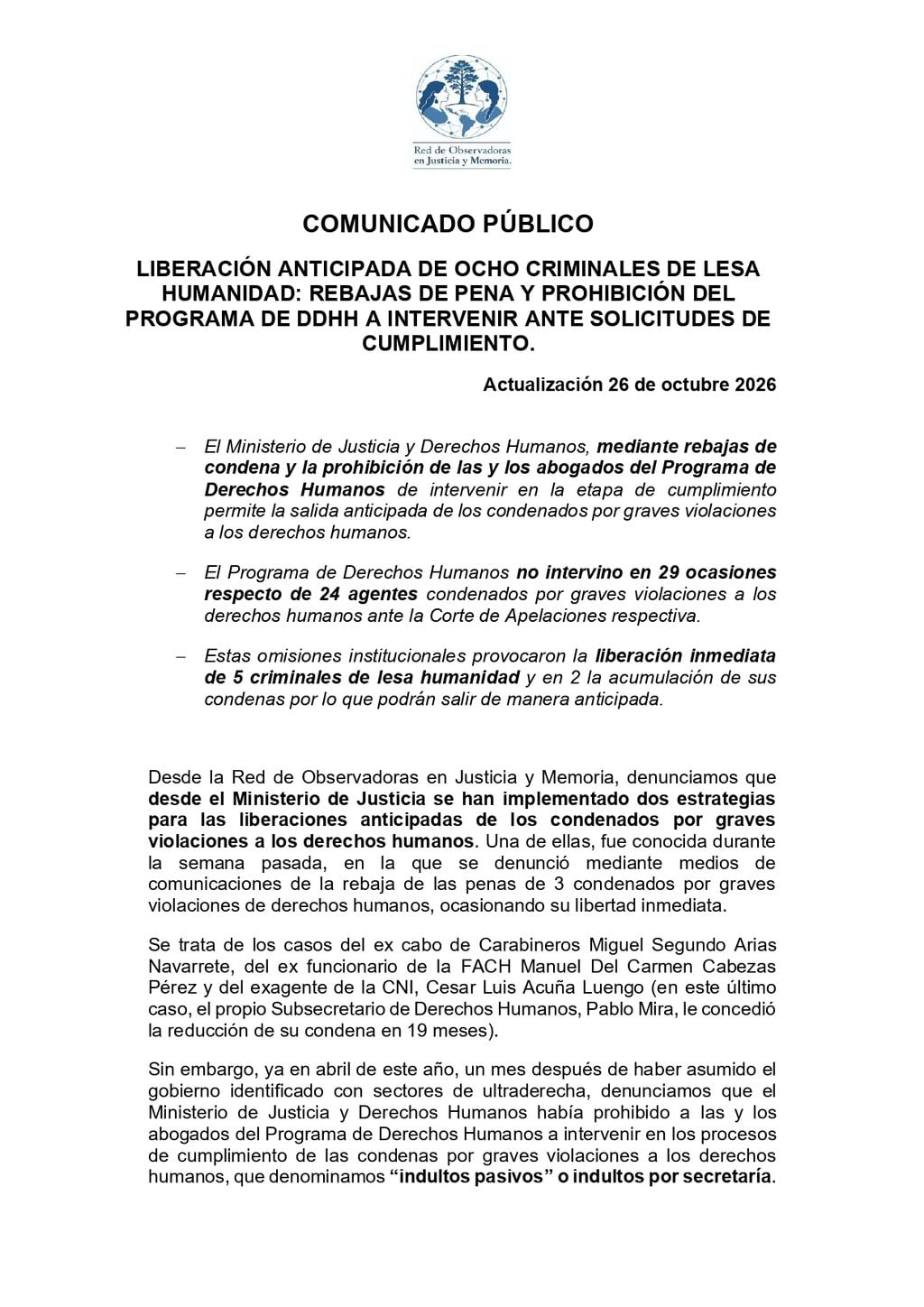
The Network of Observers for Justice and Memory has denounced the Justice Ministry’s implementation of a strategy aimed at hastening the release of individuals convicted of human rights violations: not appearing and not intervening in these cases.
The group explained that «until March 2026, lawyers from the Human Rights Program participated in hearings where former agents of the military civil dictatorship request freedom or sentence reductions».
However, «between March 11, when José Antonio Kast’s government took office, and October of this year, the Program ceased to argue in most of these cases».
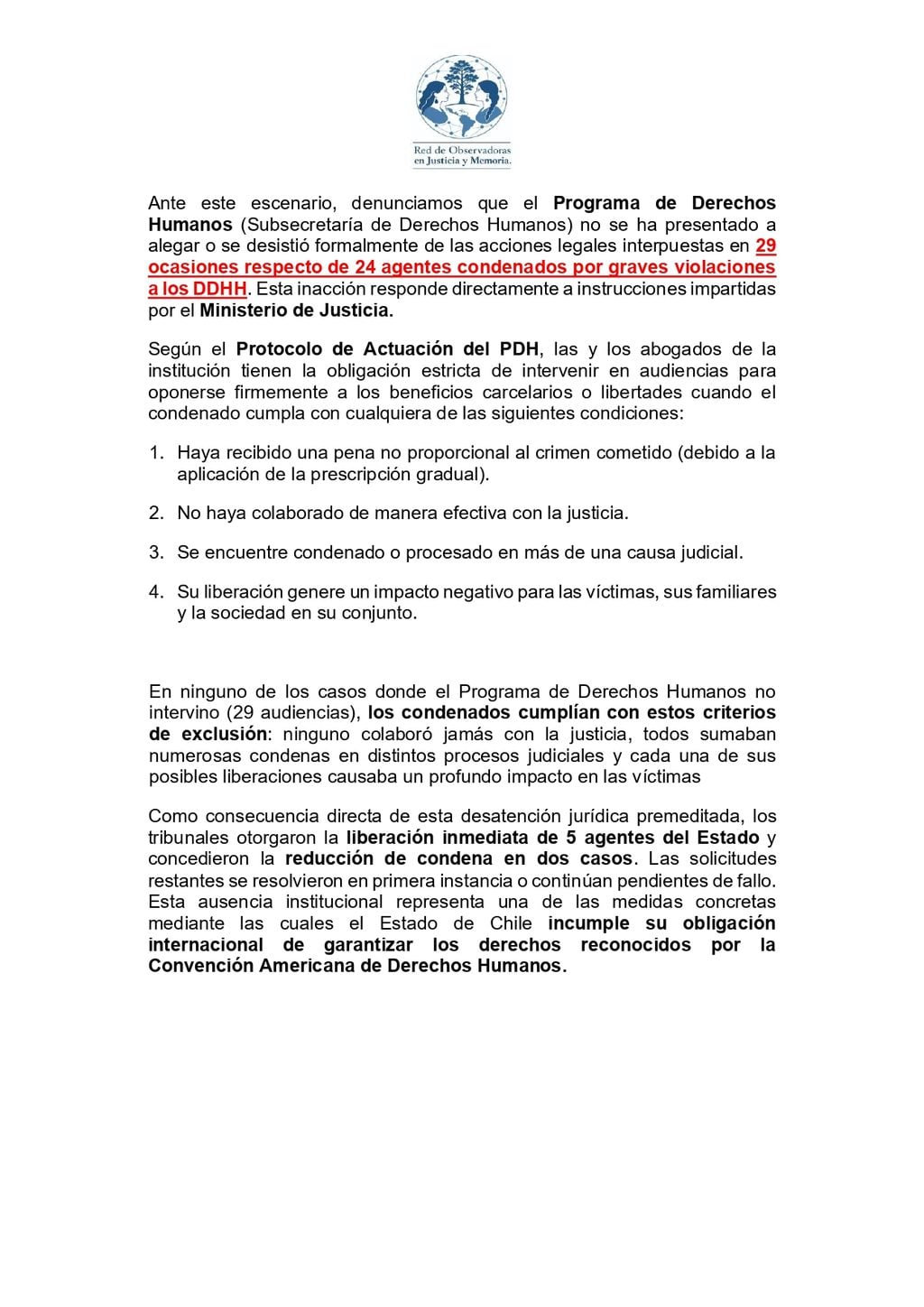
The organization reveals that «between March and October this year, the Courts of Appeals held 29 hearings to review requests for freedom or sentence reductions from those convicted of crimes against humanity. In these cases, the Program, which is responsible for implementing the National Search Plan, did not appear or formally withdrew from the actions it had previously raised».
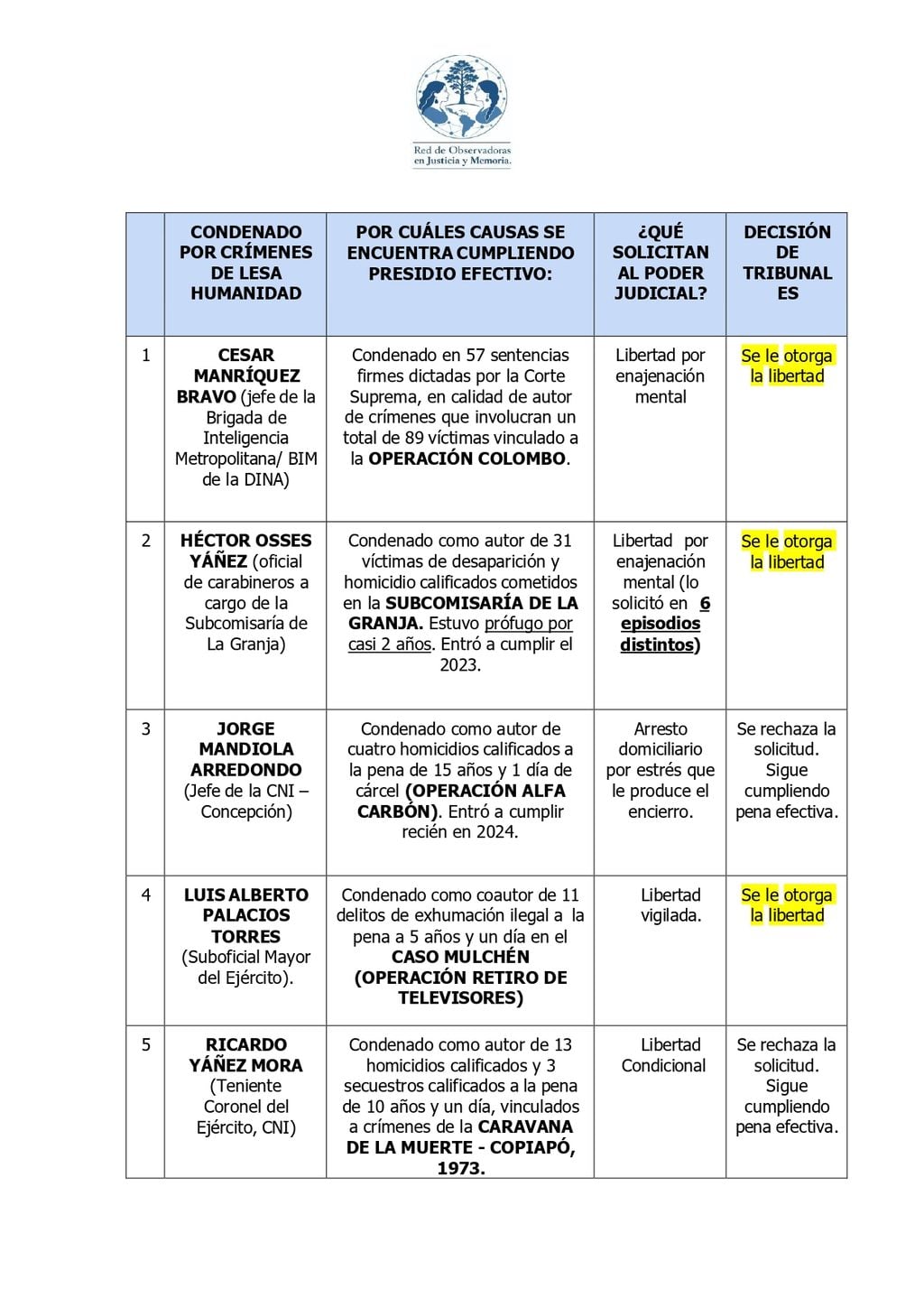
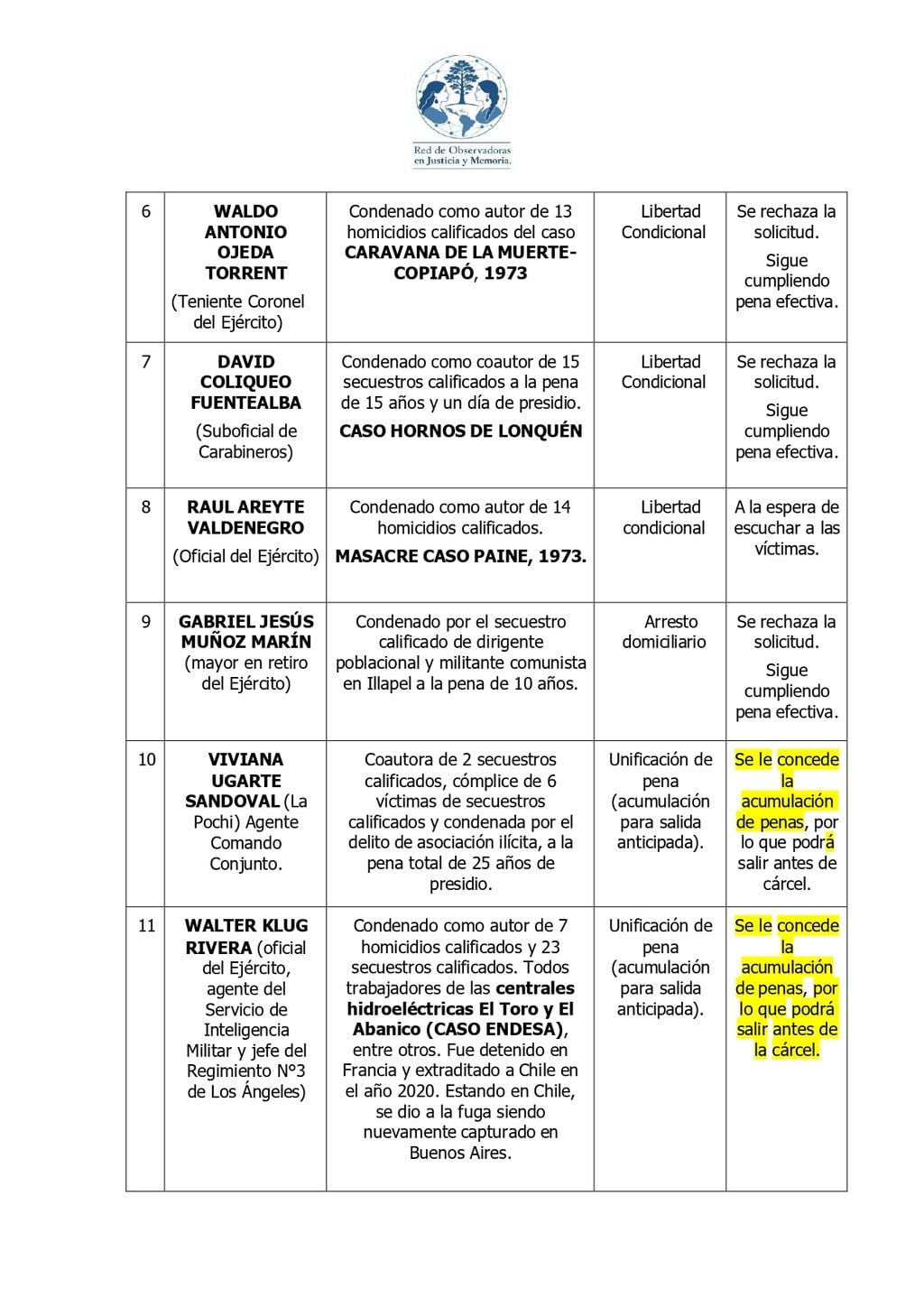
What was the outcome? The immediate release of 5 individuals convicted of humanity crimes (unrelated to sentence reductions) and in another 2 instances, their sentences were accumulated, allowing for their early release as well.
For Paulina Zamorano, former head of the Human Rights Program and current member of the Network of Observers for Justice and Memory, «the premature release of individuals convicted of crimes against humanity is not a common jail benefit; it is a strategy of impunity».
«By granting these freedoms, either through decree or the prohibiting of the Human Rights Program to intervene in these cases, the State of Chile is turning its back on the victims and openly violating international human rights treaties,» the observer stated.
Perpetrators Seeking Benefits
Magdalena Garcés, a prosecuting attorney, detailed that «to date we have recorded over 40 remedies in first-instance courts, and more than 40 remedies of protection and amparo filed before the courts of our country, through which the defense of the convicted are seeking different avenues to access benefits or ways to not serve their sentences in prison».
The attorney emphasized, «it is concerning that in this large number of actions before the country’s Courts of Appeals, the Human Rights Program is not presenting arguments, not defending the proper execution of sentences imposed for serious human rights violations, after so many years of struggle for justice by the families of the victims, and that it again falls to them and their representatives to take on the task of obtaining justice».
«The enforcement of sentences is an obligation of the State of Chile towards those condemned for the gravest crimes known in our history,» the professional asserted.
In this context, she pointed out, «we find especially serious the case of Jaime Muller Aviles, who was convicted as an accomplice in the qualified homicides of 18 victims in Mulchén due to his participation in what was called the ‘operation to remove televisions,’ during which the victims were exhumed and then their bodies disappeared again».
«He is currently under intensive supervised release, meaning, after having been condemned to a fairly minimal sentence for the gravity of the acts, which was 5 years and one day, he was previously released on supervised release and is now free,» attorney Magdalena Garcés stated.
Human Rights Program Protocol is Not Being Followed
The Network of Observers for Justice and Memory pointed out that according to the operational protocol of the Human Rights Program, «the lawyers of the institution have the strict obligation to intervene in hearings to firmly oppose prison benefits or freedoms» when certain conditions are evident in the condemned.
These conditions include: «Having received a sentence that is not proportional to the crime committed (due to the application of gradual prescription); not having cooperated effectively with justice; being convicted or prosecuted in more than one judicial case; and that their release would negatively impact the victims, their families, and society as a whole».
The Observers indicate that in all cases where the Human Rights Program did not intervene (29 hearings), the convicted fulfilled one of the exclusion criteria: «None ever cooperated with justice, they all had multiple convictions in various judicial processes, and each of their potential releases caused a deep impact on the victims».
«This institutional absence represents one of the concrete measures through which the State of Chile fails to fulfill its international obligation to guarantee the rights recognized by the American Convention on Human Rights,» declared the Network.


Obtén tu Pasaporte y apoya a El Ciudadano
Elimina la publicidad, accede a contenido exclusivo y sé parte de la comunidad.
Cancela en cualquier momento · Sin permanencia