Original article: Resultados Foro Empresarial BRICS 2026
Insights from the BRICS Business Forum 2026: Growth, Challenges, and Economic Tensions
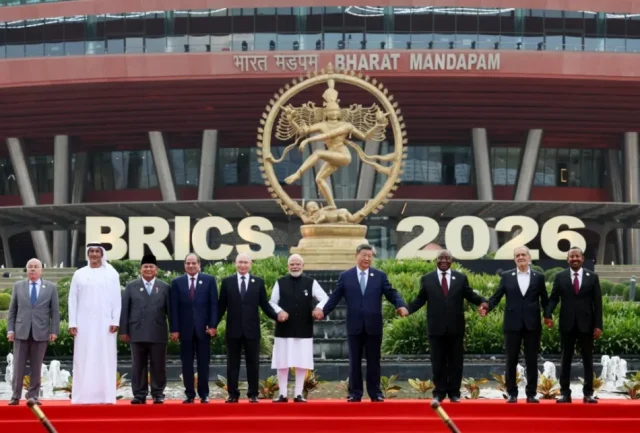
The BRICS Business Forum 2026, held on Friday, September 11, at the Bharat Mandapam in New Delhi, highlighted the underlying tensions within the bloc as it celebrates its twentieth anniversary. While this group has quadrupled its economic weight in two decades, a clear consensus on whether to stand as a counterbalance to Western order or, as Indian Prime Minister Narendra Modi put it, be a «bridge builder» that is «not against anyone» remains unresolved.
A Forum with Uncontested Numbers
India hosted the largest business forum in BRICS history, bringing together 2,000 delegates—1,100 from India and 900 from abroad—and facilitating over 600 business meetings within just four to five hours. Anant Swarup, General Secretary of FICCI, encapsulated the urgency in the private sector’s activities, stating, «In a short span, say four or five hours, we held more than 600 meetings in this room».
Behind these numbers lies the reality Modi shed light on: since 2014, India has signed free trade agreements with nearly 40 countries, even as «trade barriers are rising globally». Modi did not speak abstractly; he addressed a context where Washington threatens 100% tariffs on BRICS countries if they «play with the dollar».
Modi presented three concrete proposals to the private sector: identify the «top ten trade barriers» to eliminate, support at least 100 BRICS startups each year to expand into other markets within the bloc, and forge partnerships among 1,000 companies in the group. He also announced the creation of the BRICS Incubator Network, the BRICS MSME Portal, and the BRICS Startup Innovation Fund, platforms designed to help small businesses—typically the most challenged in crossing borders—access markets, investors, and technology partners.
The Variable Geometry of a Changing Bloc
The BRICS of 2026 are not the same as those of 2006. In 2006, there were four countries; today, there are eleven full members—Brazil, Russia, India, China, South Africa, Egypt, Ethiopia, Iran, the United Arab Emirates, Saudi Arabia, and Indonesia—plus ten partner countries, including Belarus, Bolivia, Kazakhstan, Cuba, Malaysia, Nigeria, Thailand, Uganda, Uzbekistan, and Vietnam. Together, they account for nearly 50% of the global population, about 40% of the world’s GDP, and 26% of international trade.
Modi further noted in his speech that while the global GDP has multiplied by 2.5 over these two decades, the combined GDP of the BRICS has grown «almost four and a half times». He stated that the bloc’s economic strength «grew at twice the speed of the world’s».
However, this expansion has brought a complex variable geometry that complicates a unified narrative. Saudi Arabia is still «evaluating» its formal membership. Argentina has withdrawn from the process. Iran and Russia—the most sanctioned nations in the group—are pushing for a tougher stance against the West, a position India, as chair, is not comfortable reiterating.
Internal Tensions Revealed by the Forum
Business Standard’s analysis was surgical: «The speeches of some leaders at the BRICS Business Forum revealed the internal unrest that the eleven-member bloc is undergoing».
South African President Cyril Ramaphosa was direct: BRICS is «at a turning point» and must decide whether it wants to be «merely a platform for consultations». Ramaphosa, whose country has played a key role in the bloc’s expansion, pointed out a sore spot the business forum could not hide: the gap between rhetoric of unity and the absence of tangible results.
Russian President Vladimir Putin took the opportunity to deliver a different message. He noted that the G7 is losing economic and industrial weight as BRICS steps in, criticizing the West for claiming that «competition is sacred» while imposing «more than 30,000 sanctions» on Russia. Putin also emphasized that 40 of Russia’s top companies are involved in its national committee for business cooperation with BRICS, particularly focusing on logistical routes such as the Arctic Corridor and the North-South Transport Corridor.
Russian Minister of Economic Development Maxim Reshetnikov provided a statistic illustrating the magnitude of the financial shift underway: «Three years ago, the dollar and euro accounted for 85% of Russia’s export settlements. Today, that figure is around 11%». For Moscow, the alternative financial system is not a future prospect; it is a consolidated reality that «links thousands of banks from many countries».
The Agenda Being Negotiated Behind the Scenes
The business forum was, in fact, the tip of an iceberg, with the submerged part representing the agenda for the leaders’ summit. According to the Syrian newspaper SANA, the main pillars of the summit include «strengthening economic and financial cooperation, developing payment mechanisms in national currencies, expanding the role of the New Development Bank, and supporting infrastructure and sustainable development projects».
At the center of it all is the question of the dollar. The «New Delhi Declaration 2026,» adopted on Saturday, states that BRICS will expand trade and payments in local currencies, and directs the Payment Working Group to continue researching the «cross-border interoperability of payment and messaging channels» to achieve «quick, low-cost, more accessible, efficient, transparent, and secure» transactions. The wording is careful yet unmistakable in its direction.
India, however, has marked a boundary. The Indian presidency will «promote settlements in local currencies and the interoperability of payment systems while rejecting a common BRICS currency that would invite further US retaliation». This is the red line New Delhi will not cross: advancing on technical de-dollarization—payments in rupees, yuan, rubles—without embracing the political project of a supranational currency that Washington would interpret as a declaration of financial war.
India’s Minister of Commerce and Industry Piyush Goyal provided figures: India’s Unified Payments Interface (UPI) exceeds 250 billion transactions annually and is already accepted in 11 countries. «I urge member and partner countries of BRICS to link our payment systems, trade in each other’s local currencies, globalize digital commerce, and build the future together».
Indian Commerce Secretary Rajesh Agrawal added a little-discussed dimension: the trade financing gap within BRICS is estimated at $2.5 trillion, suggesting that any new mechanism should be based on «confirmed orders and reliable payment records.»
The Shadow of Trump and India’s Impossible Balance
The geopolitical context is not a neutral backdrop. The United States, under President Donald Trump, pressured India over its purchases of Russian oil and threatened the entire bloc with 100% tariffs if it advanced towards de-dollarization.
The final declaration does not mention Trump or the United States by name but criticizes «the increase of unilateral tariff and non-tariff measures that distort trade and are inconsistent with WTO rules» while condemning «unilateral and secondary economic sanctions». It also rejects «carbon border taxes»—European green tariffs—as «unilateral, punitive, discriminatory, and protectionist measures».
As the host, India is walking a delicate balance. The Daily Pioneer aptly described it: India seeks to position itself as «the pragmatic convenor of the Global South—present at the table with Beijing and Moscow but not to be pigeonholed as anti-Western». The guest list for the summit reinforces this strategy: India invited the current presidents of the African Union, ASEAN, CELAC, and the Gulf Cooperation Council, along with UN Secretary-General António Guterres.
«It is time to turn our unity and consensus within BRICS into concrete results on the global stage,» said Modi at the summit’s opening.
What Remains After the Speeches
The final 45-page declaration was adopted «unanimously,» and Modi stated that no member «objected» to the text. However, the unanimity within a bloc of eleven countries with such divergent interests—from sanctioned Iran to the UAE, which maintains close ties with Washington—is often the result of language vague enough for everyone to agree to.
Leaders agreed that «there is no one-size-fits-all approach» and that «national priorities must be respected». This seemingly innocuous phrase explicitly recognizes that BRICS is not—and will not be in the short term—a bloc with a common financial policy.
The concrete advances on the table are modest but real: the Startup Innovation Fund, the incubator network, the MSME portal, the working group on payments tasked with continuing, and the more than 600 business meetings that FICCI reports are already generating cross-border partnerships.
DBS’s think tank analysis was perhaps the most honest: the discussion about trade in local currencies, payment links, and reserve diversification «seeks to increase the use of the domestic unit more than it engages in an active discussion on challenging the dominance of the dollar.» In other words: BRICS is not building an alternative monetary system; they are building the infrastructure to avoid dependency on a single currency.
The twentieth anniversary of the bloc, celebrated with its largest business forum to date, leaves a conclusion that neither speeches nor the final declaration could disguise: the BRICS have proven they can grow, but they have yet to show they can converge. The gap between the rhetoric of «concrete results» and the reality of «national priorities» is the unfinished business for the next presidency.
The Citizen
Obtén tu Pasaporte y apoya a El Ciudadano
Elimina la publicidad, accede a contenido exclusivo y sé parte de la comunidad.
Cancela en cualquier momento · Sin permanencia