Original article: Investigación revela que 12 salmoneras registran 435.546 toneladas de producción al margen de la ley por eludir al SEIA
12 Companies Account for 435,546 Tons of Illegal Salmon Production by Evading Environmental Evaluation
A new investigation by Fundación Terram has revealed a series of violations within the salmon farming industry, persisting since 2013 without any penalties from the Environmental Superintendence. Out of the total of 435,546 tons produced illegally, 203,000 tons are attributed to Aquachile, the country’s largest salmon farm. This company allegedly financed a campaign for Senator Miguel Ángel Calisto through fictitious advisory services in 2021, as claimed by a former advisor. Calisto is currently under investigation for fraud against the public treasury, while serving on the Senate Environment Commission, where his vote could potentially grant the government a majority in the context of the Megarreforma.
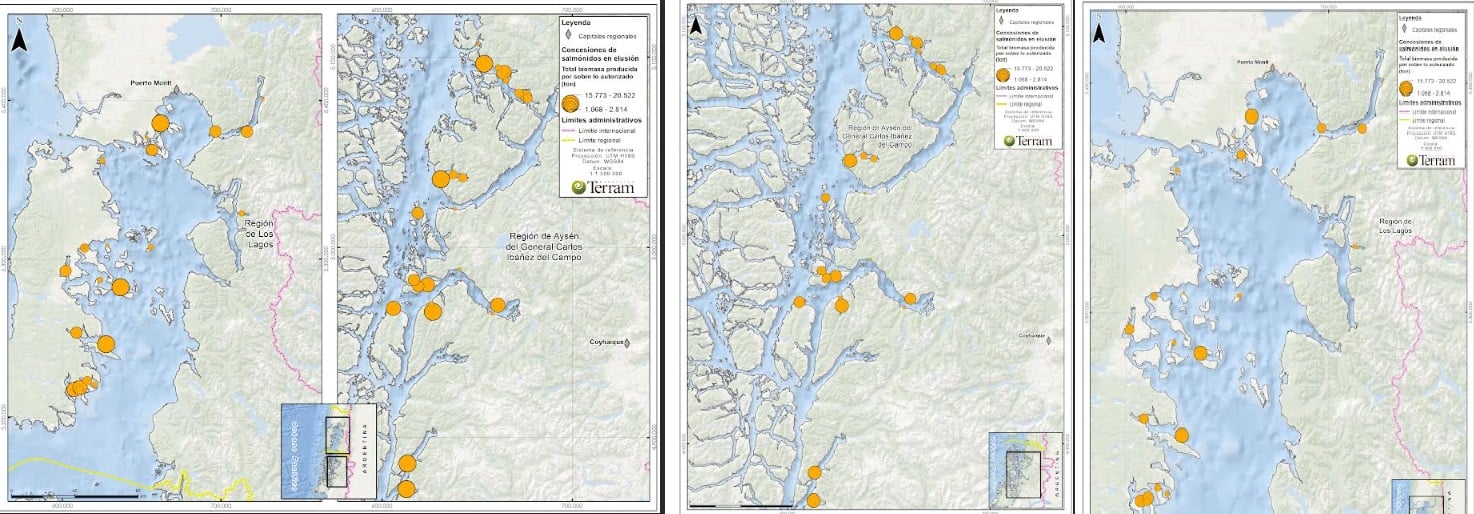
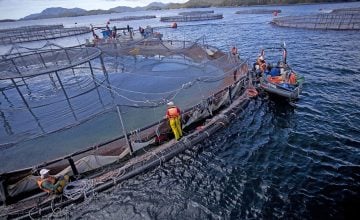
The research conducted by Maximiliano Bazán of Fundación Terram identified that 48 salmon farming centers operated by 12 parent companies have evaded the Environmental Impact Assessment System (SEIA) over 164 production cycles.
Violations occurring between 2013 and 2023 enabled a total production of 435,546 tons beyond authorized limits. For context, this excess production has an estimated market value of USD $4.263 billion in sales, based on the average selling price of salmon in the U.S.—which is the main product and destination market—during 2025 (USD $9.8/kg), according to a report from Aquabench.
This production accounts for 46% of the annual average output from the entire salmon farming industry in Chile during the same period (2013-2023), which totaled 941,703 tons of this exotic species designated for export.
Senator Calisto and the National Reconstruction Law
The legislation known as the National Reconstruction Law (Bill No. 18.216-05) includes several provisions aimed at modifying key aspects of environmental regulation to benefit the salmon farming industry. Among these amendments, it removes the requirement for environmental assessment regarding the relocation of farming centers and establishes the concept of ‘micro relocation,’ allowing moves of up to 350 meters without needing to register with the SEIA.
Maximiliano Bazán commented that “while the specific wording is still under discussion at the time this investigation is published, the government’s stated objective represents a clear loosening of environmental and aquaculture regulations, endangering ecosystems where this large-scale activity seeks to relocate without even evaluating its impacts, as mandated by current regulations.”
Following the bill’s approval in the Chamber of Deputies, the landscape is tighter in the Senate, as reflected in the approval for the legislative idea on June 24, with 26 votes in favor, 23 against, and one abstention from Senator Pedro Araya (PPD) of the opposition coalition.
In this result, Senator Miguel Ángel Calisto played a pivotal role, as despite being elected with the backing of the Regionalist Green Social Party (PRVS), which is theoretically part of the opposition, it was his vote that provided the majority for the government, potentially allowing it again when the project returns to the Senate for specific approval.
Roland Cárcamo, a former campaign chief for the current senator, testified to the Prosecutor’s Office that Aquachile—the country’s largest salmon farming company, owned by the Vial Concha group controlling Agrosuper—financed Calisto during his re-election campaign to the Chamber of Deputies in 2021 through payment for advisory services that were never rendered, provided by a consulting firm owned by Cárcamo, which was allegedly used as a front to channel payments that ultimately landed in the hands of the now-senator, as reported by Fastcheck.
Due to the fraud investigation, Calisto was already stripped of parliamentary immunity in 2025 while serving as a deputy—despite votes against from Ministers Matus and Simpertigue—but managed to evade consequences after being elected senator, regaining parliamentary privilege.
Meanwhile, the government has scheduled the vote on the project in the Senate Chamber for July 15. If the senator does not disqualify himself, he could again play a decisive role in a reform that incorporates tax, labor, and environmental changes, including favorable measures for the salmon farming industry.
Read the full investigation here:
https://www.terram.cl/descargar/Investigacion-Elusion-SEIA_Fundacion-Terram.pdf
Obtén tu Pasaporte y apoya a El Ciudadano
Elimina la publicidad, accede a contenido exclusivo y sé parte de la comunidad.
Cancela en cualquier momento · Sin permanencia