Original article: Ixtapaluca: El debate de la soberanía local
By Damaris Hoyos
Immanuel Wallerstein, a renowned economist credited with the conceptualization of world-system, argues that capitalism is not merely a combination of national economies but rather a global system that inherently generates centers and peripheries.
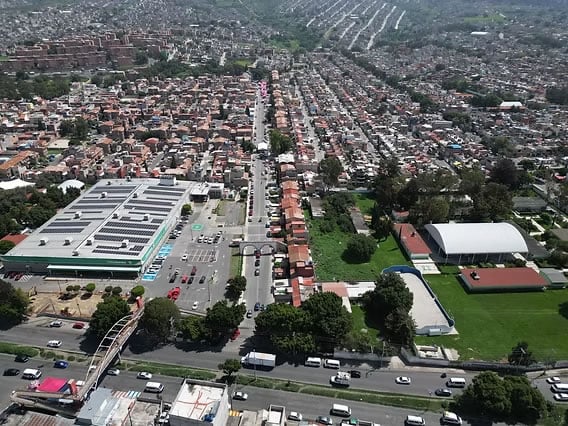
What has been less theorized is that this logic does not solely relate to border demarcations but also reproduces internally. Mexico is a peripheral part of the world system; the State of Mexico is peripheral to the capital; and municipalities like Ixtapaluca represent the periphery of the periphery. Here, at the last link in this chain, the neoliberal model violently shaped the working-class sleeping city, the most precarious in the nation.
In this context, Brazilian geographer Milton Santos differentiated between territory as a resource—what it represents for capital—and territory as a refuge—what it means for the people who inhabit it. The question I pose is how we can reclaim territory as a refuge: how can we build sovereignty from the local level?
Those of us residing in peripheral municipalities have witnessed how rapid and violent transformations have affected the configuration of our territories.
Traditional theories of growth and development have never been able to provide us with conceptual frameworks that address the problems proliferating throughout the State of Mexico. Although the Fourth Transformation has made significant strides in terms of investment and social infrastructure from the federal government, municipal administrations have lagged behind in implementing complementary policies that are urgently needed for these resource allocations to be effective and not turn into simulations due to neglect.
Across the country, these changes compel us to engage in radically different debates: in terms of public policies, but also regarding our modes of thinking, society, institutions, and all the laws aiming to regulate the chaos left by the neoliberal model.
What Can Be Done to Build Sovereignty from the Local Level?
The unregulated and excessive growth of urban sprawl was driven by the most precarious and exploited working class in our system, referred to by Marx as the «reserve army of labor.»
However, our workforce no longer predominantly operates in industry: neoliberalism dismantled both agricultural and industrial sectors— and Ixtapaluca is a notable case of both phenomena— leading to the majority of our workers being employed in the tertiary sector, with a significant informal economy.
In this sense, the dependency theory remains relevant: first, to understand our challenges from the root; secondly, to propose solutions that also stem from that root.
For this reason, I contemplate the necessity of collectively building a government plan with sufficient technical competence, articulated around three axes. The first is water, which is simultaneously the memory of the territory, a daily urgency, and a condition of any possible sovereignty. Secondly, the decentralization of job, educational, and cultural opportunities, which are currently concentrated in the city, so that living in the periphery no longer means spending hours commuting to work, study, or access culture.
Thirdly, a planning mechanism that restructures the urban area with the aim of re-establishing the connection to the countryside: not as a nostalgia, but as a strategy for food sovereignty and territorial rebalancing.
Abandoning Eurocentric and colonial theories on economic growth and development, and reviving the voices of our theorists from Latin America and the Global South to construct new development options is an urgent task that local governments must undertake.
Is It Possible to Adopt Models Designed for Nation-States in a Small Territory?
Samir Amin proposes the «theory of disconnection,» where «connection» is understood as the subordination of weaker countries to dominant global trends.
In municipal planning, a Development Plan must adhere to the objectives of state and federal planning; however, these models do not necessarily address the specificities of local problems.
Amin argues that the disconnection from hegemonic politics must lie in popular organization, with clear positions—anti-imperialist, anti-monopolistic—that challenge the hierarchies of the world system and construct mechanisms for regional cooperation.
His strategy requires diminishing the power of the five monopolies that uphold the hegemony of the centers: strategic armament, natural resources, financial capital, technical innovation, and communications.
My answer is that yes, it is possible. But only if disconnection is not understood as isolation, but as organization. Ixtapaluca cannot disconnect on its own—no territory can—but it can stop passively reproducing planning that fails to address its issues and start building from the ground up, with popular organization as the subject, forging regional cooperation alliances along with our global South allies.
Thus, an international agenda applied locally is essential, where the debate on sovereignty is not a fragmented discussion, but understood through internationalism and grounded in the territory.
Ixtapaluca means, in Nahuatl, «the place where the salt gets wet.» The name retains the memory of a territorial economy linked to the lacustrine system of Chalco: water, salt, exchange, and communal life. That lake was drained, and upon its sediments arose the urban sprawl we inhabit today, with its precariousness and dispossession.
Thus, building sovereignty from the local level is not merely a theoretical abstraction: it is about restoring the territory’s capacity to sustain life, as its name still recalls. The disconnection Amin speaks of perhaps begins with reconnecting to what we once were and what neoliberalism sought to erase: a people organized around their water.
Damaris Hoyos
Obtén tu Pasaporte y apoya a El Ciudadano
Elimina la publicidad, accede a contenido exclusivo y sé parte de la comunidad.
Cancela en cualquier momento · Sin permanencia