Original article: Revés judicial para Radio Bío Bío: Corte de Valdivia rechaza apelación y confirma condena por discriminación contra machi Millaray Huichalaf
Radio Bío Bío faced a significant legal setback as the Valdivia Court of Appeals unanimously rejected its appeal against a previous ruling finding the outlet guilty of discrimination against machi huilliche Millaray Huichalaf.
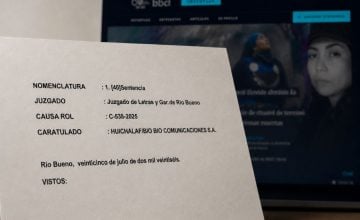
The court affirmed the first-instance ruling made on July 25, 2026, by the Río Bueno Court, which mandated the media outlet to modify its journalistic content, pay fines, publish a clarification regarding the ruling, disclose the penalties applied, and conduct mandatory training for its journalists.
The decision was endorsed by Minister María Inés Lausen, substitute Minister Germán Olmedo, and contributing lawyer Lorenzo Rehl.
The court also rejected an appeal filed by Millaray Huichalaf that sought the complete removal of the offending reports.
Key Points from the Ruling Against Radio Bío Bío
It’s important to highlight that the initial ruling from the Río Bueno Court found that Radio Bío Bío had engaged in arbitrary discrimination against machi Millaray Huichalaf in two reports published by BBCL Investiga in September 2025, marking the first time the Zamudio Law was applied against a media outlet for journalistic coverage.
The first report, aired on September 14, was titled «The ‘Machi’ of sacrifices: the dark plot behind the ritual that ended with two deaths».
The second was published two weeks later, on September 28, with the title «Journey to the regime and a turn to ‘environmental’ struggle: the networks woven by the ‘Machi of sacrifices'»«.
These publications scrutinized Huichalaf’s background and a healing ceremony that took place in August 2025 at the Pilmaiquén River, during which two individuals lost their lives.
The ruling ordered the media to remove the term «the Machi of sacrifices» from its digital platforms and replace it with «the Machi Millaray Huichalaf», remove the quotes around the term Machi, and substitute the caption “A Lost Woman” used in one of the reports with a factual description related to the publication.
Additionally, the ruling required the addition of a note at the end of the articles indicating that these modifications were made in compliance with a court ruling that determined the questioned expressions were discriminatory.
«Radio Bío Bío is ordered to publish, at the foot of the aforementioned articles, that this ruling has compelled it to change the specified expressions, considering that they produced a discriminatory effect against Machi Millaray Huichalaf, reminding that it is perfectly common and possible in the Mapuche cultural context for ancestral authorities not to be accepted by all community members. It must also mention the fine that was to be paid and the date it was completed,» stated the ruling.
Simultaneously, Radio Bío Bío was ordered to pay a fine of 10 monthly tax units (UTM) along with court costs, publicly inform about the enforcement of this financial sanction, and provide training to 90% of its journalistic staff covering the ruling’s principles, including practical writing exercises.
Judicial Setback for Radio Bío Bío
The media outlet appealed the initial ruling arguing that the imposed measures represented judicial intervention in editorial decisions and could threaten press freedom.
However, the Valdivia Court of Appeals dismissed these concerns and confirmed the ruling in its entirety.
«The appeal submitted by Bio Bío Comunicaciones S.A. against the final ruling of July 25, 2026, issued by the Río Bueno Court in the case Rol C-538-2025 is rejected,» the appellate court stated.
The court explained that the first section of article 2° of the Zamudio Law defines arbitrary discrimination as any «distinction, exclusion, or restriction lacking reasonable justification, made by state agents or private individuals, causing deprivation, disturbance, or threat to the legitimate exercise of fundamental rights established in the Political Constitution of the Republic or in international human rights treaties ratified by Chile.» It particularly occurs «when based on motives such as race or ethnicity, religion or belief, sex, and gender.»
It noted that the distinction, exclusion, or restriction was evident in articles published by Radio Bío Bío which «designated the plaintiff by her Machi status through three means: quotation marks; a nickname associating that status with ‘sacrifices’ in the titles of both publications; a morally charged featured caption.»
«Such treatment reflects the spiritual authority of a Mapuche huilliche leader, inseparable from the categories of ethnicity and religion or belief as specified in article 2° of the Law,» it elaborated.
The appellate court remarked that the discrimination arose from the media’s «editorial voice» presenting Millaray Huichalaf’s cultural and religious identity as questionable or linked to sacrifices.
«This treatment places her in an unequal position compared to those who engage in public debate and can be criticized without their protected identity being undermined,» it highlighted in its ruling.
In its ruling, the appellate court weighed the right to inform enshrined in article 1° of Law No. 19.733 on the Freedom of Opinion and Information and Journalism with the constitutional guarantees of the Chilean legal framework.
Freedom of Expression and Responsibilities
In their considerations, the judges reminded that according to article 19 No. 12 of the Political Constitution of the Republic of Chile, «the freedom to express opinions and inform without prior censorship is a democratic right of special relevance» and carries both an individual and social dimension.
However, it establishes that «none of the conflicting rights is absolute,» as these freedoms are exercised «without prejudice to being held accountable for any crimes and abuses committed during their exercise.»
Furthermore, the ruling grounded its doctrine on article 13.2 of the American Convention on Human Rights, which, while excluding prior censorship, allows for subsequent liabilities set by law to ensure respect for individuals’ rights and reputations.
The ruling issued by the Valdivia Court of Appeals reaffirms Radio Bío Bío’s obligation to adjust the content of the challenged reports for having engaged in arbitrary discrimination against the huilliche Machi Millaray Huichalaf.
Obtén tu Pasaporte y apoya a El Ciudadano
Elimina la publicidad, accede a contenido exclusivo y sé parte de la comunidad.
Cancela en cualquier momento · Sin permanencia