Original article: Gobierno de Kast suma 39 salidas: cae seremi de Salud de Arica que buscó personal para su repartición en un grupo del Partido Republicano
With the recent resignation of Karla Kepec Álvarez, the regional health minister of Arica and Parinacota, who sought personnel for her department through a WhatsApp group affiliated with the Republican Party, José Antonio Kast’s government has now seen a total of 39 officials leave their positions in less than five months of management.
In a message sent to a group of approximately 300 party members called “Partido Republicano Arica y Parinacota,” she requested resumes exclusively from Republican members for the hiring of two medical technologists at the Regional Laboratory of the Ministry of Health, showcasing a clear political bias in accessing positions within a state agency.
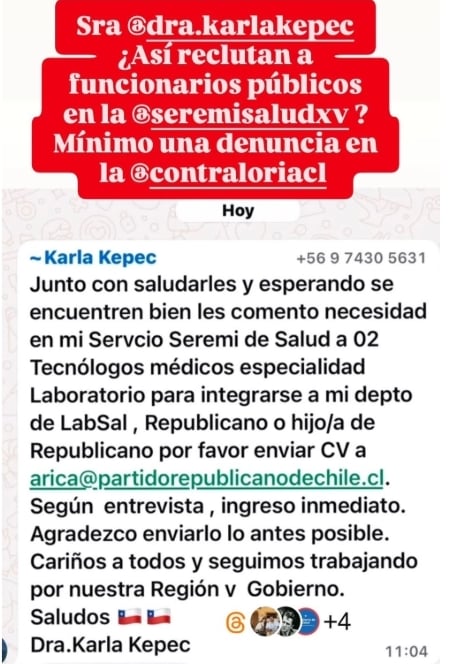
The message obtained by a protected source states: “Greetings, I hope you are doing well. I am reaching out regarding the need in my office, Seremi of Health, for two medical technologists specializing in laboratory work to join my department, LabSal. Republican or child of a Republican, please send your CV to [email protected]. According to the interview, immediate entry is available. Thank you for sending it as soon as possible. Best regards to all, and let’s continue working for our region and government. Cheers, Dr. Karla Kepec.”
The phone number from which the message was disseminated does indeed belong to the medical surgeon from the University of Concepción, validating the authenticity of the communication.
The use of a party group to offer positions in a public agency sparked widespread criticism and raised alarms regarding potential violations of transparency and merit principles in public service. The fact that Kepec requested resumes be sent directly to the Republican Party’s email in Arica, rather than to the official platform of the department, reinforced suspicions of a preferential treatment based on political affiliation, excluding other professionals who are neither members nor have familial ties to this far-right party.
Amid the controversy, around 5:30 PM on Thursday, the Ministry of Health (Minsal) confirmed that it had requested the resignation of the doctor as the seremi of Arica and Parinacota.

Kepec assumed her position on March 26, 2026, after running as a candidate for regional governor in 2024. Simultaneously, she held the regional presidency of the Republican Party, despite warnings from party leaders—who revealed to El Mostrador—that she should step down from that position “to avoid conflicts of interest or potential breaches of integrity in personnel recruitment for her department.”
32 Secretaries Have Resigned from Their Positions
With the departure of Karla Kepec, Kast’s government has reached a total of 32 regional secretaries who have resigned in just four months, setting a record for the country.
In response to inquiries about the seremi’s exit, the presidential delegate, Cristian Sayes, confirmed that the decision was based on the fact that “this method of recruitment is not in line with how we are incorporating personnel,” as reported by the media outlet.
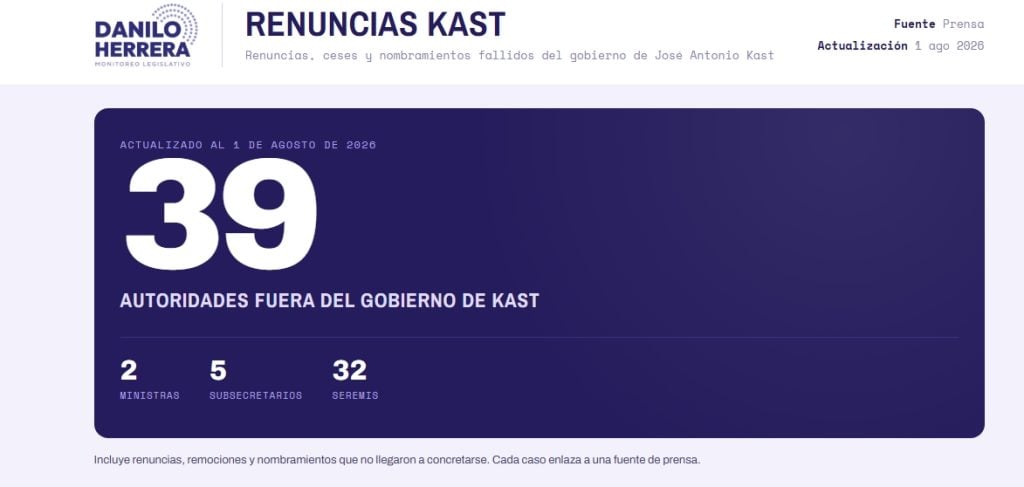
Kast Government Sees 39 Departures
With the resignation of Kepec, the Kast administration has now seen a total of 39 officials depart in nearly five months of governance.
According to a tally conducted by political scientist Danilo Herrera, available at renunciaskast.cl, the far-right administration has recorded the exits of two ministers, five undersecretaries, and 32 seremis since March 11.
Among the ministerial departures are former ministers of Public Security, Trinidad Steinert and General Secretariat of Government, Mara Sedini. As for the undersecretaries, besides the case of former Undersecretary of Finance Juan Pablo Rodríguez—who left after a positive drug test—other departures include Daniela Castro (Women and Gender Equity), Rafael Araos (Science), Andrés Jouannet (Public Security), and Ana Victoria Quintana (Crime Prevention).
Recently, the Executive has also faced additional departures of regional authorities amid judicial investigations, as was the case with the former health seremi of Magallanes, Fabián Barrientos Andrade; alongside administrative questioning and resignations for political reasons, reflecting a high turnover rate during the initial five months of governance.
Obtén tu Pasaporte y apoya a El Ciudadano
Elimina la publicidad, accede a contenido exclusivo y sé parte de la comunidad.
Cancela en cualquier momento · Sin permanencia