Original article: Kast corta financiamiento a estudios sobre concentración mediática y desinformación: expertos alertan vulneración de la Ley de Prensa
In response to the decision by José Antonio Kast to end funding for the National Information System Pluralism Study Fund, experts are warning that under the guise of austerity, the far-right leader is violating the Press Law.
The controversy arose after the General Secretariat of Government (Segegob) suspended the agreement with the National Research and Development Agency (ANID), which supported this mechanism created to generate independent studies on media ownership, electoral coverage, and the phenomenon of disinformation in the digital ecosystem.
Simultaneously, La Moneda chose to exclude the Humanities, Arts, and Social Sciences from the priority areas defined for the Fondecyt Postdoctoral Contest 2027.
Kast’s administration justified both measures by claiming the need to optimize public spending, citing Circular No. 12 from the Ministry of Finance that mandates a fiscal adjustment. However, the research community argues that this explanation is a smokescreen concealing a deep ideological bias against critical thinking.
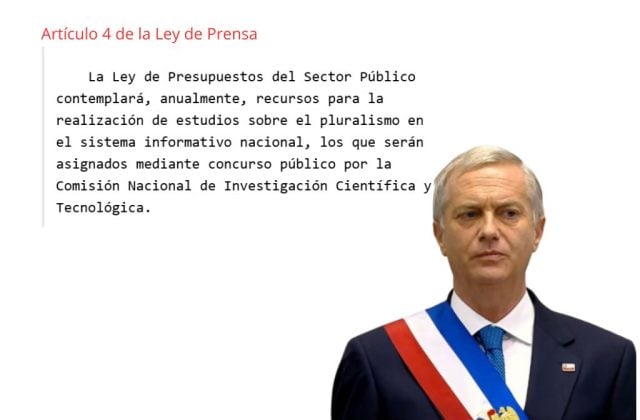
The crux of the legal conflict lies in the possible violation of Article 4 of the Press Law (No. 19.733), which explicitly states that the Budget Law must allocate annual resources for these studies, managed through public competition by ANID.
«The press law establishes an obligation. This law is being violated because those resources are not being allocated for their intended purpose,» accused Laureano Checa, president of the Chilean Association of Researchers in Communication (INCOM Chile) and an academic at the University of Chile.
The expert criticized the casual manner in which the issue has been handled, noting that a simple administrative act cannot override a national law. «What should happen here, and what we hope for, is that at some point the Comptroller’s Office will rule on what happens when a law is not complied with by the Executive,» Checa proposed.
This viewpoint is supported by a wide front of lawyers and academics, including María José Labrador (UDD), Sebastián Zárate (U. Autónoma), Pedro Anguita (U. de los Andes), and Claudia Mellado (PUCV). In a recent publication, the experts emphasized that a fiscal adjustment instruction cannot supersede a permanent legal obligation. «If the Executive believes that this public expenditure is no longer justified, the institutional route is not to terminate it administratively but to amend or repeal Article 4 of the Law,» asserted the jurists, who rejected the notion that a measure implemented under the guise of fiscal adjustment can justify not fulfilling a permanent legal obligation, as reported by Diario U. de Chile.
The Risk of a “Blind” Chile to Media Concentration
Beyond the legal aspect, the suspension of the Pluralism Fund represents a blow to the transparency of the information system. For years, these resources funded independent research that mapped media ownership, analyzed information consumption in regions, and scrutinized disinformation patterns on digital platforms. Without this input, the country remains in the dark regarding the increasing concentration of media ownership.
«If we are not investing in researching what is happening in these areas (…), it is very hard to think that this will emerge from other sources in those volumes,» reflected Checa.
The academic made it clear that this decision leaves the country «blind» to the factual powers that control the public narrative, especially at a time when disinformation threatens global democratic stability.
Exclusion of Humanities and Social Sciences from Postdoctoral Funds
The situation is aggravated by linking this cut to the exclusion of the humanities and social sciences from postdoctoral funds. Checa interpreted this double decision as an explicit message from La Moneda about what kind of knowledge is valuable for the country.
This perception was reinforced when officials from the Ministry of Science publicly questioned the validity of humanistic research titles, leading to episodes of digital harassment against the authors. «A ministry whose mission is to develop knowledge (…) by questioning a series of researches and exposing the authors is failing in its duty to safeguard its human capital,» Checa reported.
Finally, experts warn that this centralizing policy also stifles regional development. The original design of the Pluralism Fund prioritized research conducted by universities outside the capital, promoting the decentralization of knowledge. Checa lamented the «passivity of the regional councils» in the face of the cuts and asserted that «the central executive is undermining the power of regional decision-making spaces without any visible reaction,».
In response to this uncertain and regressive scenario, the academic community has decided to raise its voice. According to Diario U. de Chile, a hundred researchers and citizens have called for the submission of a formal protest letter on Wednesday, August 19, to the Ministry of Science, demanding that social sciences, arts, and humanities be included «on an equal footing» through a transparent and participatory process, halting what they consider an authoritarian regression in the country’s scientific and communicational policy.
Obtén tu Pasaporte y apoya a El Ciudadano
Elimina la publicidad, accede a contenido exclusivo y sé parte de la comunidad.
Cancela en cualquier momento · Sin permanencia
Artículos Relacionados
New Hungarian Government Tracks Funds Linked to Orbán, Connecting to Organization Led by Kast
Hace 3 semanas