Original article: Más castigo y control del espacio público: Kast amplía el poder punitivo del Estado con su nueva agenda de seguridad
Under the principles of increased punishment and public space control, José Antonio Kast unveiled a new security agenda that significantly expands the punitive power of the State.
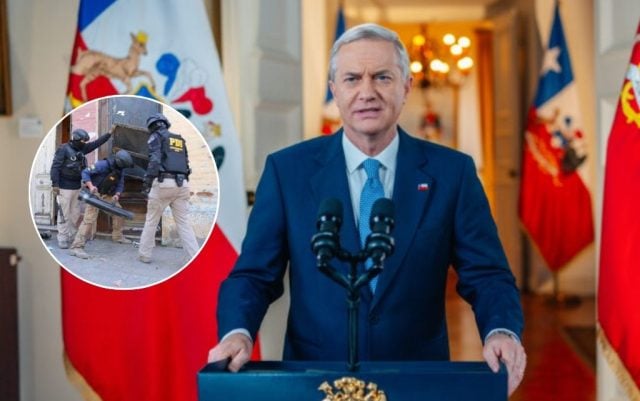
During a nationwide broadcast on Wednesday night, the President not only celebrated the passage of a controversial mega economic-tax reform, but also presented a package of measures that deepens territorial control, arguing the need to confront organized crime.
The new security agenda includes reforms ranging from the capture of criminal organizations to amending the Constitution to protect state intervention.
Specifically, Kast announced that his government will maintain a «permanent police deployment in the 50 most critical neighborhoods across the country, with saturation, patrolling, and technology implemented in each area; a measure aimed at establishing a state presence as a form of strategic occupation of the territory.
Furthermore, he revealed that the flagrant arrest period will be extended from 12 to 24 hours, allowing police to detain individuals without a judicial order when they are committing a crime or have just committed one, constituting an exception to the personal freedom principle set forth in Article 19 N° 7 letter c) of the Chilean Constitution.
This measure opens the door to prolonged preventive detentions and increases the risk of arbitrary actions against innocent individuals in contexts of high social tension.
The President’s speech took on a confrontational tone as he promised to target «entire organizations, in their leadership, territory, and finances,» a statement aimed at dismantling the infrastructure of drug trafficking and organized crime, but which also lays the groundwork for an expansion of state control over public spaces.
At another point in his address, Kast explicitly stated that «the carabinero, police, gendarme, or soldier acting in legitimate defense will not be treated as if they were the criminal,» a formulation intended to protect law enforcement from potential allegations of excessive force, serving as a blank check for repression.
The immigration and border dimension also took center stage in his announcements as the far-right leader promised to increase the detention of illegal migrants and the capacity for effective expulsion of foreigners without residency rights, in addition to strengthening border control with trenches, drones, and continuous technological monitoring, a measure reminiscent of the physical wall policies implemented by Donald Trump’s administration in the United States and which deepens the criminalization of irregular migration as synonymous with insecurity.
Simultaneously, the President introduced new criminal categories that will penalize obstructing public spaces through barricades or blocked vehicles, as well as recruiting minors for criminal activities, establishing aggravated penalties without mitigation for those who involve children in drug trafficking operations.
Constitutional Reform
The fourth pillar of the presidential announcement was the most ambitious in institutional terms: a constitutional reform that «clearly establishes that protecting the safety of citizens is the duty of the State,» a move intended to provide the Executive with a broader framework of action to combat crime that could reinterpret the scope of fundamental rights in favor of state intervention.
«It will allow us to have a much broader framework of action and more effective tools to combat crime,” he affirmed before the television cameras, as reported by CNN Chile.
Kast detailed that this reform aims to criminalize membership in criminal organizations, establish special prison regimes for drug traffickers operating from prison, and create a new state agency to confiscate and destroy assets related to organized crime without delay.
The President set a concrete deadline for the processing of these initiatives: «before Christmas» all legal tools must be approved to reclaim «freedom from criminals,» a timeline that highlights the urgency with which the government seeks to position its security agenda as the central focus of its governance, as promised during his election campaign.
«These Decisions Have Consequences»
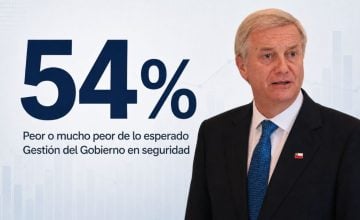
This battery of measures arrives just as the public approval of the far-right leader’s management fell to 25.6%, marking his lowest rating since taking office in March, according to the latest Pulso Ciudadano survey.
Kast closed his remarks with a warning: «We know that these decisions have consequences and that there will be some who will want to oppose them. To all of them we say: there is no going back,» a statement that consolidates the confrontational political strategy that has characterized his administration.
The challenge for the government will be to demonstrate that these tools effectively reduce violence without becoming a mechanism for criminalization, exclusion, and violation of human rights.
*Featured image: Government of Chile.
Obtén tu Pasaporte y apoya a El Ciudadano
Elimina la publicidad, accede a contenido exclusivo y sé parte de la comunidad.
Cancela en cualquier momento · Sin permanencia