Original article: Juristas y trabajadores judiciales cierran filas con Daniel Urrutia: cuestionan su remoción y advierten riesgos para la independencia judicial
Legal Experts and Judicial Workers Rally Behind Judge Daniel Urrutia, Question His Dismissal and Warn About Judicial Independence Risks
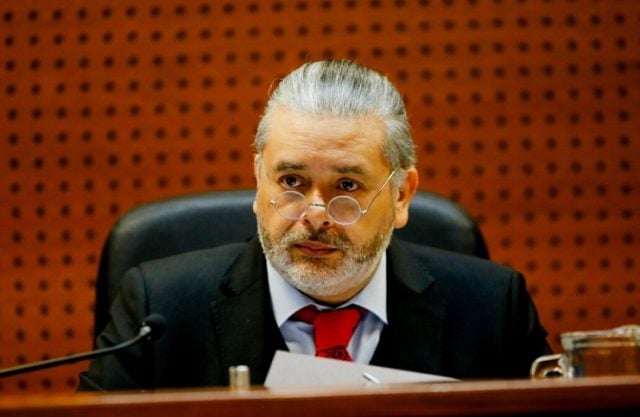
Legal experts and judicial workers have united in support of Judge Daniel Urrutia, expressing concern over his removal from his position at the 7th Criminal Court of Santiago, warning that it poses a risk to judicial independence.
The Supreme Court voted to remove Urrutia along with two other judges for traveling abroad while on medical leave. This decision came despite Urrutia being previously cleared of disciplinary measures by the Santiago Court of Appeals.
President of the Supreme Court, Gloria Ana Chevesich, explained that the session addressed five judges’ cases, and while defense arguments were heard, voting was suspended due to the Constitutional Court halting proceedings on these cases.
Urrutia’s removal followed his two trips—one to Costa Rica in 2020 and another to Ecuador in 2022—during a psychiatric medical leave. Despite earlier absolution from the Santiago Court of Appeals, the country’s highest tribunal decided to initiate removal proceedings to assess his judicial role.
Following the announcement, reactions surged. The Judicial Workers’ Organization (OTJ) voiced its “strongest rejection” of Judge Urrutia’s removal, stating it represents a serious violation of union freedoms, due process, and safeguards required to preserve judicial independence.
“It is particularly concerning that this decision was made without providing necessary safeguards for union protection, as explicitly stated in Article 25 of Law No. 19.296. This guarantee aims to protect the exercise of union representation and prevent the arbitrary dismissal of those defending workers’ rights,” they stated in a public declaration.
They reminded that the judge had previously been acquitted and cleared regarding relevant charges in the disciplinary proceedings against him for utilizing medical leaves.
OTJ members find it hard to comprehend that facts already examined by the Santiago Court of Appeals without sanctions could lead the Supreme Court to implement the most extreme measure in their legal framework against Urrutia.
Divergence in Supreme Court Decisions
Another point raised by judicial workers concerns “the clear differences in disciplinary criteria seemingly reflected in the decisions of the Supreme Court.”
They noted it is impossible not to recall the case of Minister Antonio Ulloa, who was involved in serious issues related to his connections with lawyer Luis Hermosilla, facing accusations regarding judicial appointments, information leaks, and breaches of integrity. Despite the severity of these circumstances, “the Supreme Court could not gather the necessary votes to remove him from office,” they questioned.
“Despite these serious allegations, the Supreme Court was unable to muster enough votes to remove him. The contrast between the actions taken in both cases is difficult to justify to the public,” OTJ representatives stated.
“While a judge involved in issues that directly compromise integrity and judicial independence wasn’t removed, a judge who concluded his disciplinary process without sanctions ends up dismissed. This disparity raises a question that the Supreme Court has a duty to clarify: Are objective and uniform legal criteria being applied, or do personal relationships and rivalries influence the differing severity with which members are judged?” asked the judicial workers.
In their declaration, they emphasized that public trust in justice requires disciplinary decisions to adhere to “verifiable legal criteria and avoid any reasonable suspicions of preferential or discriminatory treatment.”
“Equality under the law also obliges those responsible for administering it, especially when exercising the highest disciplinary powers of the judiciary,” they stressed.
“Removing a Judge for Advocating for Human Rights Undermines Judicial Independence”
Similarly, the Association of Jurists for Democracy (AJD) condemned the Supreme Court’s decision to remove Judge Urrutia, expressing solidarity with him and warning that it raises serious questions about due process and judicial independence.
They criticized the decision for being based on facts previously examined by the Santiago Court of Appeals, which resulted in his acquittal and dismissal. They stated that initiating another proceeding to impose the maximum penalty for those same facts “compromises legal security and demands a rigorous examination of the guarantees that must limit the exercise of disciplinary power.”
According to AJD members, the highest tribunal’s decision must be considered “in light of the repeated procedures and acts of harassment reported by Urrutia throughout his career as a human rights defender.”
“In 2020, the Inter-American Court of Human Rights declared Chile internationally responsible for violating his freedom of expression, judicial guarantees, and the principle of legality, due to a sanction imposed for critical academic work regarding the judiciary’s conduct,” they reminded.
They made it clear through a public statement that “judicial independence requires those exercising jurisdiction to operate without fear of retaliation, including those originating from their own judicial hierarchy.”
As a result, they indicated that every disciplinary procedure must be rooted in respect for legality, impartiality, and proportionality.
They denounced that the misuse of these processes “to isolate a judge for his defense of human rights undermines that independence and creates an intimidating effect on the entire judiciary.”
“The AJD finds Judge Daniel Urrutia’s removal unjustifiable and calls for a review of this decision through a process that fully safeguards his rights and the guarantees of independence and judicial immunity, in accordance with inter-American standards,” they asserted.
Furthermore, they called upon associations of judges and human rights organizations to stand by Judge Urrutia’s case and promote solidarity and follow-up actions.
“The AJD joins these efforts and reaffirms its commitment to defending Daniel Urrutia and an independent judiciary dedicated to democracy and human rights,” they concluded.
Obtén tu Pasaporte y apoya a El Ciudadano
Elimina la publicidad, accede a contenido exclusivo y sé parte de la comunidad.
Cancela en cualquier momento · Sin permanencia