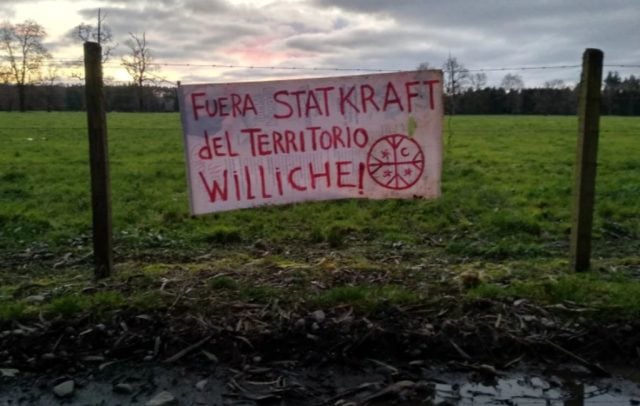
Original article: Inédita acción desde Wallmapu: comunidades mapuche williche denuncian en Noruega a la estatal Statkraft por impactos sobre territorio sagrado
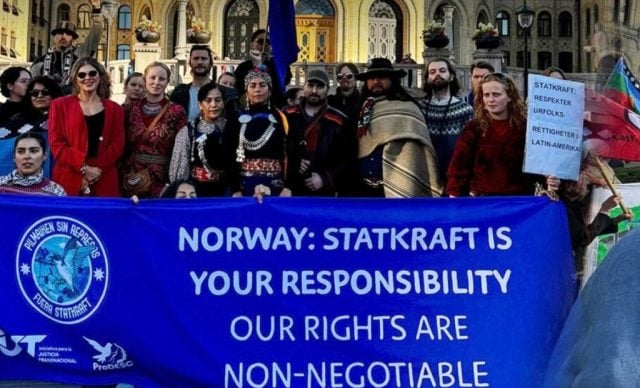
In a groundbreaking initiative from Wallmapu, Mapuche Williche communities have filed a complaint in Norway against the state-owned company Statkraft AS due to impacts on sacred territory, under the framework of the Transparency Law of the European nation.
The complaint was submitted by the Aylla Rewe del Ngen Mapu Kintuantü—an organization representing over 150 communities in the river Pilmaiquén basin and nearby areas, which marks the boundary between the Los Ríos and Los Lagos regions in southern Chile—and has the backing of the Economic, Social and Cultural Rights Project (ProDESC) and the Transnational Justice Initiative (IJT).
This legal action marks the first time an indigenous group from Latin America has utilized this Norwegian regulation to challenge the operations of a corporation from that country in its territory and request an investigation.
The issue revolves around the Rucatayo hydroelectric plant and the Los Lagos project, both Statkraft initiatives in the Pilmaiquén basin, where the risk of flooding sacred spaces has raised alarm. The Norwegian Transparency Law, enforced by the Norwegian Consumer Authority, requires large companies to conduct human rights due diligence processes encompassing all their activities, including those carried out beyond the borders of the European nation. The complaint requests this regulatory body to investigate whether the state company has fully complied with its obligations in this regard.
The grounds for the complaint are not merely environmental; they invoke the violation of fundamental collective rights, such as the right to consultation and free, prior, and informed consent; cultural and spiritual rights; self-determination; and the safety and integrity of women, children, and human rights defenders.
It also addresses the risk that the Rucatayo hydroelectric plant and the Los Lagos project may cause irreversible damage, such as the potential flooding of a sacred territory of great cultural and spiritual significance.
Machi Millaray Huichalaf: «We urge Norway to act before the damage becomes irreversible»
For the complainants, the Pilmaiquén River is viewed as more than a natural resource; it represents a living and sacred territory that is directly linked to ancestral memory, healing practices, communal and ceremonial life, as well as the spiritual connection with the Ngen Mapu Kintuante, a guardian spirit of the space or territory that the Mapuche Williche communities have worshipped for generations in the Los Ríos Region, hence they request the Norwegian authority to independently review these facts and determine whether the state company identified, prevented, and addressed the risks and impacts on human rights linked to the development of its operations in a timely manner.
In this context, Machi Millaray Huichalaf, spiritual leader and representative of the Aylla Rewe del Ngen Mapu Kintuantü, emphasized that “this complaint is not just a legal action; it is a call to protect life, memory, and our sacred territory.”
“We ask Norway to listen to our words and act before the damage becomes irreversible,” she affirmed in statements included in a press release issued by ProDESC.
A significant element that adds urgency to the case is the timeline of the Los Lagos project, as the filling of the reservoir could occur before any investigation or remediation takes effect. For the complainants, time becomes the main adversary, as a delayed decision would equate to a finalized sentence against their worldview and ceremonial sites. Consequently, the organizations have urged the Norwegian Consumer Authority to prioritize the case, advocating for the impact assessment to be conducted from a preventive perspective rather than merely corrective, since an investigation or potential remedy could be too late if an irreversible loss of territory occurs.
The state-owned nature of Statkraft—entirely owned by the Norwegian government—heightens the political dimension of the claim, testing Oslo’s international commitments regarding human rights.
As Alejandra Ancheita, Executive Director of ProDESC and IJT, pointed out, “this case raises a fundamental question for the energy transition: whether states’ commitments to human rights apply with the same strength when their companies operate beyond their borders. Renewable energy cannot be deemed fair if its generation violates the rights of indigenous peoples.”
The complaint from the Williche communities and supporting organizations does not oppose clean energy; instead, it demands that the energy transition respect sacred territories and mechanisms for effective participation and consultation.
The transnational relevance of the case is underscored by the legal advisement of Knut Hurum in Norway, who previously represented the Sami people in the landmark Fosen case against Statkraft itself. This connection emphasizes a pattern of conflict between large energy companies and the rights of indigenous peoples, both in the Arctic and southern Chile.
The action before Norwegian authorities complements a broader strategy that extends beyond Chile’s borders, including resources before the Inter-American Human Rights System and United Nations mechanisms.
Finally, Guillermo Torres, Transnational Justice Coordinator at ProDESC, emphasized that “the significance of this action is that it brings a question arising from the company’s operations in Chile back to its home country: whether Statkraft adequately identified and prevented risks to human rights.”
In this regard, transnational justice emerges as a crucial tool as the Williche communities request Norwegian authorities to examine the case promptly, for when the damage is irreversible, any subsequent remedy is insufficient.
Featured photo: Diario Constitucional.
Obtén tu Pasaporte y apoya a El Ciudadano
Elimina la publicidad, accede a contenido exclusivo y sé parte de la comunidad.
Cancela en cualquier momento · Sin permanencia