Original article: Millones de euros bajo tierra en Hungría: el dinero de Orbán y la red internacional de la que Kast ha sido actor clave
The Hungarian National Asset Recovery and Protection Office uncovered €17.7 million buried in forests and barns as part of the investigation into former minister Miklós Seszták. This case adds to the inquiry concerning public funds that Viktor Orbán’s government funneled into the Political Network for Values, the transnational conservative organization led by José Antonio Kast.
El Ciudadano
Budapest / Santiago — During two days in November, twelve Treasury officials from Hungary spent eight hours using five bill counting machines to tally what police had unearthed in the counties of Pest, Békés, and Nógrád. The result: approximately €17.7 million in forints, euros, and dollars, scattered across forests, barns, warehouses, a residence, and a high-security safe in a remote area.
This discovery was made by the National Asset Recovery and Protection Office (NVVH)—the anti-corruption agency established in August by the Péter Magyar government—and serves as a stark representation of an investigation that extends beyond Hungarian borders. The trail of these funds may lead to the network of think tanks and conservative organizations supported by Orbán over his 16 years in power, including the Political Network for Values (PNfV), directed by José Antonio Kast.
The Seszták Case: Bribery and Buses
The money located on November 12 and 13 is linked to Miklós Seszták’s management of the Ministry of National Development from 2014 to 2018. The investigation focuses on an alleged bribery scheme surrounding Volánbusz, the public bus company.
According to the prosecutor’s hypothesis, those involved allegedly received illicit payments amounting to 12.6 billion forints through the purchase of over 600 used vehicles at inflated prices. This overpricing was said to have fueled a network of commissions funneled through intermediary companies and fictitious loan contracts.
Seszták, a member of the KDNP —a satellite party of Fidesz—lost his parliamentary immunity in September and was subsequently detained. His defense, led by attorney Gábor Papp, argues that the official statement does not attribute ownership of the money to him and that it could belong to other suspects. The former minister denies committing any crime.
From the Forest to the Transnational Network
The importance of this case extends beyond the amount involved. The NVVH has a broader mandate: to trace public assets that left the state coffers during Orbán’s era, either through direct bribery or through grants to like-minded ideological organizations.
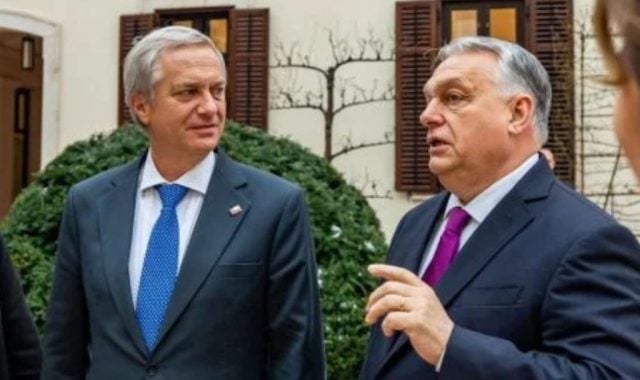
This is where the PNfV comes into play. The network, which brings together conservative and pro-life organizations from Europe and America, received funding from the Hungarian government during the second half of the last decade and the beginning of this one, as part of Orbán’s strategy to establish a conservative international with Budapest as its epicenter. José Antonio Kast, leader of the Chilean Republican Party, has been reported to have presided over the organization.
Why It Matters
The case has three significant implications.
First, domestic politics. The Magyar government has made the fight against corruption its chief banner. The discovery of the buried money allows it to showcase tangible results: three former Orbán ministers have been jailed in recent weeks, including György Matolcsy, former governor of the Central Bank. Magyar stated that the discovery «officially puts an end to the Fidesz-KDNP mafia».
Second, transnational dimension. If the investigation confirms that Hungarian public funds financed political structures in Latin America and the United States, the scandal will transcend domestic issues. In Washington, Democratic lawmakers are already calling for investigations into whether these funds were used to support political campaigns, including Donald Trump’s.
Third, legal precedent. The NVVH is a new body with no clear equivalent in the region, and its ability to pursue assets beyond Hungarian borders will be put to the test. The PNfV case, in that sense, serves as a stress test for the agency.
The case leaves several unresolved questions. What is the exact amount received by the PNfV beyond electronic transfers and under what legal concept? Were there any counter-benefits or were these discretionary grants? What level of knowledge did the organization’s leadership have regarding the origin and conditions of these funds? And what responsibility do those who have presided over it bear?
Seszták’s defense insists the money does not belong to him. The Hungarian prosecution has yet to formalize charges related to the November discovery. Meanwhile, the PNfV has not publicly commented on the NVVH’s inquiry.
What is clear, however, is that the case has evolved from a story about a former minister and buried cash to a narrative of how a political project has been financed over the years using public money, and how that trail, once unearthed, continues to reverberate around the globe.
El Ciudadano
Obtén tu Pasaporte y apoya a El Ciudadano
Elimina la publicidad, accede a contenido exclusivo y sé parte de la comunidad.
Cancela en cualquier momento · Sin permanencia