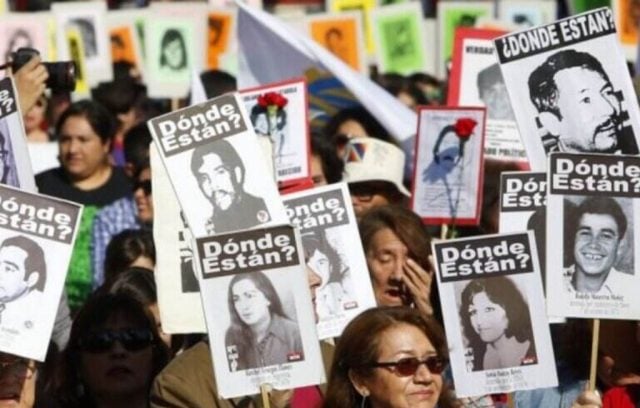
Original article: Comité del Plan Nacional de Búsqueda exige explicaciones a Rabat por rebajas de penas a violadores de DD. HH.
The Monitoring and Participation Committee of the National Search Plan (PNB) has called upon Justice and Human Rights Minister Fernando Rabat to provide explanations regarding the sentence reductions that have allegedly benefited at least three individuals convicted of crimes against humanity committed during Augusto Pinochet’s dictatorship.
In a statement, they also requested information on the ongoing actions of the Human Rights Program regarding decisions on the execution of sentences imposed for crimes against humanity, as well as the restrictive interpretation by the Head of the Human Rights Program and the Undersecretariat of Human Rights concerning the Committee’s functions.
Furthermore, they expressed their concern over sentence reductions granted by the Justice Ministry during José Antonio Kast’s administration to individuals convicted of sexual offenses against children and adolescents.
The Committee stated that after insufficient responses in regular meetings, they sent a formal letter on October 28 to the state secretary demanding transparency, documentary evidence, and institutional coordination, arguing that the pursuit of truth and justice «cannot be carried out without effective information and participation.»
Below is the full statement:
October 29, 2026
PUBLIC STATEMENT
The Monitoring and Participation Committee of the National Search Plan requests details and explanations from the Minister of Justice and Human Rights
The Monitoring and Participation Committee for Truth and Justice (PNB) informs that, after voicing their concerns and not receiving adequate responses in regular meetings, a letter was sent to the Minister of Justice and Human Rights on October 28 requesting explanations and details regarding the sentence reductions granted to those convicted of crimes against humanity; the actions of the Human Rights Program in court hearings related to benefits for individuals convicted of serious human rights violations; and the restrictive interpretation of the Committee’s functions communicated by authorities from that Undersecretariat.
We share a summary of the contents of said letter.
Sentence Reductions: We Demand Information and Rationale
We have learned, through press reports and public statements, about sentence reductions that allegedly benefitted at least three individuals convicted of crimes against humanity committed during the civil-military dictatorship, during decisions that also involved individuals convicted of sexual crimes against children and adolescents.
We are concerned that decisions of such significance are known publicly without the Committee having received institutional information on the matter, despite previous requests directed at the authorities of the Undersecretariat of Human Rights and the Human Rights Program.
Therefore, we have requested information on the administrative acts by which the sentence reductions were carried out, the original sentences, the reduced time, the legal grounds, and the criteria applied. Additionally, we have sought to know if there are other cases or requests for sentence reductions involving individuals convicted of crimes committed during the dictatorship.
Without disregarding the legal competencies of the bodies involved in these decisions, we find it necessary to understand their reasoning and examine their implications for the state’s obligations regarding truth, justice, and reparations, the rights of victims and their families, and the objectives of the National Search Plan.
We also express our concern over the sentence reductions granted to individuals convicted of sexual crimes against children, and we extend our solidarity to the victims.
What is happening with the Human Rights Program’s involvement in decision-making regarding the execution of sentences imposed for crimes against humanity?
Another of our concerns pertains to the participation of lawyers from the Human Rights Program in judicial hearings discussing penitentiary benefits, sentence reductions, or other modalities of compliance with sentences imposed on those responsible for grave human rights violations.
We have requested, in both the letter addressed to the Minister and via a transparency request made through the mechanisms established by the Council for Transparency, to know if there are instructions or criteria that account for the absence of representatives from the Program or the decision not to formulate arguments, what their justifications are, and what measures have been taken to ensure a founded and consistent institutional performance.
We do not intend to replace the authorities of justice or the competencies of the bodies responsible for state judicial representation. What we demand is information regarding institutional actions and the criteria guiding them, given their relevance to truth and justice policies.
The Committee’s monitoring and participation functions must be respected.
We express our disagreement with the position held by both the Head of the Human Rights Program and the Undersecretariat of Human Rights, which asserts that the Committee lacks the authority to request information on these matters.
The Committee is an entity established under the National Search Plan, composed of representatives from family organizations, human rights agencies, memorial sites, academia, and other actors committed to truth and justice. Its composition reflects the diversity of experiences and knowledge within civil society engaged in monitoring this state public policy.
Its functions require access to pertinent and timely information to understand the development of the Plan, identify difficulties in its implementation, and formulate informed observations and proposals.
Actions related to convictions for crimes against humanity are integral to the objectives of the Plan. Determining criminal responsibilities, fulfilling sentences, and the potential contribution of convicted individuals in providing vital information to clarify the fate of the forcibly disappeared are matters that justify the Committee’s interest in understanding the institutional criteria applied.
We acknowledge that there may be information subject to legal confidentiality. However, that must be based on applicable regulations and specifically pertain to the data that need protection. It is not sufficient to broadly invoke an alleged lack of authority of the Committee to exclude these matters from its oversight.
Participation cannot be reduced to a formality.
The National Search Plan is a state public policy that requires coordination, transparency, and effective participation. For the Committee to perform its functions, it is essential to have institutional communication channels and timely and justified responses from the competent authorities.
Consequently, we have requested that the Minister address the matters raised, provide the requested documentation, and establish the necessary coordination instances to address these concerns.
The letter sent on October 28 requests a formal and justified response, as well as the corresponding documentary evidence, and reiterates the Committee’s willingness to meet with the Minister, who has yet to attend any of its sessions.
The pursuit of truth and justice demands responsive institutions that inform and take responsibility. Oversight of the National Search Plan cannot proceed without effective information and participation.
Committee of Monitoring and Participation of the National Search Plan
Erika Hennings Cepeda, president of the Monitoring and Participation Committee and president of «Londres 38, space of memories».
Mónica Díaz García, president of the Association of Families of Executed Political Prisoners and the Disappeared of Antofagasta.
Juan Carlos Chávez Pilquil, Collective 119 Families and Companions.
Alicia Lira Matus, president of the Association of Families of Executed Political Prisoners of Santiago (AFEP).
Carlos Oliva Troncoso, president of the Association of Families of the Disappeared and Executed Political Prisoners of Araucanía.
Ida Sepúlveda Miranda, president of the Association of Families of the Disappeared and Executed Political Prisoners of Valdivia.
María Erita Vera Vera, president of the Human Rights Association of Coyhaique.
Daniela Accatino Scagliotti, Doctor of Law, Academic at the Faculty of Legal Sciences, Austral University of Chile.
Patricio Bernedo Pinto, Doctor of History, professor at the Institute of History and director of the Center for Dialogue and Peace, Catholic University of Chile.
Lidia Casas Becerra, Doctor of Law and director of the Center for Human Rights, Diego Portales University.
Yerko Ljubetic Godoy, Director of the National Institute for Human Rights (INDH). Tomás Scherz Take, priest proposed by the Cardinal Archbishop of Santiago.
Obtén tu Pasaporte y apoya a El Ciudadano
Elimina la publicidad, accede a contenido exclusivo y sé parte de la comunidad.
Cancela en cualquier momento · Sin permanencia